
First Launch? How to Get Your First Upvotes on Product Hunt
 Jan Orsula
You spent two months coding on weekends. You polished the UI, squashed the bugs, and finally clicked submit on Product Hunt. Then you sit back, refresh the page, and listen to the crickets. Nothing happens.
If you want to know how to get upvotes on Product Hunt, you have to accept a hard truth. Building a great product is only twenty percent of the battle. The rest is distribution. I've watched brilliant indie hackers launch fantastic apps only to fail because they thought upvotes would magically roll in. If you want to crack the top five on launch day, you need a plan.
Quick Answer: How to Get Upvotes on Product Hunt
Getting upvotes on Product Hunt requires warming up an audience weeks before your launch date, designing scroll-stopping assets, and actively engaging in the comments section on launch day. The algorithm heavily rewards organic momentum, meaning your first 50 upvotes need to come from genuine supporters you recruited before hitting publish.
Step 1: Build Your 'Coming Soon' Momentum Early to Get Upvotes on Product Hunt
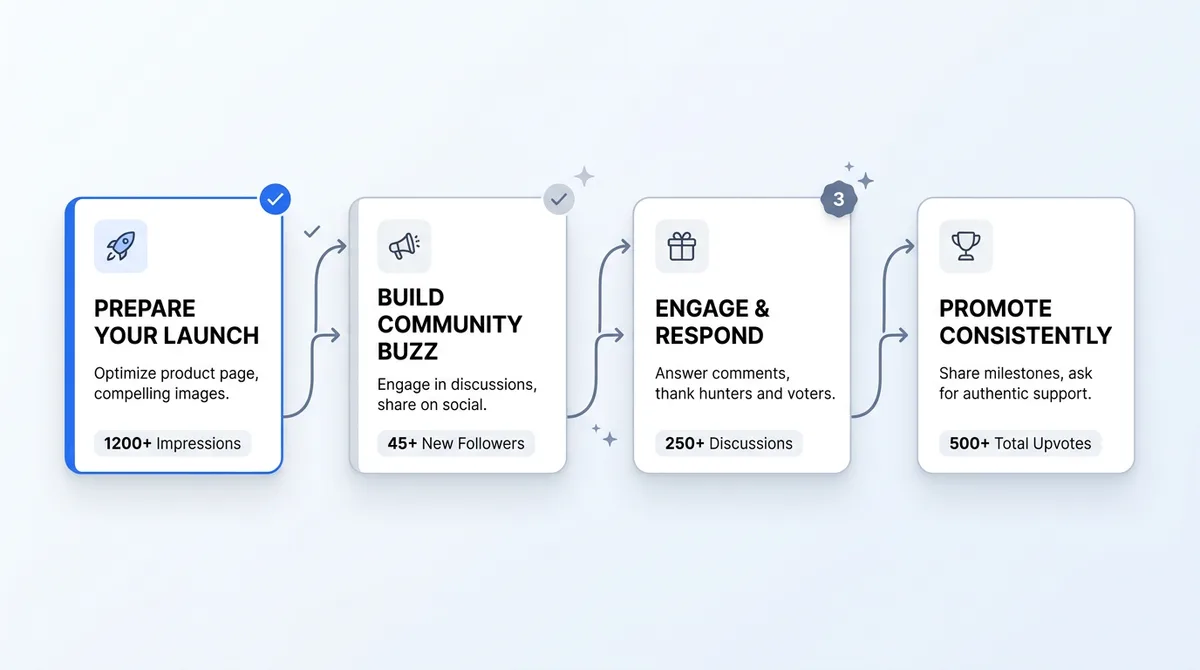
Most founders make this mistake. They treat launch day as day one of their marketing. That is a guaranteed way to end up on page three.
Realistically, your work starts a month before your launch date. You need an audience waiting to upvote your app the moment it goes live. This is what separates a top-three product from the graveyard of forgotten launches. If you ever wondered why your product launch failed (and how to fix it), lack of pre-launch momentum is usually the culprit.
Use Product Hunt Ship for Pre-Launch Leads
Product Hunt has a built-in feature called Teasers. Use it. You set up an upcoming page with a logo, a tagline, and an email capture form. It takes maybe ten minutes.
When people subscribe to your upcoming page, they receive an automated notification from Product Hunt the exact moment you launch. That is free distribution. I know makers who collected 300 emails on their upcoming page and translated that into 100 immediate upvotes within the first two hours. Don't overcomplicate this page. Keep the copy punchy. State exactly what problem you solve. Make them curious.
Identify Your 'Power Users' and Support Circle
Your first 20 upvotes are the hardest to get. You cannot rely on strangers browsing the 'New' tab to give you that initial push. Strangers scroll.
You need a street team. Build a list of 15 to 20 people you know on Twitter, LinkedIn, or maker Slack channels. Reach out to them privately three days before launch. Explain what you built. Ask if they would be willing to check it out and leave honest feedback on launch day. Don't ask for a blind upvote. Ask for their feedback. Makers respect other makers who actually care about the product. If you need help finding these early supporters, there are 10 proven places to find beta users for your SaaS that double as excellent launch day advocates.
Step 2: Optimize Your Listing for 'The Scroll'
Picture the typical Product Hunt user. They are scrolling through the daily feed on their phone while waiting for a coffee. You have exactly one second to stop their thumb.
If your logo is a generic screenshot and your tagline is boring corporate speak, they will scroll right past you. Getting eyes on your listing heavily depends on your visual packaging.
Design High-Contrast Visuals and Animated GIFs
Your thumbnail is the most critical asset of your entire launch.
Make it a GIF. Static images blend into the background. A well-designed, three-second looping GIF showing your product in action immediately stands out. Use high-contrast colors like neon yellow on dark gray. Make the text large enough to read on a mobile screen. The same goes for your gallery images. Do not just upload raw screenshots. Frame them nicely. Add concise text overlays explaining the features. Users want to understand your app without having to read a novel.
Mastering the 'Maker’s First Comment'
The first comment on your launch post should always be from you.
This is your chance to tell the story behind the code. Explain why you built it. Talk about the late nights, the specific problem that annoyed you enough to start building, and who the product is actually for. Here's the thing. People upvote makers just as much as they upvote products. Offer something special to the community. A 30% discount code for early adopters goes a long way. Make it personal. End the comment by asking a specific question to encourage replies, like "What integration should we build next?"
Step 3: The Launch Day 24-Hour Blitz to Get Upvotes on Product Hunt
Launch day is a marathon. Clear your schedule. Do not plan on writing code, attending meetings, or sleeping much.
Timing Your Post for Maximum Global Visibility
Product Hunt operates on Pacific Standard Time. The daily cycle resets at 12:01 AM PST.
If you post at 9:00 AM PST, you have already lost nine hours of potential voting time to competitors who posted at midnight. Schedule your launch for exactly 12:01 AM PST. This gives you the full 24 hours to accumulate upvotes and stay at the top of the feed. The algorithm heavily favors velocity, especially in the first few hours. An early lead often translates into a permanent spot in the top five. You can see this exact strategy detailed in how to launch a SaaS product without any ad spend.
Engaging with Every Comment and Review
Comments are the lifeblood of a successful launch.
The Product Hunt algorithm looks at engagement, not just raw upvote counts. A product with 100 upvotes and 50 meaningful comments will frequently outrank a product with 150 upvotes and zero comments. Reply to everything. If someone says "Great job," thank them. If someone points out a bug, acknowledge it and explain your timeline for fixing it. Show the community that there is a real human behind the keyboard. Active comment threads signal to the ranking engine that your launch is hot.
Common Mistakes: How to Avoid the 'Spam' Filter
If you are trying to figure out how to get upvotes on Product Hunt, you might be tempted to take shortcuts. Don't. Product Hunt has spent years refining their anti-spam mechanisms. They will catch you.
The Danger of Buying Upvotes or Using Voting Rings
I will say this clearly. Never buy upvotes.
The platform's algorithm is incredibly sophisticated at detecting inorganic behavior. If 50 brand-new accounts from the same region suddenly upvote your product within five minutes, your launch will be shadow-banned. Your upvote count will drop, and your product will vanish from the homepage. Quality beats quantity. An upvote from an account that has been active for three years carries far more weight than ten upvotes from accounts created yesterday. According to the official Product Hunt launch guide, asking directly for upvotes in mass emails or using voting rings can actively hurt your ranking.
Linking Directly to the 'Upvote' vs. Your Product Page
This is a technical mistake almost every first-time maker makes.
When you send an email or tweet about your launch, never link directly to the upvote button or tell people "Click here to upvote." Instead, link to your main Product Hunt post. Ask people to join the conversation or share their feedback. The algorithm tracks referring traffic. If an overwhelming percentage of your traffic clicks the upvote button immediately without spending time on the page or reading comments, those votes might get discounted as bot activity. You want users to act like humans, which means lingering on the page.
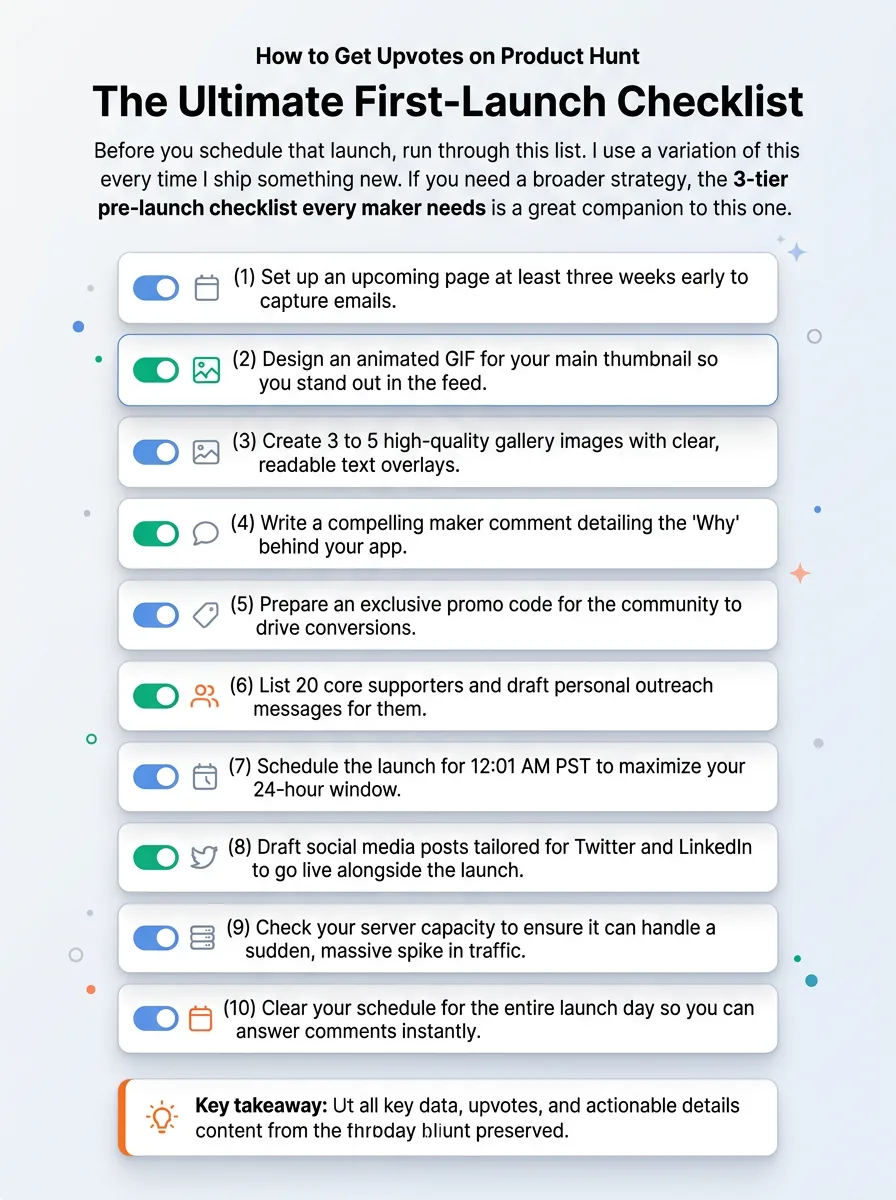
The Ultimate First-Launch Checklist
Before you schedule that launch, run through this list. I use a variation of this every time I ship something new. If you need a broader strategy, the 3-tier pre-launch checklist every maker needs is a great companion to this one.
Set up an upcoming page at least three weeks early to capture emails.
Design an animated GIF for your main thumbnail so you stand out in the feed.
Create 3 to 5 high-quality gallery images with clear, readable text overlays.
Write a compelling maker comment detailing the 'Why' behind your app.
Prepare an exclusive promo code for the community to drive conversions.
List 20 core supporters and draft personal outreach messages for them.
Schedule the launch for 12:01 AM PST to maximize your 24-hour window.
Draft social media posts tailored for Twitter and LinkedIn to go live alongside the launch.
Check your server capacity to ensure it can handle a sudden, massive spike in traffic.
Clear your schedule for the entire launch day so you can answer comments instantly.
Frequently Asked Questions About Product Hunt
Does the Hunter matter?
Not anymore. Years ago, having a top hunter submit your product meant an automatic email blast to their massive follower list. That is no longer the case. Today, the product's quality and your own marketing efforts matter infinitely more than who clicks submit. Hunt it yourself.
Can I launch the same product twice?
Yes, but there are rules. You generally need to wait at least six months between launches, and the product needs a massive update. Think a 2.0 release, a major pivot, or a complete redesign. You cannot just relaunch the exact same app hoping for a better result.
How many upvotes do I need to be Product of the Day?
There is no magic number. It depends entirely on the competition that specific day. Some days, 300 upvotes will win first place. On heavy launch days, you might need over 800. Focus on your own momentum rather than the raw number.
Conclusion: Your Launch is Only the Beginning
Winning product of the day feels incredible, but upvotes do not pay server bills! The goal is converting that traffic into real users who genuinely need what you built.
Treat your first launch as a learning experience. You will make mistakes, the servers might crash, and some feedback will sting. That is just part of being an indie hacker. Keep shipping. If you want a lower-stakes environment to practice launching and get guaranteed feedback, dropping your project in a community like WeekHack is a solid way to build that muscle before hitting the big stage. Get back to work.
Written by

Jan Orsula
Serial maker and founder of WeekHack, SocialCal, and SocialOrbit. Builds tools that help creators launch side projects, schedule social media, and generate content — so they can focus on what matters.
Related Articles
How to Get Comments on Product Hunt: 5 Proven Launch Strategies
Most makers obsess over Product Hunt upvotes, but comments are what actually drive the ranking algorithm. Learn how to craft the perfect maker story, run feedback-first outreach, and dominate the first 4 hours of your launch.
How to Plan a Startup Launch That Gains Real Traction
Learn how to plan a startup launch that actually gets traction. From finding your early users to engineering a launch day spike, here is the exact playbook indie hackers use.
How to Launch an AI Tool and Rank #1 on Product Hunt
Learn exactly how to launch an AI tool on Product Hunt and claim the top spot. This practical guide covers pre-launch community building, high-converting asset optimization, and a 24-hour tactical sprint.