
How to Plan a Startup Launch That Gains Real Traction
 Jan Orsula
Imagine spending six months writing code in a dark room. You finally push to production, post a tweet, and... silence. Nothing hurts quite like launching to absolute crickets after pouring your soul into a product. You refresh analytics. Still zero active users. Sound familiar?
Most makers spend 95% of their time building features and maybe 5% thinking about distribution. That ratio is exactly backwards. A purely technical focus fails every single time because the best code in the world cannot market itself. If you want to know how to plan a startup launch that actually moves the needle, you have to stop acting like a pure developer. You need a structured approach to get your product in front of people who actually care. Traction is not an accident. It is engineered. Let's break down exactly how you do it.
What Does It Mean to Plan a Startup Launch?
Planning a startup launch is the strategic coordination of your product, target audience, and marketing channels for a specific release window. It involves building momentum before day one so you hit the market with an existing wave of traction, rather than starting from zero.
Phase 1: How to Plan a Startup Launch Around Your Audience
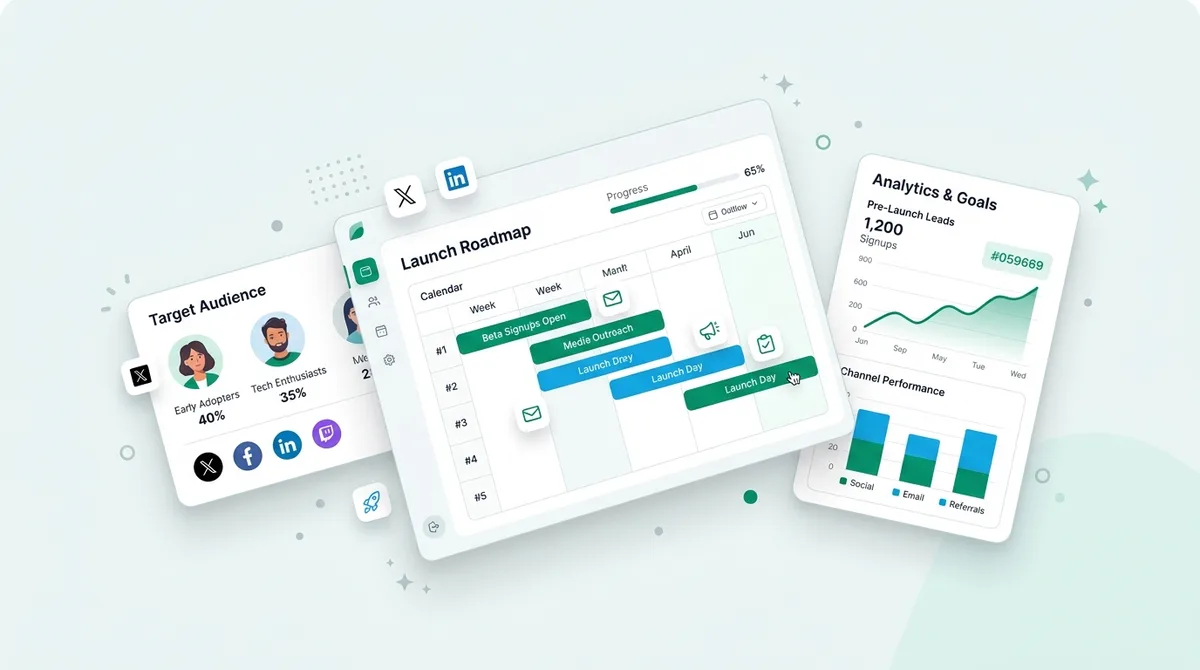
Before you even think about platforms or copy, you have to know exactly who you are talking to. Pre-launch work is entirely about matching the right message to the right crowd. Most founders skip this and go straight to making a logo. Big mistake.
Identifying Your Ideal Customer Profile (ICP)
Look, you cannot sell to everyone. If your target market is "small business owners," you are going to fail. That net is way too wide. A generic B2C habit tracker app gets lost in the app store immediately because nobody is searching for a generic habit tracker. But an ADHD management tool specifically designed for remote software engineers? Now you have a precise target.
That level of focus dictates exactly where you find them, what copy you write, and what features you actually need to build. If you need a framework for this, following a structured SaaS launch plan template can help you define exactly who those first 100 users should be. You want to find a group of people who are so desperate for a solution that they will forgive your early bugs.
Action Step: Create a one-page User Persona document listing their biggest pain point, the software tools they currently use, and exactly where they hang out online.
The Power of a High-Converting Waitlist
Launch day without an audience is just you shouting into the void. You need a seed audience ready to upvote, comment, and share the moment you go live. Set up a simple landing page weeks or even months before you finish the code.
I have seen founders build massive hype simply by offering an early-access referral loop. Give people a reason to share. Maybe you bump them up the waitlist if they invite two friends. Or you offer a lifetime discount for the earliest believers. Just get their email. When launch day arrives, you send one broadcast and instantly guarantee your first hundred visitors. That initial traffic is what triggers the algorithms on aggregator sites.
Action Step: Spin up a basic email capture page today, even if your product is only 10% built.
Phase 2: Selecting Your Distribution Stack
Where you launch depends entirely on where your users actually spend their time. You have to go to them. Do not expect them to magically find your domain.
Mastering the 'Big Three': Product Hunt, Hacker News, and Indie Hackers
You know the big names. But treating them all the same is a fatal error. Product Hunt loves polished visuals, custom animations, and supportive maker stories. Hacker News will tear your code apart if you use slick marketing speak—they just want raw, technical truth and zero fluff. Indie Hackers wants to see your MRR struggles and transparent growth tactics.
I remember a database visualizer tool that absolutely bombed on Product Hunt because the design was basic. A week later, they dominated Hacker News just by posting a plain-text explanation of their unique indexing architecture. Know your audience. Going through a solid pre-launch checklist ensures you have the right assets tailored for each specific platform.
Action Step: Build a Launch Kit folder containing your logo, high-resolution screenshots, a quick demo video, and three different variations of your text pitch tailored to different audiences.
Using Niche Communities and Dark Social
The real magic happens in dark social. Private Slack groups, niche Discord servers, and highly guarded subreddits are where your actual buyers live. You cannot just drop a link to your product and run away. Moderators will ban you instantly, and rightly so.
Instead, use a value-first approach. Let's say you built a tool for Notion creators. Go into a Notion subreddit and post a detailed breakdown of a complex workflow problem the community faces. Share exactly how you solved it. Give away the templates for free. Then, casually mention your tool at the very end as a side note. The community will naturally click through because you proved your expertise first.
Action Step: Find and join 5 highly relevant communities today. Start answering questions and building goodwill so you aren't a stranger when launch day arrives.
Phase 3: The 'Thunderclap' Launch Day Execution
Algorithms dictate visibility across the modern web. If you want to trend, you have to engineer a massive, concentrated spike in traffic.
Coordinating Your Support Network
This means coordinating all your efforts so the traffic hits within a single 24-hour window. This early spike tells ranking algorithms to push you to the front page of wherever you posted. You need to mobilize your network.
Reach out to founder friends, past coworkers, and Twitter mutuals. Send them a polite, direct DM. "Hey, we are finally going live tomorrow. Would mean the world if you could check it out and drop some honest feedback." Keep it casual. Never beg for upvotes or try to game the system with fake accounts. Just ask for genuine eyes on your product. A few early comments create social proof for the strangers who find your post later.
Action Step: Build a simple spreadsheet of 50 people you can personally DM the morning of your launch.
Real-Time Engagement and Feedback Loops
Launch day is not a spectator sport. You do not hit publish and go to sleep. You need to be glued to your screen, replying to every single comment, tweet, and support ticket within minutes. Fast replies build incredible goodwill.
I've watched founders turn harsh internet critics into paying customers just by jumping into a thread, acknowledging a bug, and deploying a code fix 20 minutes later. That kind of unhinged hustle wins people over. People love buying from a maker who clearly cares about their craft.
Action Step: Block out your entire calendar for 24 hours. Schedule "War Room" shifts if you have a co-founder so someone is always awake and watching the logs.
Phase 4: Post-Launch Momentum and Retention
The launch high fades fast. By day three, traffic usually drops off a cliff. Now you have to retain the people who actually showed up.
Analyzing the Data and Iterating Fast
You have to look at the cold, hard numbers. Check your conversion rates. Did a thousand people visit your landing page but only two bothered to sign up? Your hero copy is probably broken, or your pricing makes no sense. Did they sign up but leave after three minutes? Your onboarding flow is too complicated.
One startup I know realized 80% of their launch traffic came from a single obscure subreddit they had barely focused on. They immediately pivoted their marketing strategy to double down on that exact niche. Launch data is a goldmine. Let it tell you what to do next.
Action Step: Set up an automated feedback survey that triggers two days after a new user signs up, asking them what exactly convinced them to try the product.
4 Critical Mistakes That Kill Startup Traction
I have seen dozens of launches crash and burn. Here is what usually kills them.
First, launching to the wrong room. Getting 5,000 teenagers to visit your enterprise compliance software site is entirely useless traffic. Vanity metrics look great on social media, but they do not pay your server bills. Optimize for relevance, not sheer volume.
Second, ignoring SEO completely. A launch spike is a sugar rush. Search traffic is actual nutrition. According to Ahrefs data, nearly 68% of online experiences begin with a search engine. If you do not build your landing pages with organic search in mind from day one, your traffic will permanently flatline by week two.
Third, treating the launch as a one-and-done event. If your first attempt flops, figure out why. Take a breather. You can always read up on how to relaunch a SaaS later with a better angle, a fresh design, and a new hook. Iteration is a core part of the indie hacker game.
Fourth, bad server configuration. This is the saddest mistake. If Hacker News actually gives you the hug of death because your database isn't indexed properly, you just wasted your golden ticket. Test your load capacity before you post the link.
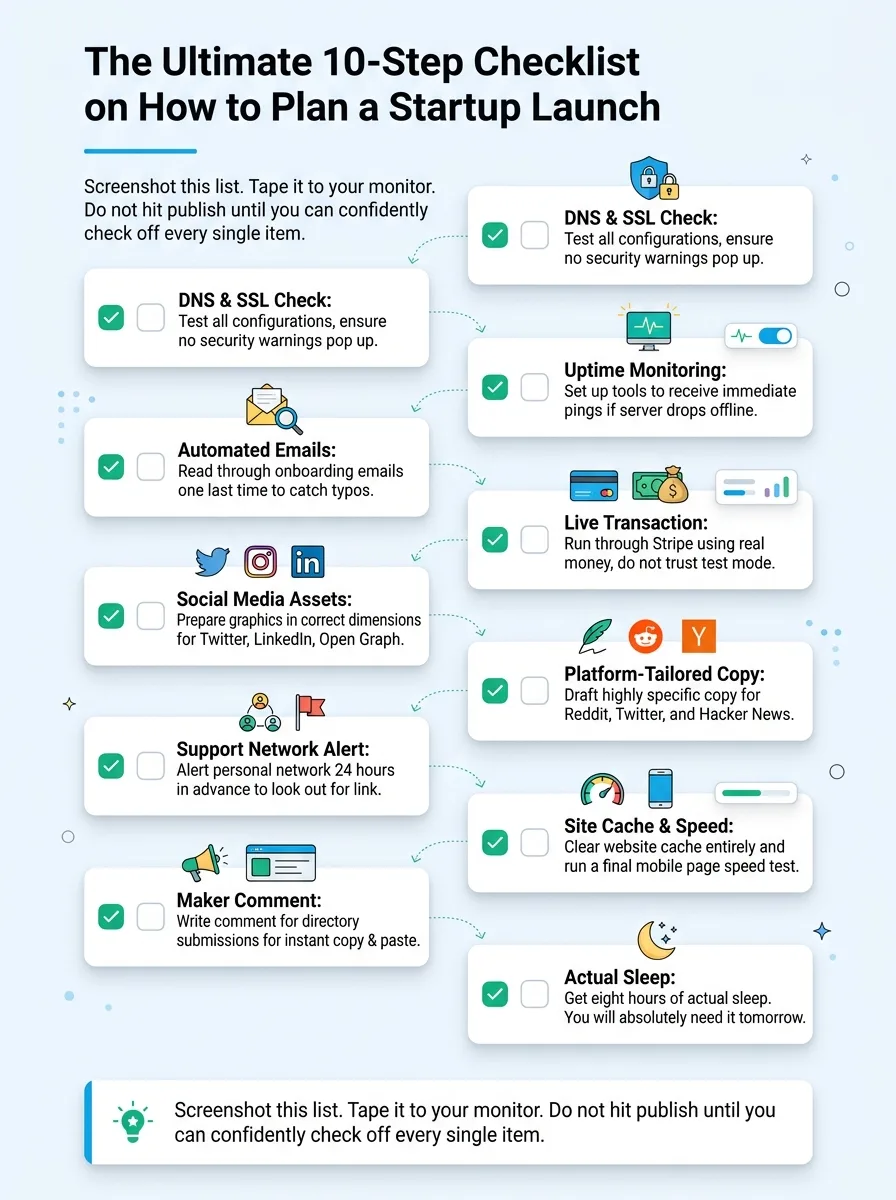
The Ultimate 10-Step Checklist on How to Plan a Startup Launch
Screenshot this list. Tape it to your monitor. Do not hit publish until you can confidently check off every single item.
Test all DNS configurations and SSL certificates to ensure no security warnings pop up for visitors.
Set up uptime monitoring tools so you get pinged immediately if the server drops offline.
Read through your automated onboarding emails one last time to catch typos.
Run a live transaction through Stripe. Use real money, do not just trust the test mode.
Prepare all your social media graphic assets in the correct dimensions for Twitter, LinkedIn, and Open Graph.
Draft highly specific, platform-tailored copy for Reddit, Twitter, and Hacker News.
Alert your personal support network 24 hours in advance so they know when to look out for your link.
Clear your website cache entirely and run a final mobile page speed test.
Write your "maker comment" for directory submissions so you can copy and paste it instantly.
Get eight hours of actual sleep. You will absolutely need it tomorrow.
Frequently Asked Questions About Startup Launches
When is the best day to launch?
For B2B products targeting professionals, Tuesdays and Wednesdays are generally best since people are actively at their desks avoiding real work. For B2C apps or indie hacking tools, weekends can actually be a goldmine. Platforms like Product Hunt have significantly less competition on Saturdays, making it easier to secure a top spot.
How much budget do I need?
Zero dollars. Time, sweat equity, and community goodwill matter far more than paid ads. In practice, I rarely see paid ads work for an initial indie launch anyway. Your budget should just be your server costs and your own coffee supply.
Should I launch on multiple platforms at once?
If you have a co-founder or a small team, yes. Go for the massive thunderclap effect and hit everything simultaneously. If you are a solo founder, stagger your posts. Do Product Hunt on Tuesday, Hacker News on Thursday, and Reddit over the weekend. This ensures you can actually handle the influx of customer support tickets without burning out.
Beyond the Hype: Building a Sustainable Business
A launch is just the starting line. The real work is showing up every single week after that initial spike fades away. Keep talking to your early users, shipping incremental updates, and staying ruthlessly consistent. If you need a supportive place to build momentum, WeekHack is a great spot to post weekly updates, gather community feedback, and grab some dofollow backlinks while you grind it out. Launch day is exciting, but week two is where the real business gets built. Keep shipping.
Written by

Jan Orsula
Serial maker and founder of WeekHack, SocialCal, and SocialOrbit. Builds tools that help creators launch side projects, schedule social media, and generate content — so they can focus on what matters.
Related Articles
How to Get Comments on Product Hunt: 5 Proven Launch Strategies
Most makers obsess over Product Hunt upvotes, but comments are what actually drive the ranking algorithm. Learn how to craft the perfect maker story, run feedback-first outreach, and dominate the first 4 hours of your launch.
How to Launch an AI Tool and Rank #1 on Product Hunt
Learn exactly how to launch an AI tool on Product Hunt and claim the top spot. This practical guide covers pre-launch community building, high-converting asset optimization, and a 24-hour tactical sprint.
The Ultimate SaaS Launch Plan Template: Get Your First 100 Users
Getting your first 100 users is the hardest part of building a startup. Use this proven SaaS launch plan template to move from zero traffic to consistent user acquisition.