
How to Launch an AI Tool and Rank #1 on Product Hunt
 Jan Orsula
Why Launching an AI Tool is Harder Than Ever (And How to Win Anyway)
Building an AI wrapper takes a weekend now. Everyone is doing it. That means the market is completely flooded with generic text generators, chatbot overlays, and image generators. Most founders slap together an interface, post a link, and sit back expecting a flood of users. Then they watch their launch flatline with zero upvotes. Figuring out exactly how to launch an AI tool properly takes actual work. You need a proven framework to cut through the noise and claim that top spot on Product Hunt. Here is exactly what actually works.
How to Launch an AI Tool: The Quick Strategy
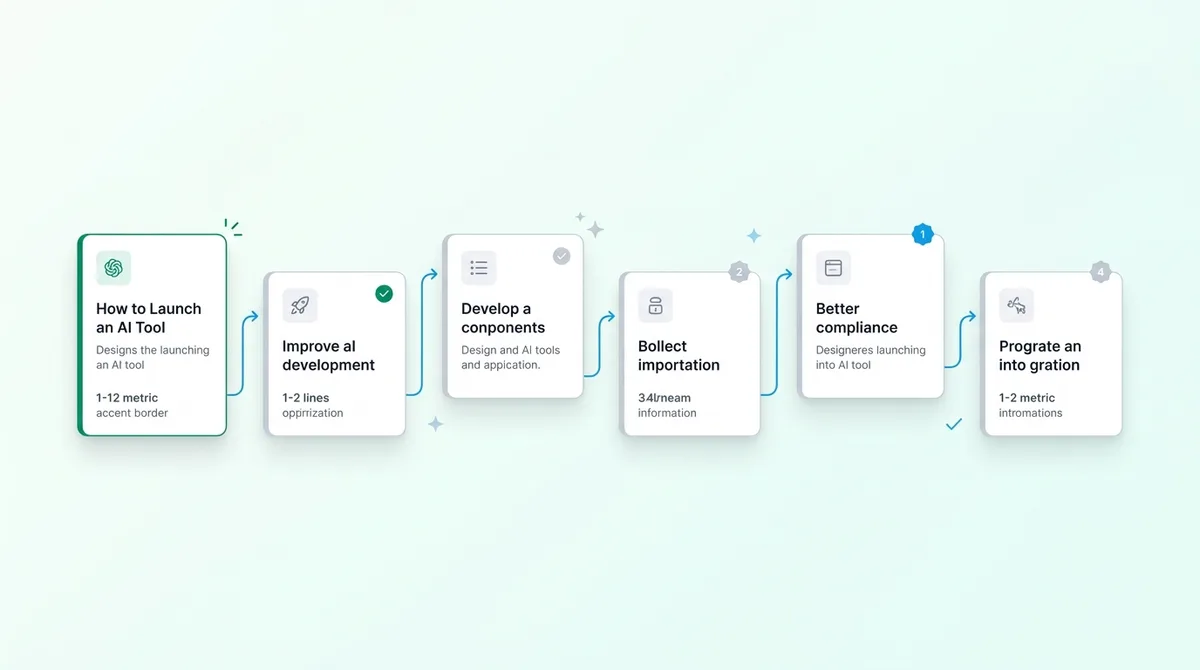
How to launch an AI tool effectively boils down to three core phases executed in perfect sequence. You need pre-launch community building to guarantee early momentum, highly optimized visual assets to grab attention in the feed, and a relentless 24-hour engagement sprint. Mastering these components turns a quiet release into a top-ranking product.
Phase 1: Pre-Launch Engineering and Audience Priming
The real work starts a full four weeks before your actual launch date. Many makers try figuring out how to launch without an audience by dropping a random link in an empty Discord server. That rarely works for highly competitive AI categories. You need proof of concept and a warm list of users first.
Refining Your AI Value Proposition
Stop calling your product a GPT-4 wrapper. Nobody cares what large language model you use behind the scenes. They care about what painful, tedious workflow you eliminate. Most founders make this mistake by leading with the technology instead of the human outcome.
Focus on a very specific industry solution. Say you built an AI receipt scanner. Do not pitch "AI-powered expense tracking." Pitch "Turn a crumpled Uber receipt into a perfectly formatted QuickBooks entry in two seconds." That paints a picture. It tells the user exactly what pain goes away.
Action step: Write a one-sentence pitch for your product without using the word "AI" more than once. Read it out loud. If it sounds like a generic tech company, rewrite it until it sounds like a real solution.
Building a 'Coming Soon' Page That Converts
You absolutely need a waitlist. Not a generic email box sitting at the bottom of a template, but a landing page that actually captures intent. I've seen products blow up just by collecting a couple hundred targeted emails before the big day.
Use a simple Tally form or a basic Carrd site. Offer a massive discount or a lifetime deal exclusively for the early adopters who sign up early. That gives you a highly motivated, warm list of 200 people to email the minute you go live. Those are your day-one upvotes.
Phase 2: Preparing High-Converting Product Hunt Assets
Product Hunt is basically a visual platform disguised as a tech directory. When users scroll the "Newest" feed, your product is competing against dozens of others. Your assets need to stop them in their tracks. This visual friction is a critical part of how to launch an AI tool successfully.
The Psychology of the Product Hunt Thumbnail
The thumbnail is everything. Forget static corporate logos. You need an animated GIF that demonstrates your core feature in under three seconds. Most makers use subtle, minimalist colors that blend right into the background. Do the exact opposite.
Use high-contrast borders. Bright orange, neon green, or stark black. Make it physically impossible for someone scrolling on their phone to ignore your icon against the white Product Hunt UI. Keep the file size under 3MB so it actually loads on mobile.
Action step: Put your thumbnail next to five screenshots of yesterday's top products. If yours does not immediately draw your eye, redesign it.
The Hunter vs. Maker Dilemma
Should you spend weeks chasing a top-tier hunter with 50,000 followers? Usually, no. The official Product Hunt guidelines clarify that makers can successfully hunt their own products without penalty. The algorithm no longer sends massive email blasts to a hunter's entire follower list anyway. Self-hunting is completely fine.
What actually moves the needle is your Maker's Comment. Write a vulnerable, honest opening comment explaining exactly why you built the tool. Talk about the late nights, the weird bugs, and the specific problem you were trying to solve for yourself. Humanize the project so people want to root for you.
Phase 3: The 24-Hour Launch Day Playbook
Launch day is a chaotic, caffeine-fueled sprint. You need a minute-by-minute plan starting right at 12:01 AM Pacific Time. This is exactly where having a strict SaaS launch plan template pays off massively.
Dominating the First Two Hours
Product Hunt's ranking algorithm heavily favors early velocity. Getting 20 to 30 upvotes in the first two hours signals the trending system to push your product higher up the homepage. If you miss this window, climbing back up is brutal.
Email your waitlist the exact minute your page is live. Send direct messages to your beta testers. Call your indie hacker friends. Do whatever it takes to get those initial organic interactions. Just keep it natural and avoid explicitly begging for upvotes.
Using 'AI Aggregator' Communities
Do not rely solely on Product Hunt's internal traffic. You need external eyeballs hitting your page all day long. Blast your launch out to X, niche Reddit communities, and specialized newsletters simultaneously. Finding exactly where to announce your AI tool outside of the main site creates a compounding traffic effect.
Action step: DM creators and influencers who have previously engaged with similar AI tools. Ask for their feedback on your specific implementation, not just a blind upvote. Authentic engagement drives ranking.
4 Common Mistakes That Kill AI Launches
Even a flawless prep phase can fall apart if you make rookie errors on launch day. Avoid these pitfalls.
Buying Upvotes and 'Botting' the Launch
Never pay for upvote services. Product Hunt's fraud detection is incredibly strict and getting smarter every month. They will shadow-ban your launch, drop your rank to the bottom, or remove your account entirely. Buying a bunch of cheap bot votes from click farms is the absolute fastest way to kill your project permanently.
Neglecting the Comments Section
A launch with 500 upvotes and zero comments looks suspicious to the algorithm. Engagement matters just as much as the raw vote count. Reply to every single comment on your thread. Ask follow-up questions. Create a dialogue. The longer people stay on your page discussing the product, the better your ranking holds up against competitors.
Launching on the Wrong Day
Launching on a Tuesday or Wednesday means you are competing against massive venture-backed companies with massive marketing budgets. Unless you have a massive audience yourself, avoid the middle of the week.
Failing to Setup Analytics
Imagine getting 5,000 visitors and having no idea what they clicked on or where they dropped off. Install PostHog, Google Analytics, or Plausible before you launch. You need that data to fix your onboarding funnel later.
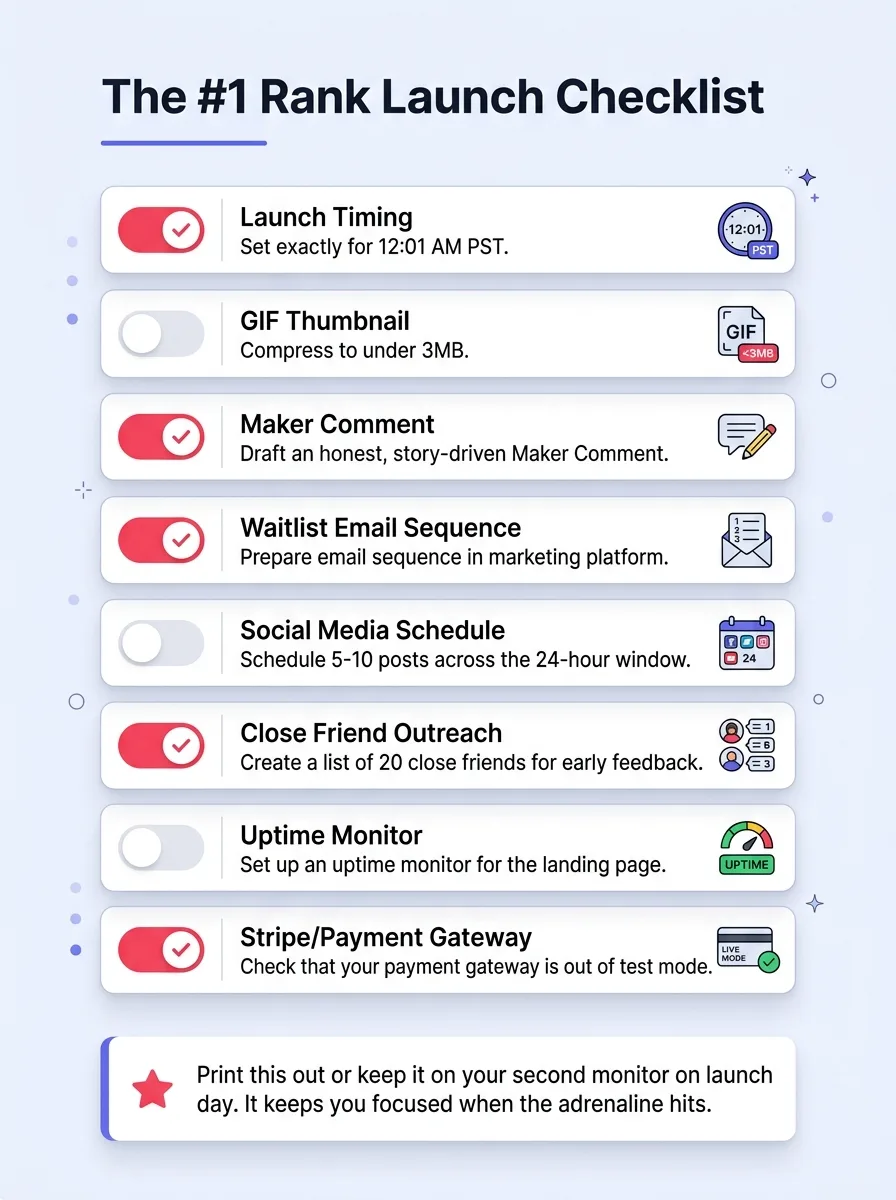
The #1 Rank Launch Checklist
Print this out or keep it on your second monitor on launch day. It keeps you focused when the adrenaline hits.
Verify your launch time is set for exactly 12:01 AM PST.
Compress your animated GIF thumbnail to under 3MB.
Draft an honest, story-driven Maker Comment.
Prepare your waitlist email sequence in your marketing platform.
Schedule 5-10 social media posts across the 24-hour window.
Create a list of 20 close friends to message for early feedback.
Set up an uptime monitor for your landing page.
Check that your Stripe or payment gateway is out of test mode.
Product Hunt Launch FAQ
What is the best day to launch on Product Hunt?
Weekends are generally less competitive but have lower overall traffic. Monday or Thursday are great middle-ground days for indie hackers looking for visibility without fighting billion-dollar startups.
Does the Hunter really matter?
Not nearly as much as it used to. A good product hunted by the maker will easily outperform a mediocre product hunted by a platform influencer.
Can I launch the same tool twice?
Yes, but only if you have released a major V2 update with significant new features. Product Hunt requires at least six months between launches of the same core product.
How much does a launch cost?
A Product Hunt launch is completely free. Your only costs are your server hosting and the time you spend building and marketing.
Turning a Top Rank Into a Sustainable Business
Hitting number one on Product Hunt feels incredible, but it is just a 24-hour vanity metric. The real test is converting that massive spike in traffic into paying, long-term users. Keep iterating, keep talking to the people who commented on your launch, and keep shipping. If you want to rapidly prototype and test your next big idea before dedicating months to it, WeekHack provides an excellent environment to get real community feedback early. Now go finalize your assets and get ready for launch day.
Written by

Jan Orsula
Serial maker and founder of WeekHack, SocialCal, and SocialOrbit. Builds tools that help creators launch side projects, schedule social media, and generate content — so they can focus on what matters.
Related Articles
How to Get Comments on Product Hunt: 5 Proven Launch Strategies
Most makers obsess over Product Hunt upvotes, but comments are what actually drive the ranking algorithm. Learn how to craft the perfect maker story, run feedback-first outreach, and dominate the first 4 hours of your launch.
How to Plan a Startup Launch That Gains Real Traction
Learn how to plan a startup launch that actually gets traction. From finding your early users to engineering a launch day spike, here is the exact playbook indie hackers use.
The Ultimate SaaS Launch Plan Template: Get Your First 100 Users
Getting your first 100 users is the hardest part of building a startup. Use this proven SaaS launch plan template to move from zero traffic to consistent user acquisition.