
How to Launch a SaaS Product Without Any Ad Spend
 Jan Orsula
Why Most SaaS Founders Fail by Spending Too Much on Ads
Most makers think they need a massive marketing budget to get off the ground. They throw thousands at Meta and Google ads on day one, hoping the algorithm will magically find their perfect users. I've watched founders drain their personal savings before getting a single paying subscriber. According to CB Insights, running out of cash remains one of the top reasons startups die. Figuring out how to launch a saas product shouldn't mean taking out a second mortgage.
What actually works is an organic-first approach. You build sustainable growth loops instead of setting cash on fire. When you rely entirely on paid acquisition early on, you mask terrible retention rates with expensive traffic. Bootstrapping forces you to actually talk to people. It forces you to build something people care enough about to share for free. That's the real validation you need.
How to Launch a SaaS Product Without Ad Spend (Quick Answer)
How to Launch a SaaS Product Without Any Ad Spend
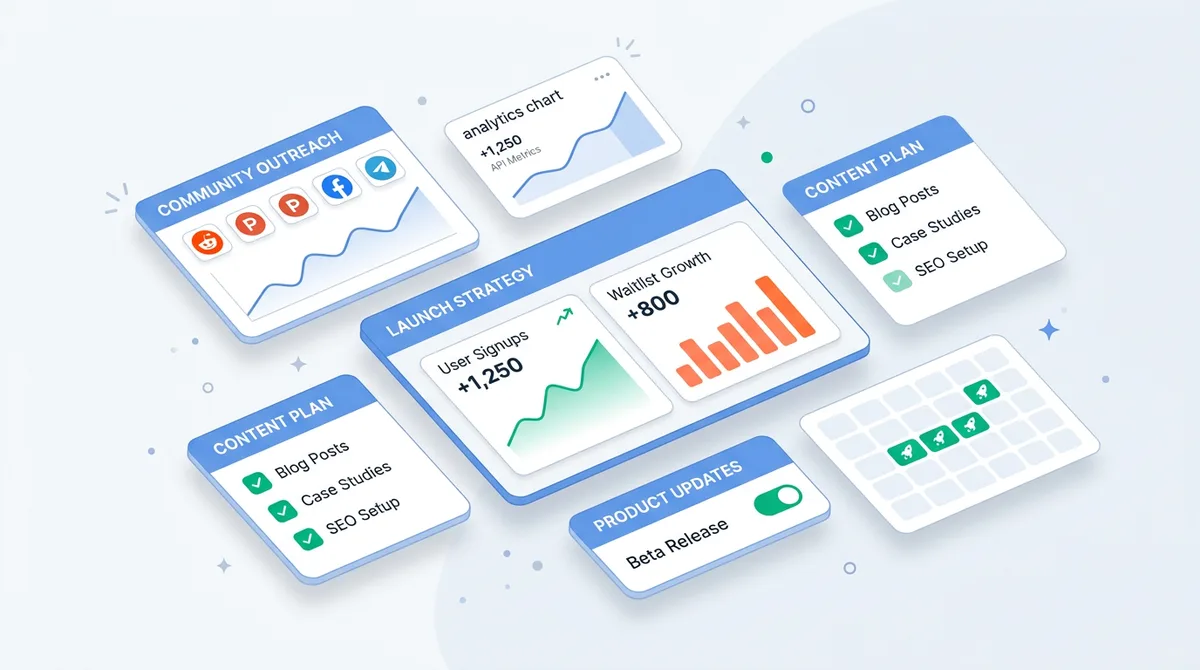
An organic SaaS launch is a zero-budget strategy that acquires your first 100 to 1,000 users for free. It relies on community outreach, building in public, and content marketing rather than paid ads. Instead of buying attention, founders earn it by documenting their journey and solving specific problems in niche communities before the payment gateway even goes live.
Phase 1: Building Your 'Invisible' Audience Before the Reveal
Pre-launch momentum is everything. The actual day you drop the link is just the finish line of a 60-day marathon. If you start your marketing engine on launch day, you're already dead in the water.
The Power of Building in Public on X and LinkedIn
Share the messy parts of your build. Did Stripe randomly reject your account? Post about it. Did you spend 14 hours fixing a weird UI alignment bug? Take a screenshot. People don't follow perfect corporate brands anymore. They follow humans trying to figure things out. If your target audience is content creators, you might feel tempted to act like a guru and write massive guides like How to Get 1,548,599 Followers on Instagram (Without Ads) just to look smart. Don't do it! Just share one honest lesson you learned today.
Imagine you spend a week building a feature nobody asked for. That same time could've gone into talking to 10 potential users on X. Posting your daily struggles acts as a filter. It attracts the exact people who resonate with the problem you are solving.
Validating with a Low-Friction Waitlist
Set up a simple Carrd or Tally form right now. Capture emails by offering an "Early Bird" lifetime deal to the first 50 signups. It gives people a selfish reason to give you their inbox access. If you can't convince a handful of people to hand over their email for a promised solution, your product idea needs tweaking.
You can read up on Why Your Product Launch Failed (And How to Fix It) to see why validating early saves you months of wasted code. A waitlist isn't just a list of names. It is your initial focus group.
Phase 2: Hijacking High-Traffic Platforms and Communities
Stop trying to buy attention on empty streets. Go directly to where your target users already hang out and borrow the audience.
Mastering Reddit and Niche Forums Without Getting Banned
Redditors despise self-promotion. They will nuke your post into oblivion if you just drop a link to your pricing page. You have to use the "Give-Give-Ask" method. Let's say your SaaS helps social media managers. Go to a marketing subreddit and post a massive, free-text guide, e.g., "How the Instagram Algorithm Works - Your 2026 Action Plan." Give away the farm for free. At the very bottom, casually mention you built a software tool to automate part of that workflow.
You should also make sure your personal profiles look legitimate before posting anywhere. Treat your Reddit or forum bio seriously. First impressions dictate whether someone clicks your link or reports you for spam.
Executing a Top 3 Launch on Directories
You need a structured plan for how to launch a saas product successfully on the big stage. Product Hunt is still huge, and the algorithm heavily favors the first four hours. You want to launch exactly at 12:01 AM PT. You need a launch day kit ready—outreach DMs drafted, social graphics exported, and an email scheduled for your waitlist.
Not quite ready for the massive spotlight? Check out WeekHack Launches to get your reps in. It is a great place to gather community feedback and grab a guaranteed dofollow backlink from other indie makers before going after the broader tech press.
Phase 3: Setting Up the Content and SEO Flywheel
Spike traffic is an ego trip. SEO is an actual business model. You want to transition from massive launch days to quiet, consistent daily signups.
Dominating Directory Listings for Early Backlinks
Submit your domain to Indie Hackers, Betalist, G2, Capterra, and startup directories immediately. This gives you early domain authority. If your SaaS helps influencers secure blue checks, don't just sit there waiting for search console to update. Write a detailed guest post for those directories and link naturally back to your landing page. According to Ahrefs, early link building is the primary driver of domain rating for new websites.
Creating 'Programmatic' Comparison and Alternative Pages
Target high-intent search queries. People searching for "Hootsuite Alternative" have their credit card in hand. They already know the problem, they just hate the current solution. Build pages explaining exactly why your tool is better for a specific niche. Be totally transparent about your Pricing or whatever billing model you use compared to the big guys. Make it an absolute no-brainer for small teams.
If your target user is searching for quick tactical wins like How to get 100 Instagram Followers in 24 hours (Step by Step), build a free micro-tool that calculates engagement rates. Free calculators and templates rank incredibly fast and funnel users right into your core software.
How to Launch a SaaS Product: 4 Common Mistakes
Founders shoot themselves in the foot all the time. Here are the traps I see every single week.
First, launching and disappearing. You hit submit on a directory and close your laptop to get lunch. Not even close. You need to stay at your desk for 12 hours replying to every single comment and question.
Second, ignoring brutal feedback. If 10 people in your early access group tell you the onboarding flow sucks, it sucks. Do not argue with them.
Third, over-automating your outreach. Auto-DMs are spam. If you wouldn't say it to a founder friend over coffee, don't DM it. If your SaaS helps creators write better content, do not spam them with generic robot messages.
Finally, choosing an 'everything' niche. If your project management tool is for "everyone," it is for no one. Pick a hyper-specific group first.
Treat your launch like a human conversation. Founders who try to cheat the system by skipping the basics will rarely succeed. The rules of human psychology simply do not change.
The No-Ad SaaS Launch Checklist
Here is what you actually do. Screenshot this and tape it to your monitor.
Set up a low-friction waitlist using Carrd or Tally exactly 60 days out.
Post one daily update on X or LinkedIn about the ugliest part of your build process.
Niche Reddit communities are goldmines—write two massive "Give-Give-Ask" value posts.
Submit your naked domain to at least 15 startup directories for initial SEO juice.
You need a spreadsheet of 50 warm contacts to manually DM on launch morning.
Draft three "Alternative to [Competitor]" SEO blog posts focused on long-tail keywords.
Stay at your keyboard for 12 straight hours on launch day to reply to the community.

FAQ: Common Questions About Zero-Budget Launches
How long does an organic launch take?
The actual launch is one day, but the prep takes 30 to 60 days. Building the invisible audience and preparing your assets is where the heavy lifting happens.
Can I figure out how to launch a saas product without a social media following?
Yes. You hijack existing audiences instead. Use Reddit, Hacker News, Facebook groups, and startup directories where traffic is already flowing naturally.
Is Product Hunt still relevant for bootstrappers?
Absolutely. Even if it doesn't bring you thousands of paying users directly, the high-authority SEO backlink alone is worth the effort of a well-executed launch.
Conclusion: Building a Sustainable Growth Engine
An ad-free launch is a marathon, not a quick sprint. The traffic you earn organically sticks around much longer than the expensive clicks you rent from tech giants. Keep talking to your users, keep shipping features that solve real friction, and trust the slow process. Using platforms like WeekHack can help you maintain the consistency needed to execute these manual tasks without burning out before you reach profitability.
Written by

Jan Orsula
Serial maker and founder of WeekHack, SocialCal, and SocialOrbit. Builds tools that help creators launch side projects, schedule social media, and generate content — so they can focus on what matters.
Related Articles
How to Get Comments on Product Hunt: 5 Proven Launch Strategies
Most makers obsess over Product Hunt upvotes, but comments are what actually drive the ranking algorithm. Learn how to craft the perfect maker story, run feedback-first outreach, and dominate the first 4 hours of your launch.
How to Plan a Startup Launch That Gains Real Traction
Learn how to plan a startup launch that actually gets traction. From finding your early users to engineering a launch day spike, here is the exact playbook indie hackers use.
How to Launch an AI Tool and Rank #1 on Product Hunt
Learn exactly how to launch an AI tool on Product Hunt and claim the top spot. This practical guide covers pre-launch community building, high-converting asset optimization, and a 24-hour tactical sprint.