
Why Your Product Launch Failed (And How to Fix It)
 Jan Orsula
Last month, I watched a founder spend six months building what he was convinced would be "the next big thing." Launch day came. Crickets. Five signups. Two of those were from his mom's email addresses.
Sound familiar?
Here's the brutal truth: 95% of product launches fail to meet their creator's expectations. Even experienced founders blow launches regularly. I've done it myself more times than I care to admit.
But here's what nobody tells you: most launch failures aren't because the product sucks. They fail because founders treat the launch as the starting line instead of the finish line.
What Is a Product Launch?
A product launch is the coordinated effort to introduce a new product or service to your target market, involving pre-launch preparation, launch day execution, and post-launch optimization to drive initial adoption and feedback.
That's the textbook definition. In reality? It's your make-or-break moment where months of work either find their audience or disappear into the void.
Why Product Launches Are So Hard for Indie Hackers
Why Your Product Launch Bombed (And How to Fix It)
You're not Coca-Cola. You don't have a million-dollar marketing budget or a team of specialists handling each piece.
You're wearing every hat. Developer, marketer, customer support, CEO. By the time you finish building, you're exhausted. The idea of "doing marketing" feels like learning a foreign language while running a marathon.
Most indie hackers think building is the hard part. Wrong. Getting people to care about what you built? That's where dreams go to die.
The worst part? You've been so heads-down building that you haven't talked to potential customers in months. You're launching to strangers who have no idea you exist.
Strategy 1: Validate Demand Before Building (Not After)
This is where most founders get it backwards. They build first, then try to find customers. It's like cooking an elaborate meal before checking if anyone's hungry.
Smart founders flip this script. They validate demand before writing a single line of code.
How to Validate Without Building
Start with a landing page. Not a fancy one - a simple page explaining your product idea with an email signup form.
Drive traffic to it through targeted ads or by sharing in relevant communities. If people aren't signing up for updates about a product that doesn't exist yet, they won't buy it when it does exist.
Pre-orders work even better. Stripe checkout, "Available Q2 2024," and see if people actually pull out their credit cards. Money talks louder than email addresses.
SocialCal did this perfectly. They started with a landing page describing their social media scheduling tool before building anything. The signups convinced them to build it.
The MVP Validation Framework
Your MVP isn't your product with fewer features. It's the smallest thing you can build that tests your core assumption about why people would pay you.
For a project management tool, your MVP might be a simple Google Sheet template that you manually update for customers. For a content creation platform, it could be a weekly email where you manually curate content.
The goal isn't to scale. It's to learn if anyone actually wants what you're thinking about building.
Action Step: Your 48-Hour Validation Test
This weekend, create a one-page site describing your product idea. Include three key elements: the problem you solve, how you solve it, and an email signup.
Share it in three places where your target customers hang out. Set a goal: if you can't get 50 email signups in 48 hours, your idea needs work.
Use tools like Carrd or even a simple Typeform. Don't overthink it. You're testing interest, not design skills.
Strategy 2: Build Your Audience While You Build Your Product
Why Your Product Launch Bombed (And How to Fix It)
Here's what separates successful launches from failures: audience timing.
Failed launches start building their audience on launch day. Successful ones started months earlier.
Building in public isn't just trendy - it's strategic. Every day you're coding, you should be sharing what you learned, what broke, what worked. People love watching things get built.
Choose Your Platform Based on Your Audience
Don't try to be everywhere. Pick one platform and own it.
Building for developers? Twitter and dev.to are your spots. Creating for small business owners? LinkedIn and relevant Facebook groups. Targeting creators? Instagram and TikTok might be your play.
The key is understanding where your audience already spends time, not where you think they should be. This article can help if you're going the Instagram route.
The 80/20 Rule of Audience Building
Share value 80% of the time. Promote your product 20% of the time.
Most founders get this backwards. They share screenshots of their app every day and wonder why engagement drops off a cliff.
Instead, share lessons learned, industry insights, behind-the-scenes struggles. Be useful first, promotional second.
When you do promote, make it part of the story. "Here's a feature I built this week because three people told me they needed it."
Action Step: Your Weekly Content Calendar
Plan four posts per week: one tutorial related to your niche, one behind-the-scenes building update, one industry insight or trend discussion, and one community engagement post (asking questions, responding to others).
Schedule these in advance. Use Buffer, Later, or just write them in your notes app. Consistency beats perfection.
Strategy 3: Create Anticipation With Strategic Pre-Launch Marketing
The best product launches feel inevitable. Like everyone's been waiting for this exact solution.
That feeling doesn't happen by accident. It's manufactured through strategic teasing and scarcity.
Key takeaways at a glance
The Teaser Campaign That Converts
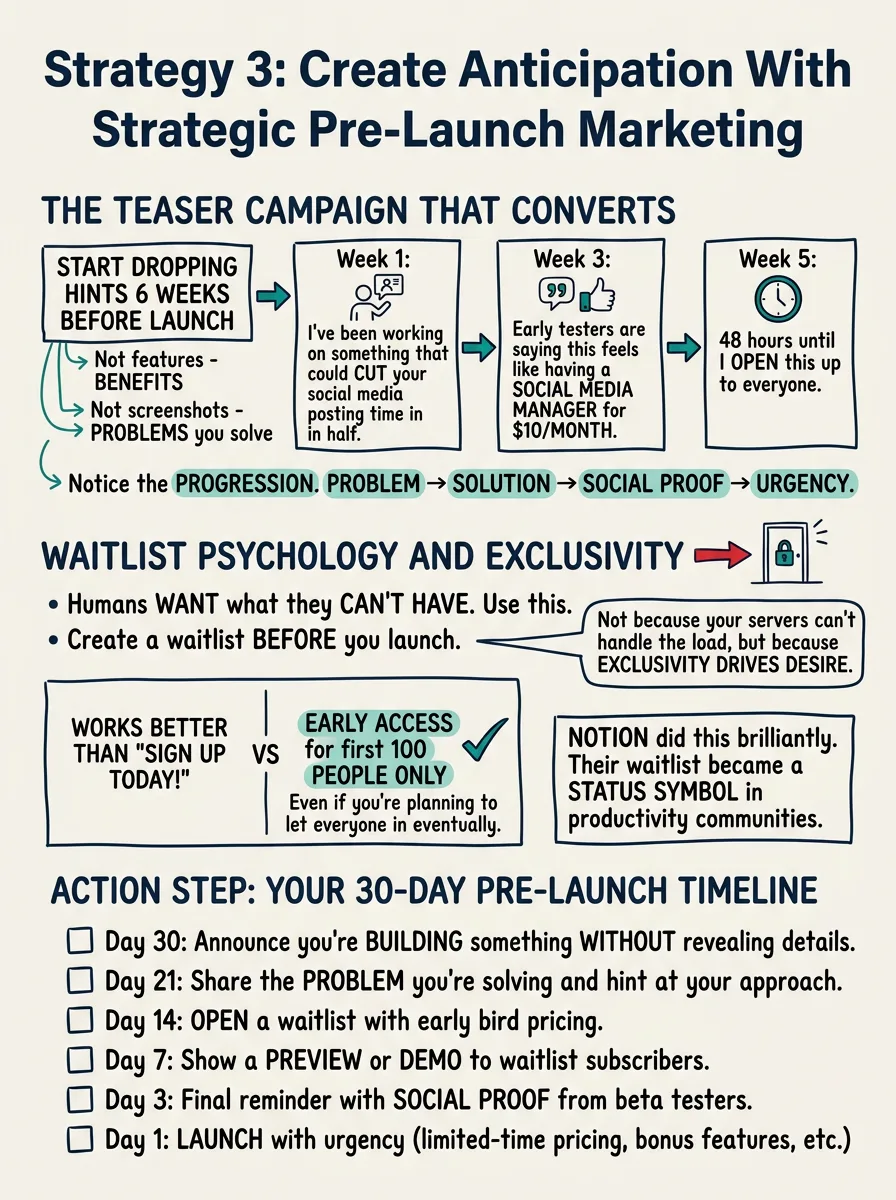
Start dropping hints six weeks before launch. Not features - benefits. Not screenshots - problems you solve.
Week 1: "I've been working on something that could cut your social media posting time in half."
Week 3: "Early testers are saying this feels like having a social media manager for $10/month."
Week 5: "48 hours until I open this up to everyone."
Notice the progression. Problem → solution → social proof → urgency.
Waitlist Psychology and Exclusivity
Humans want what they can't have. Use this.
Create a waitlist before you launch. Not because your servers can't handle the load, but because exclusivity drives desire.
"Early access for first 100 people only" works better than "Sign up today!" Even if you're planning to let everyone in eventually.
Notion did this brilliantly. Their waitlist became a status symbol in productivity communities.
Action Step: Your 30-Day Pre-Launch Timeline
Day 30: Announce you're building something without revealing details.
Day 21: Share the problem you're solving and hint at your approach.
Day 14: Open a waitlist with early bird pricing.
Day 7: Show a preview or demo to waitlist subscribers.
Day 3: Final reminder with social proof from beta testers.
Day 1: Launch with urgency (limited-time pricing, bonus features, etc.).
Strategy 4: Launch on Multiple Platforms Simultaneously
Putting all your launch eggs in one Product Hunt basket is like betting your startup on a coin flip.
Smart founders coordinate launches across multiple channels. More touchpoints, more chances to catch fire.
The Platform Mix That Works
Your platform mix should include:
One major launch platform (Product Hunt, Indie Hackers, etc.)
Your existing audience (email list, social media followers)
3-5 niche communities where your target customers hang out
Your personal network (friends, family, former colleagues)
Different platforms have different audiences. Reddit's r/entrepreneur wants different messaging than your LinkedIn network.
Timing Your Multi-Platform Launch
Start with your warm audience first. Email subscribers and social media followers get first access.
Then hit the major launch platforms while you have momentum. Social proof from early adopters helps with cold audiences.
Finally, roll out to niche communities with platform-specific messaging. What works on Hacker News won't work on Facebook groups.
Action Step: Your Launch Day Battle Plan
6 AM: Email your list
7 AM: Post on social media with launch day hashtags
8 AM: Submit to Product Hunt (if Tuesday-Thursday)
10 AM: Share in relevant Slack communities
12 PM: Post in niche Reddit communities (check posting rules first)
2 PM: Follow up on social media with user testimonials
5 PM: Send launch update to your network
8 PM: Final social media push with day's metrics
Strategy 5: Follow Up Relentlessly (Most Founders Stop Too Soon)
Launch day isn't the finish line. It's mile one of a marathon.
Most founders celebrate for a day, then move on to building new features. Meanwhile, 90% of their launch traffic bounces and never comes back.
The real winners double down on what's working and fix what's broken. Immediately.
The Follow-Up Sequence That Converts
Not everyone who visits on launch day is ready to buy. Create a nurture sequence for warm leads:
Day 1: Welcome email with onboarding guide
Day 3: Case study or success story
Day 7: Feature highlight with use case
Day 14: Limited-time offer or bonus
Day 30: Survey asking what stopped them from signing up
This sequence turns browsers into buyers over time. Mailchimp's founders credit their early email sequences with turning a failed launch into a billion-dollar company.
Turning Launch Feedback Into Product Gold
Launch day feedback is pure gold. People tell you exactly what's confusing, missing, or broken.
Most founders get defensive. Smart ones take notes and start fixing things immediately.
Create a simple system: feedback goes into a spreadsheet with columns for category, urgency, and status. Fix the highest-impact issues first.
If five people mention the same problem, stop everything and fix it. If your pricing page confuses people, rewrite it before building that new feature.
Action Step: Your Post-Launch Optimization Plan
Week 1: Fix any technical issues or major user experience problems
Week 2: Optimize your most visited pages based on launch day traffic
Week 3: Follow up with people who signed up but haven't converted
Week 4: Analyze metrics and plan your next marketing push
This systematic approach to post-launch optimization can double your conversion rate in a month.
Real Examples: 3 Indie Hackers Who Turned Failed Launches Into Success
Sarah launched her freelance project management tool to crickets. Literally zero sales on day one.
Instead of giving up, she spent the next week personally reaching out to every freelancer who'd joined her waitlist. She asked what went wrong. The answer? Her pricing was confusing and her value proposition wasn't clear.
She simplified both and relaunched a month later. Same product, clearer messaging. First month revenue: $2,400.
Mike's productivity app got featured on Product Hunt and... bombed. 50th place, 23 upvotes. Brutal.
But he noticed something interesting in his analytics. People spent an average of 4 minutes on his landing page - way above average. They were interested but not converting.
The problem? His signup process required 12 fields. He cut it to 3 fields and added a demo video. Conversion rate jumped from 2% to 8% overnight.
Jenny's SaaS tool for content creators launched to her 50 Twitter followers. Revenue after week one: $47.
She could've gotten discouraged. Instead, she started creating helpful content for creators daily. Tutorials, tips, behind-the-scenes content. Six months later, she had 5,000 followers and was doing $3,000 MRR.
The pattern? None of these founders had perfect launches. They had perfect persistence.
How to Execute Your Product Launch Effectively
Managing a multi-platform launch while building a product is like juggling fire. You need systems.
Most founders try to track everything in their heads or scattered across different tools. Launch day becomes chaos.
The Fool-Proof Way To Drive Website Traffic (Step by Step Guide) covers some traffic generation tactics that work well during launch periods.
Smart founders use launch management platforms to coordinate everything in one place. WeekHack helps indie hackers organize their launch across multiple platforms while connecting with a community of makers who can provide feedback and support.
The key is having one place where you can track your pre-launch checklist, coordinate launch day activities, and measure results across all platforms.
The Ultimate Product Launch Checklist
Pre-Launch (4-6 weeks before):
Validate your product idea with target customers
Build a landing page with email capture
Start building an audience on the chosen platform
Create a waitlist with early bird incentives
Prepare launch assets (screenshots, videos, copy)
Launch Week:
Email your waitlist with early access
Post on social media with launch hashtags
Submit to relevant launch platforms
Share in niche communities (follow their rules)
Reach out to your personal network
Post-Launch (first 30 days):
Fix critical bugs and user experience issues
Follow up with leads who didn't convert
Optimize high-traffic pages for better conversion
Collect and categorize user feedback
Plan your next marketing campaign
Frequently Asked Questions About Product Launches
When is the best time to launch a product?
Tuesday through Thursday typically see the highest engagement on most platforms. Avoid Mondays (people are catching up from the weekend) and Fridays (attention shifts to weekend plans). For global products, consider time zones where your primary audience lives.
How long should I spend preparing for a product launch?
Plan for 4-6 weeks of pre-launch preparation minimum. This gives you time to build anticipation, create marketing materials, and coordinate across multiple platforms. Rushed launches almost always underperform.
What's the biggest mistake indie hackers make with product launches?
Starting their marketing on launch day instead of weeks earlier. Successful launches feel inevitable because founders spent months building relationships and anticipation. You can't manufacture instant virality, but you can build consistent momentum.
How many platforms should I launch on simultaneously?
Focus on 3-5 platforms maximum for your initial launch. Better to do fewer platforms well than many platforms poorly. Include one major launch platform (like Product Hunt), your existing audience, and 2-3 niche communities where your customers spend time.
What should I do if my product launch fails?
Analyze what went wrong, fix the biggest issues, and relaunch. Most "overnight successes" are actually second or third launches. The key is learning from failure quickly and iterating based on real user feedback rather than assumptions.
Your Launch Success Starts With Better Preparation
Most product launches fail because founders treat them like events instead of processes.
The best launches feel effortless because months of groundwork made them inevitable. Every successful founder I know will tell you the same thing: the launch is just the celebration. The real work happens before anyone's watching.
Ready to Plan Your Next Launch?
Whether you're planning your first launch or trying to recover from a disappointment, remember that preparation beats perfection every time. WeekHack's launch tools can help you coordinate your efforts and connect with other makers who've been through the same process.
Written by

Jan Orsula
Serial maker and founder of WeekHack, SocialCal, and SocialOrbit. Builds tools that help creators launch side projects, schedule social media, and generate content — so they can focus on what matters.
Related Articles
How to Get Comments on Product Hunt: 5 Proven Launch Strategies
Most makers obsess over Product Hunt upvotes, but comments are what actually drive the ranking algorithm. Learn how to craft the perfect maker story, run feedback-first outreach, and dominate the first 4 hours of your launch.
How to Improve Your Launch Conversion Rate Step-by-Step
Struggling to turn product launch traffic into actual sales? Discover a practical, step-by-step framework to fix your messaging, remove friction, and drastically improve your conversion rates.
How to Collect User Feedback Before Launch: A Beginner's Plan
Stop guessing what your users want. Learn how to systematically collect pre-launch feedback using smoke tests, problem interviews, and lo-fi prototypes before writing a single line of code.