
The 3-Tier Pre-Launch Checklist Every Maker Needs
 Jan Orsula
Stop Shipping to Silence: Why This is the Definitive Pre-Launch Resource
You know the feeling. You spend three straight months coding in a dark room, hyped up on caffeine and blind optimism. You finally push to production, tweet the link, and wait for the internet to break.
Nothing happens.
You refresh Google Analytics. Zero active users. You check Stripe. Crickets. You just experienced the 'ghost town' phenomenon, and it is the single most demoralizing thing that can happen to an indie hacker. Building a great product is only half the battle. If you don't have a reliable pre-launch checklist for startups, you are essentially throwing a party and forgetting to send out the invitations.
Most founders get this wrong. They treat the launch as an afterthought. A quick post on a Tuesday morning and a few DMs to friends. What actually works is treating your launch like a separate product entirely. It requires engineering, marketing, and operational foresight. This guide breaks down the exact 3-tier system I use to prevent silent launches. We cover the product foundation, the distribution engine, and the operational backbone. No fluff. Just the exact steps you need to take before hitting publish.
What is a Startup Pre-Launch Checklist?
The 3-Tier Pre-Launch Checklist Every Maker Needs
A pre-launch checklist for startups is a strategic framework that outlines every technical, marketing, and operational task a founder must complete before releasing a product to the public. It ensures the software is bug-free, an audience is primed to buy, and the underlying business systems can handle the influx of new users. Think of it as your safety net against a failed launch.
The High Cost of a 'Winged' Launch
We wing it because we are impatient. You just want to see people use the thing you built. But rushing across the finish line usually ends in disaster.
According to CB Insights data on startup failure, nearly a fifth of startups fail because of flawed business models or ignoring their customers. When you launch without preparation, you amplify those risks. You miss out on the initial burst of traffic that algorithms reward. A botched launch doesn't just cost you early revenue. It costs you momentum. And momentum is the only currency early-stage startups actually have.
Imagine you get a top spot on Hacker News. A thousand concurrent visitors hit your site. But you forgot to optimize your database queries. Your server crashes instantly. You just wasted your golden ticket because you skipped a basic stress test.
A structured rollout changes the psychology of launching. Instead of panicked scrambling, you execute a plan. You sleep better. You respond to user feedback instead of fighting server fires. That is why this tier system exists.
Tier 1: The Product Foundation (Technical Excellence)
Before you invite people into your house, you need to make sure the roof isn't caving in. The first tier of your pre-launch checklist for startups focuses entirely on the software itself. It has to work.
Defining the 'Minimum Viable Experience' (MVE)
We all know about the MVP. The Minimum Viable Product. But I prefer optimizing for the MVE—the Minimum Viable Experience. Users have incredibly low tolerance for janky software these days.
Your product doesn't need every feature. It doesn't need a dark mode toggle or an AI chatbot. But the core action your user takes must be flawless. If you built a video compressor, the upload, compression, and download flow needs to feel like magic. Strip away the secondary features and polish the primary one until it shines. If the core value proposition is hidden behind a clunky UI, people will bounce and never return.
The Technical Audit: Speed, Security, and SEO
Technical debt catches up to you on launch day. Do a hard audit.
Start with page load times. Nobody waits five seconds for a landing page to render. Compress your images, minify your CSS, and use a CDN. Next, verify your SSL certificates. A giant "Not Secure" warning in the browser address bar is a massive conversion killer. Finally, nail down your basic on-page SEO. Your title tags, meta descriptions, and Open Graph images need to be populated. When someone shares your link on Twitter or Slack, it should generate a beautiful preview card, not a broken grey box.
Error Handling and 'The Broken Window' Test
I call this the broken window test. If a user sees a single broken element, they assume the whole app is fragile.
Click every single link on your site. Make sure your 404 error page is helpful and directs people back to the main flow. Test your form validations. What happens if someone enters an invalid email? Do they get a clear error message, or does the app just fail silently? Check your empty states. If a user hasn't created any projects yet, don't just show a blank white screen. Give them a clear button that says "Create your first project." These small details dictate how professional your product feels.
Tier 2: The Distribution Engine (Marketing & Audience)
You cannot build it and expect them to come. That is a myth. The second tier is about building a gravity well that pulls users toward your product well before the actual launch date.
Landing Page Psychology and Conversion Optimization
Your landing page is your best salesperson. Most founders make it too technical. They talk about the tech stack or the complex algorithm.
Nobody cares. They only care about how it solves their specific pain point.
Your hero section needs a clear, punchy headline that states exactly what the product does. The subheadline explains how. Right below that, you need a single, impossible-to-miss Call to Action (CTA). "Join the waitlist" or "Get early access." Do not give them five different buttons to click. Use social proof early, even if it's just a quote from a beta tester. Keep the friction low. Just ask for an email address. Asking for a first name, last name, and phone number at this stage will tank your conversion rate.
The 'Waitlist' Flywheel: Building Anticipation
A static waitlist is useless. You need to engineer virality into it.
When someone signs up, give them a referral link. Tell them they will move up the queue or get a lifetime discount if they invite three friends. I've seen products blow up just by offering a simple PDF guide as a reward for sharing the waitlist on Twitter.
Combine this with building in public. Share your progress, your struggles, and your revenue numbers on social media. People love following a journey. By the time you launch, those followers feel like they are part of the team. They will become your earliest evangelists.
Platform Strategy: Where to Launch for Maximum Impact
You don't just launch once. You launch in phases across different platforms.
Product Hunt is the standard for tech products. Hacker News is great if your tool is highly technical or developer-focused, but they will destroy you if your copy is too marketing-heavy. Indie Hackers is perfect for bootstrapping stories. Reddit can be a goldmine, but only if you provide immense value in your post rather than just dropping a link.
To keep the momentum going long after the initial spike, consider using a platform designed for sustained visibility. Getting listed on WeekHack Launches is a smart move here, as it provides a community of active builders, guarantees a dofollow backlink, and keeps your product in front of an audience that actually cares about indie software.
Asset Preparation: The Launch Media Kit
Scrambling to record a demo video at 2 AM on launch day is a terrible idea.
Prepare a folder a week in advance. You need a 60-second walkthrough video demonstrating the core value. Keep it fast-paced. You need high-resolution screenshots of your UI. You need pre-written social media swipe files—short snippets of text that your friends and early supporters can easily copy, paste, and post to help amplify your launch. Having these assets ready makes the actual day feel like a breeze.
Tier 3: The Operational Backbone (Scale & Feedback)
The doors are open. The traffic is hitting. Now what? The third tier of your pre-launch checklist for startups focuses on the systems that keep you from flying blind.
Don’t Fly Blind: The Analytics Stack
If you don't have analytics installed, you have no idea what is actually happening. You might get 10,000 visitors, but if nobody signs up, you need to know exactly where they dropped off.
Set up an event tracking tool like PostHog or Amplitude. Track specific actions. When do they click the pricing page? How many users start the onboarding flow but never finish it? This data is crucial for the days immediately following your launch. It tells you exactly what needs to be fixed to improve conversions.
The Feedback Loop: Customer Support Channels
First impressions matter, but fast support can save a bad first impression. Bugs will happen. Users will get confused.
Put a live chat widget like Crisp or Intercom on your site for the first week. Talk to every single person who drops by. If they encounter friction, fix it in real-time. Create a Discord community or a simple dedicated support email. The goal here is to capture user friction early before they abandon the app forever. A founder who actively responds to bugs within minutes wins customers for life.
Legal, Terms, and Privacy: The 'Boring' Essentials
We all hate writing Terms of Service. But you cannot ignore this step.
Make sure you have a basic Privacy Policy and Terms of Service linked in your footer. If you are handling user data, you need to be aware of GDPR compliance. A simple cookie consent banner and clear policies protect you from unnecessary headaches down the line. You don't need a thousand-dollar lawyer for this on day one; use a generator, read through it, and make sure it covers your basic liabilities.
Payment Processing and Billing Stress-Tests
Imagine people actually want to give you money, but your checkout form is broken. Yes, this happens all the time.
Run your Stripe integration through rigorous testing. Use Stripe's test clocks to simulate subscriptions renewing and failing. What happens when a user's credit card is declined? Do they get a clear error, or does the app just freeze? Test your coupon codes. Verify that your webhooks are properly updating the user's status in your database after a successful payment. Revenue lost on day one is usually gone forever.
The Psychology of a Maker: Managing Pre-Launch Stress
Let's talk about the mental toll. Launching a product is exhausting. The fear of failure is real, and the adrenaline crash afterward can leave you burnt out for weeks.
Setting Realistic KPI Benchmarks
Define what success looks like before you launch. And no, "getting 10,000 visitors" is not a good metric.
Vanity metrics will drive you crazy. Instead, focus on actionable numbers. Aim for 50 qualified waitlist signups. Aim for 5 paying customers. Aim for 10 pieces of highly detailed user feedback. If you set your expectations strictly around revenue or viral traffic, you are setting yourself up for disappointment. Celebrate the small wins. A user taking time out of their day to report a bug means they actually care about your product.
The 'Build in Public' Balance
Building in public is great for marketing, but it can become a massive distraction.
You don't need to document every single line of code you write. That is performative and wastes time. Share the milestones. Share the major technical hurdles you overcame. Share your pricing strategy thoughts. Keep a balance. If writing a Twitter thread is taking you away from fixing a critical payment bug, close Twitter. The product always comes first.
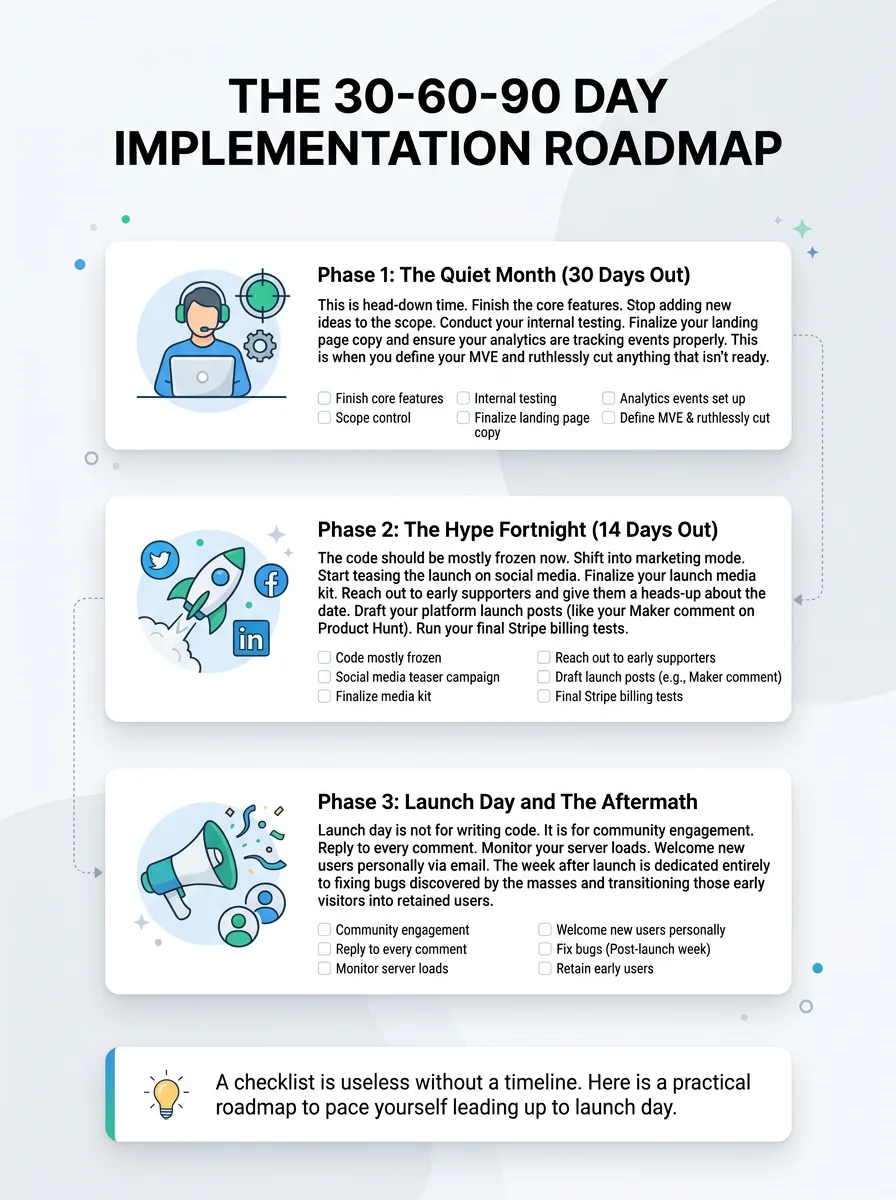
The 30-60-90 Day Implementation Roadmap
A checklist is useless without a timeline. Here is a practical roadmap to pace yourself leading up to launch day.
Phase 1: The Quiet Month (30 Days Out)
This is head-down time. Finish the core features. Stop adding new ideas to the scope. Conduct your internal testing. Finalize your landing page copy and ensure your analytics are tracking events properly. This is when you define your MVE and ruthlessly cut anything that isn't ready.
Key takeaways at a glance
Phase 2: The Hype Fortnight (14 Days Out)
The code should be mostly frozen now. Shift into marketing mode. Start teasing the launch on social media. Finalize your launch media kit. Reach out to early supporters and give them a heads-up about the date. Draft your platform launch posts (like your Maker comment on Product Hunt). Run your final Stripe billing tests.
Phase 3: Launch Day and The Aftermath
Launch day is not for writing code. It is for community engagement. Reply to every comment. Monitor your server loads. Welcome new users personally via email. The week after launch is dedicated entirely to fixing bugs discovered by the masses and transitioning those early visitors into retained users.
5 Fatal Mistakes to Avoid in Your Pre-Launch Checklist for Startups
Even with a plan, founders stumble. Watch out for these common traps.
First, premature scaling. You don't need a Kubernetes cluster for an app with 100 users. Keep your infrastructure simple and cheap until it physically breaks.
Second, ignoring mobile users. Half your traffic from Reddit or Twitter will be on a phone. If your landing page looks terrible on a mobile screen, you will lose those users instantly.
Third, launching to the wrong crowd. If you built a tool for enterprise sales teams, a viral post on an indie dev forum might bring traffic, but it won't bring buyers.
Fourth, feature creeping at the last minute. The urge to squeeze in just one more feature right before launch is strong. Resist it. It usually introduces critical bugs.
Finally, treating the launch as the end. A launch is just the beginning of your feedback loop. The real work starts on day two.
The Maker’s Toolkit: Resources for a Seamless Launch
You need the right tools to manage the chaos. Use Stripe for payments. Use PostHog for analytics. Vercel or Render for hosting. Resend for transactional emails.
Productivity & Scheduling: Why We Recommend WeekHack
Managing fifty different tasks across product, marketing, and operations is overwhelming. Standard to-do lists usually break down under the pressure of a launch.
What helps is aggressive time-blocking and having a dedicated community backing you. I highly suggest looking into WeekHack Pricing to see how their weekly tracking system can keep you accountable during those final, chaotic 30 days. By structuring your pre-launch tasks into distinct weekly sprints, you prevent the paralyzing feeling of having too much to do at once. Plus, participating in the community puts you in direct contact with other founders who can support your upcoming launch.
The Master Pre-Launch Checklist for Startups (Condensed)
Bookmark this section. This is your rapid-fire master list.
Product: Core workflow tested. Broken links fixed. 404 page created.
Technical: SSL active. Mobile responsive. Page load speed under 3 seconds.
Marketing: Landing page optimized. Clear CTA. Waitlist emails collecting properly.
Assets: Demo video recorded. High-res screenshots ready. Social copy drafted.
Legal: Privacy Policy and Terms of Service live. Cookie banner active.
Operations: Stripe checkout tested. Webhooks firing properly. Analytics tracking key events.
Support: Live chat installed or support email actively monitored.
Frequently Asked Questions About Startup Launches
How much money do I need for a pre-launch?
Almost nothing. You can run a highly successful pre-launch with zero ad spend. Your costs should primarily be your domain name, basic server hosting, and maybe a low-tier subscription for your email provider. Rely on organic content, SEO, and community building.
Is Product Hunt still worth it in 2026?
Yes, but expectations have shifted. It is no longer a magic wand that guarantees thousands of paying customers. It is, however, an excellent way to get an initial spike of traffic, secure high-quality backlinks for your domain, and test your messaging against a tech-savvy audience.
How many emails should I have before launching?
There is no magic number, but a healthy target for a bootstrapped indie app is 300 to 500 highly engaged waitlist signups. I would rather have 100 people who desperately need the product than 5,000 people who clicked a link out of mild curiosity.
What if my launch fails and nobody visits?
Pivot to a soft launch mindset. Reach out manually. Send cold emails to 50 people who fit your ideal customer profile. Go into niche Discord servers or subreddits and ask for brutal feedback. A failed public launch just means you need to do things that don't scale for a while.
Final Thoughts: Launching is a Milestone, Not the Destination
A solid pre-launch checklist for startups takes the panic out of shipping. It turns a chaotic, stress-inducing event into a predictable, manageable process. By securing your product foundation, prepping your distribution, and fortifying your operations, you give your product the best possible chance to survive its collision with the real world.
Get your checklist in order, block out your timeline on WeekHack, and push the button. The internet is waiting.
Written by

Jan Orsula
Serial maker and founder of WeekHack, SocialCal, and SocialOrbit. Builds tools that help creators launch side projects, schedule social media, and generate content — so they can focus on what matters.
Related Articles
How to Get Comments on Product Hunt: 5 Proven Launch Strategies
Most makers obsess over Product Hunt upvotes, but comments are what actually drive the ranking algorithm. Learn how to craft the perfect maker story, run feedback-first outreach, and dominate the first 4 hours of your launch.
How to Plan a Startup Launch That Gains Real Traction
Learn how to plan a startup launch that actually gets traction. From finding your early users to engineering a launch day spike, here is the exact playbook indie hackers use.
How to Launch an AI Tool and Rank #1 on Product Hunt
Learn exactly how to launch an AI tool on Product Hunt and claim the top spot. This practical guide covers pre-launch community building, high-converting asset optimization, and a 24-hour tactical sprint.