
How to Get Comments on Product Hunt: 5 Proven Launch Strategies
 Jan Orsula
Why Upvotes are Vanity Metrics (and Comments are the Real Engine)
Most makers watch the upvote counter like it is a slot machine. They hit refresh, see the number climb, and assume they are winning. They aren't. If you have 500 upvotes and three comments, the Product Hunt algorithm assumes you bought bots. Investors assume the exact same thing.
Upvotes are pure vanity metrics. Comments are the actual engine of your launch day momentum. If you are trying to figure out how to get comments on Product Hunt, you need to understand a harsh reality about modern product launches. High-quality comments prove that real human beings actually care about the problem you are solving. Sentiment drives the ranking just as much as raw numbers. A page with deep, multi-threaded conversations looks alive. A page with a thousand silent upvotes looks entirely fake.
How to Get Comments on Product Hunt: The Quick Answer
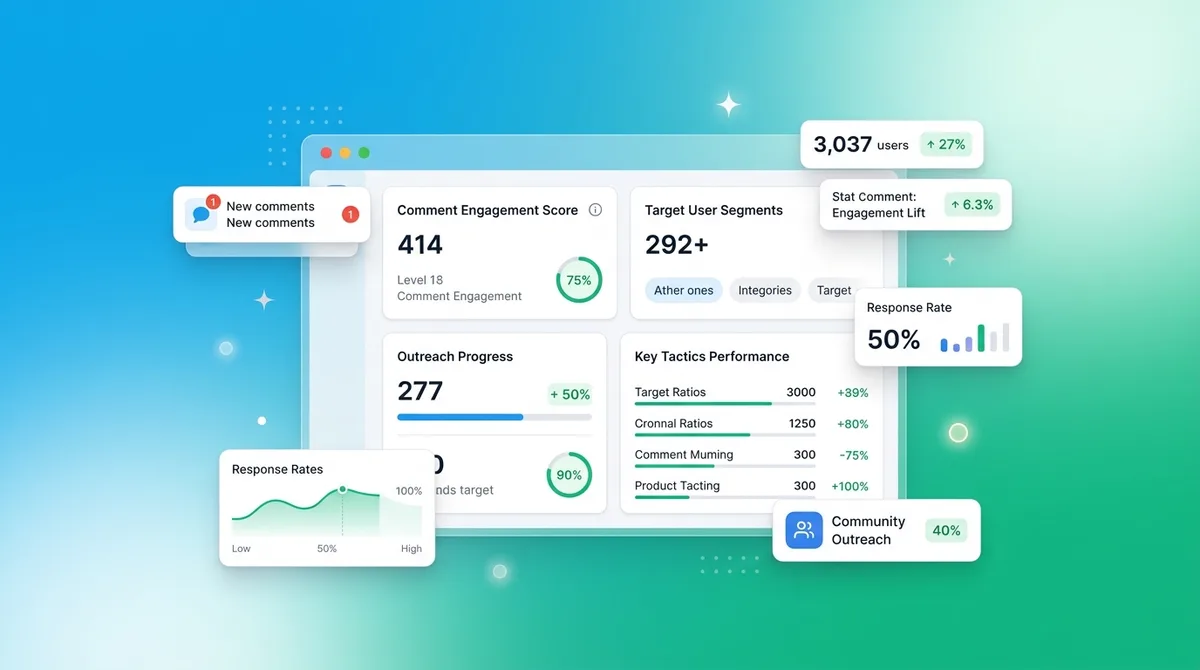
Getting comments on Product Hunt requires a combination of a highly personal 'Maker's Comment' and proactive, feedback-driven outreach to your existing network. Instead of asking for votes, ask targeted, open-ended questions in your product description to invite genuine feedback. You must also commit to replying to every single comment within minutes to keep the algorithm engaged during the critical early hours.
Strategy 1: Crafting the Perfect 'Maker’s Story' First Comment
The very first comment on your launch page has to come from you. This sets the entire tone for the day. If your maker comment is a dry, bulleted feature list, expect absolute silence. People do not reply to feature lists. They reply to human struggles, interesting origin stories, and genuine vulnerability.
The Structure of a High-Conversion Maker Comment
A successful maker comment breaks down into three distinct beats. First, explain the "why now." What specific trigger forced you to build this? Next, share the personal struggle. Maybe you lost a client because of a workflow bottleneck, or you spent three entire weekends fighting a poorly documented API. Make it real.
Finally, ask for targeted feedback. Do not just say "let me know what you think." Give them a specific area to tear apart. While writing a Product Hunt tagline that converts gets people to click your page, your maker comment is what actually gets them to talk. Ask them to roast your onboarding flow or critique your pricing model.
The 'P.S. Question' Technique
This is a stupidly simple trick. It works every time.
End your maker comment with a specific "P.S." question. Try something like, "P.S. We are debating whether to add Stripe billing or PayPal next—which do you prefer?" or "P.S. What is the single biggest feature missing here that would make you switch?"
This drastically lowers the friction to reply. People love giving their opinions on A/B choices. It gives lurkers an easy excuse to jump into the conversation.
Strategy 2: How to Get Comments on Product Hunt via Personalized Outreach
Look, blasting your network with desperate pleas to upvote your launch is a surefire way to get ignored. Nobody likes feeling like a transaction. When figuring out how to get comments on Product Hunt, your existing network is the spark that starts the fire. You just have to approach them correctly.
Scripts for Slack, Discord, and Twitter DMs
I have seen mediocre products blow up just by shifting their DM strategy. Prioritize genuine curiosity over a hard ask. Do not beg for clicks. Ask for brainpower.
Here are two scripts I actually use on launch day.
The Slack Community Drop: "Hey folks, we just put [Product] live on PH today. I actually built this after struggling with [problem] in this exact community last month. I would genuinely love your feedback on the new onboarding flow if anyone has two minutes to roast it."
The Twitter DM: "Hey [Name], I know you write a lot about [Topic]. We just launched a tool tackling exactly that. If you have a second to look at the PH page, I would love to know if our pricing model makes sense to someone with your specific expertise."
Notice the subtle difference. You are validating their expertise. This feedback-first approach is also exactly how to get your first upvotes on Product Hunt without sounding desperate. Users who take the time to leave thoughtful comments almost always upvote naturally anyway.
Strategy 3: Maximize the First 4 Hours for Real-Time Replies
The Product Hunt algorithm heavily favors early, rapid activity. The first four hours are the golden window. The 12:01 AM Pacific launch time is brutal, and you will likely be staring at your screen in the dark running on stale coffee. But if your page is a ghost town by 4 AM, you are dead in the water.
The 'Reply-to-All' Rule
The founder must reply to every single comment within minutes. I mean it.
Keep a tab open and refresh constantly. If someone simply says "Congrats on the launch," do not just reply with a lazy "Thanks." Reply with "Thanks Sarah. I saw you build a lot of SaaS tools—how do you handle early user onboarding?" Turn every dead-end compliment into a persistent conversation thread.
This literally doubles your comment count and keeps your product pinned to the top of the 'Active' feed. According to the official Product Hunt guidelines, sustained conversation is a major signal for trending products. You have to manufacture that momentum yourself.
Strategy 4: Incentivizing Quality Feedback (Not Bribes)
Product Hunt will quickly penalize you if you buy votes or blatantly bribe people. Your account can get flagged and your launch buried. But you can absolutely incentivize deep, meaningful feedback ethically.
Offering 'Beta Access' or Extended Trials for Reviewers
In your maker comment or on your personal social feeds, mention that you are hanging out in the comments all day giving away perks to people who provide detailed roasts. You might say, "I am dropping a 6-month pro code in the DMs for anyone who leaves a piece of constructive criticism today."
You are not paying for upvotes. You are compensating beta testers for their time and brainpower. This strategy encourages users to write rich, multi-sentence reviews instead of dropping a useless rocket ship emoji and leaving.
Strategy 5: Tagging Contributors and Early Supporters
Do not launch as a solo maker if you had help. Use the 'Makers' feature to add absolutely anyone who touched the product. Add your co-founder, your freelance designer, and that guy from Discord who beta tested it for three hours last week.
When you add makers, their respective followers often get notified. More importantly, you should tag your early supporters directly in your initial comments to pull them into the thread automatically.
Try something like: "Huge thanks to @username and @username for tearing apart the early beta. I would love to hear what you think of the final UI today." That instantly puts two high-quality commenters on the hook to reply.
Common Pitfalls: What Kills Engagement?
I see founders ruin their launches by making the same stupid, avoidable mistakes. Here is what actually kills your momentum on launch day.
Buying comments from click farms. The algorithm catches this immediately. The bot accounts have zero history and leave generic phrases. Your product will get quietly shadowbanned.
Generic thank yous. Replying "Thanks a lot" to fifty different people makes the thread incredibly boring for anyone reading it later. Always ask a follow-up question to keep the chain alive.
Arguing with trolls. Sometimes a competitor or a grumpy user will leave a snarky comment. Defending yourself aggressively is a massive mistake. The community watches how you handle pressure. A polite, objective response wins you silent admirers.
Link-dumping in random groups. Dropping your bare URL in a giant Facebook group with no context yields high bounce rates and zero comments. The algorithm notices when hundreds of people click your page and immediately leave without engaging.
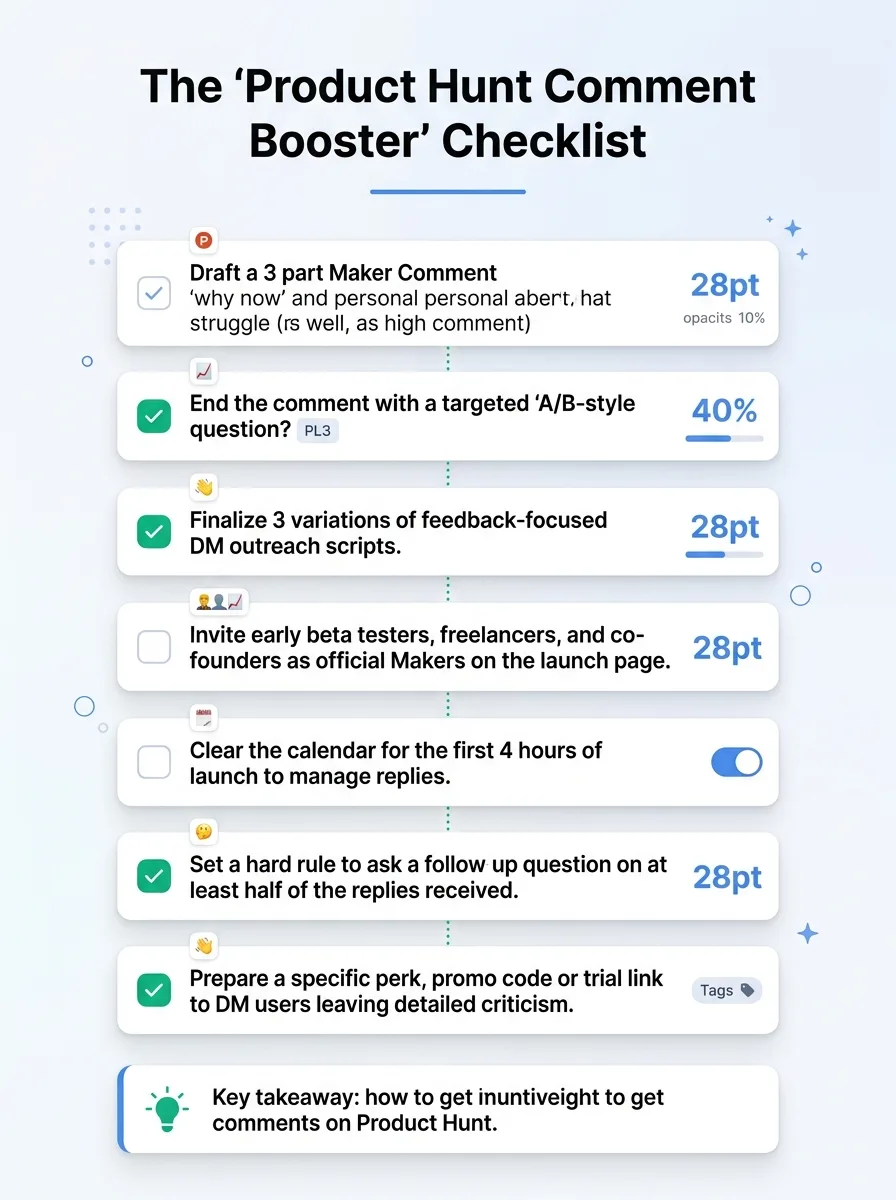
The 'Product Hunt Comment Booster' Checklist
Print this out or screenshot it. Follow these exact steps on launch day to ensure your engagement numbers actually translate into ranking momentum.
Draft a 3-part Maker Comment focusing on the "why now" and your personal struggle.
End the Maker Comment with a targeted A/B style question to lower reply friction.
Finalize three variations of DM outreach scripts focused purely on gathering feedback.
Invite all early beta testers, freelancers, and co-founders as official Makers on the launch page.
Clear your calendar for the first four hours of launch to manage the real-time reply window.
Set a hard rule to ask a follow-up question on at least half of the replies you receive.
Prepare a specific perk, promo code, or trial link to DM users who leave detailed criticism.
Frequently Asked Questions About How to Get Comments on Product Hunt
Do comments actually help with ranking?
Yes. The ranking algorithm heavily factors in velocity and engagement, not just raw upvotes. A product with 300 upvotes and 100 deep comments will frequently outrank a product with 400 upvotes and only 10 superficial comments.
Can I ask my friends to comment?
You can ask friends for genuine feedback, but do not tell them exactly what to say. If twenty new accounts all post variations of "Great product," the spam filters will kick in. Ask them to be specific about what they actually like or dislike.
What happens if my launch gets zero comments?
If your page stays quiet, you will likely drop off the featured feed as the algorithm assumes the product lacks market interest. If you completely tanked your first try due to low engagement, you might be wondering can you relaunch on Product Hunt. You can, but usually only after six months or a major version update.
Should I use automated DM tools to ask for comments?
Absolutely not. Automated DMs are painfully obvious. People ignore them, report them as spam, and actively avoid supporting products that use them. Do things that don't scale on launch day. Hand-write your messages.
Conclusion: Building a Community, Not Just a Launch
Figuring out how to get comments on Product Hunt is really just about treating people like humans. Stop looking for technical hacks to artificially inflate your numbers. The real secret is simply being present, asking good questions, and actually caring about the answers you get back.
Comments are the very start of a relationship with your early users. Once the launch dust settles, you need a reliable way to keep that exact momentum going. That is why smart builders use WeekHack to share weekly product updates, gather continuous community votes, and secure guaranteed dofollow backlinks. Build the habit of talking to your users every single week, and the comments will take care of themselves.
Written by

Jan Orsula
Serial maker and founder of WeekHack, SocialCal, and SocialOrbit. Builds tools that help creators launch side projects, schedule social media, and generate content — so they can focus on what matters.
Related Articles
How to Plan a Startup Launch That Gains Real Traction
Learn how to plan a startup launch that actually gets traction. From finding your early users to engineering a launch day spike, here is the exact playbook indie hackers use.
How to Launch an AI Tool and Rank #1 on Product Hunt
Learn exactly how to launch an AI tool on Product Hunt and claim the top spot. This practical guide covers pre-launch community building, high-converting asset optimization, and a 24-hour tactical sprint.
The Ultimate SaaS Launch Plan Template: Get Your First 100 Users
Getting your first 100 users is the hardest part of building a startup. Use this proven SaaS launch plan template to move from zero traffic to consistent user acquisition.