
10 Proven Places to Find Beta Users for Your SaaS
 Jan Orsula
The Ghost Town Problem: Why Finding Beta Users is Your First Real Hurdle
You spend three months coding on nights and weekends. The Stripe integration is flawless. The UI looks crisp. You finally push it live, refresh your analytics dashboard, and nothing. Just your own IP address staring back at you.
Sound familiar?
Building a product is hard, but finding those first 50 people to actually use it is where most founders quit. The ghost town phase is brutal. If you want to know how to get beta users without spamming your mom's Facebook friends, you need a tactical roadmap. You have to find where your early adopters already hang out, speak their language, and convince them to try your buggy prototype.
Quick Answer: How to Get Beta Users for Your SaaS
Figuring out how to get beta users comes down to finding high-intent communities and offering them exclusive early access to solve a specific pain point. It requires pitching your rough prototype to niche groups, running targeted social outreach, and using a structured feedback loop to iterate before a public launch.
Strategy 1: Tapping into High-Density Founder and Indie Communities
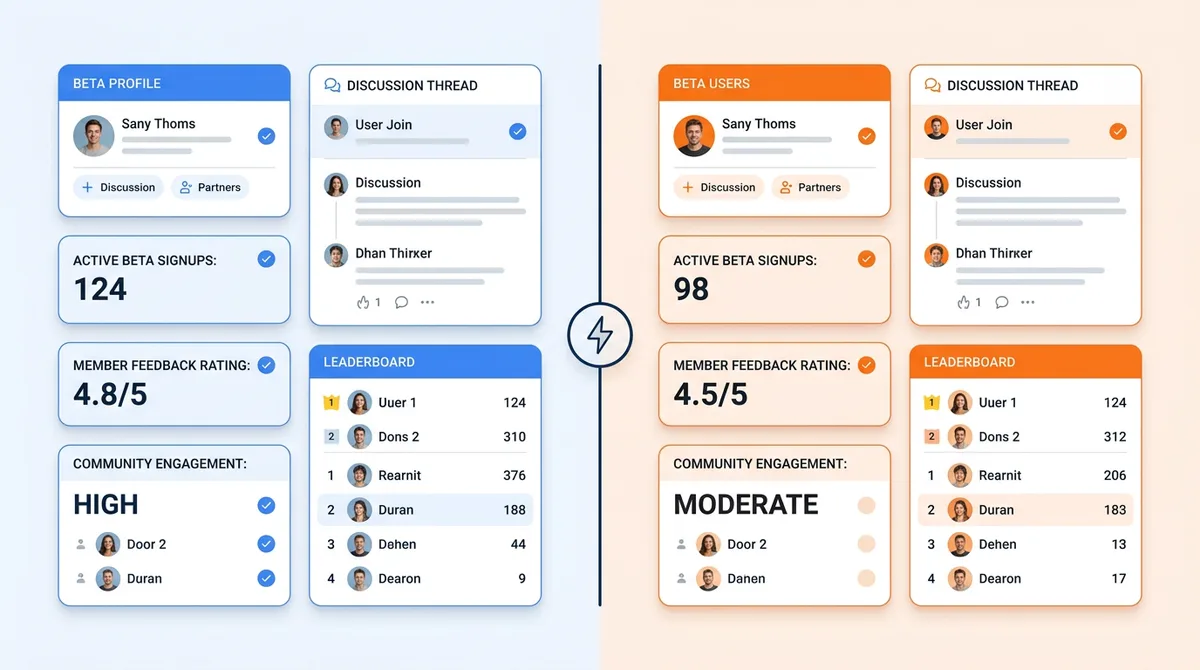
Makers love helping other makers. It is an unwritten rule of the internet. When you are just starting out, founder communities are the lowest-hanging fruit because the culture is built entirely on reciprocity. People know your app is going to be rough around the edges. They don't care. They just want to see what you are building.
Indie Hackers and Product Hunt 'Ship'
Don't just drop a link and run. That never works. Instead, write a milestone post detailing your journey building in public. Share your tech stack, your struggles, and exactly why you decided to build this specific tool. Be vulnerable about what isn't working yet. If you are prepping for a bigger drop later, WeekHack Launches or Product Hunt's pre-launch pages are great places to collect emails from peers who want to test your early build.
Using Niche Subreddits (The Non-Spammy Way)
Here is the thing about Reddit. They hate marketers. If you march into a subreddit and pitch your SaaS, you will be banned in about four minutes.
The trick is the advice-seeking approach. Find a community related to your problem space. Write a post explaining a frustration you had, how you built a rough internal script to fix it, and ask if anyone else experiences the same issue. If they say yes, send a casual DM asking if they want to play around with your prototype. That's it.
Strategy 2: How to Get Beta Users via Dedicated Directories
Sometimes you just need volume to stress-test your servers and catch weird edge-case bugs. Dedicated directories exist solely to connect early-stage startups with tech enthusiasts who actually enjoy breaking early software.
Getting Featured on BetaList and BetaBound
Getting onto or BetaList is a rite of passage for indie hackers. But there is a catch. The traffic spike is completely useless if your landing page leaks visitors. Before you submit, make sure your hero section explains exactly what the product does in under five seconds. Put an email capture form right at the top. Set up an autoresponder offering immediate access so you don't waste the initial surge of visitors.
Using 'Show HN' on Hacker News Effectively
Hacker News is a notoriously tough crowd. They will critique your font choices, your tech stack, and your entire business model in one breath. But a successful "Show HN" post can easily crash your servers.
Keep your pitch minimalist. Explain the technical problem you solved. Do not use marketing speak or claim you are changing the world. Engineers want to know how it works under the hood. According to Y Combinator's launch guide, the best posts are direct, humble, and highly responsive in the comment section.
Strategy 3: Targeted Social Listening and Direct Outreach
Passive listings are fine. Active hunting is better. Your competitors have angry users right now, and you just need to find them.
Social Listening on X (Twitter) and LinkedIn
People complain on the internet constantly. Use advanced search operators to look for queries like "frustrated with [Competitor]" or "how do I [Action your SaaS does]". When you find someone complaining, reply with a helpful tip first.
Then, send a low-friction DM. Say something like: "Hey, saw you were annoyed by X. I'm building a lightweight alternative and looking for early feedback. Mind if I send you a link? No worries if not." It converts shockingly well because you are offering a direct solution to a problem they vocalized minutes ago.
Niche Slack and Discord Communities
Walled gardens are goldmines.
Whether it is a Slack group for freelance designers or a Discord for AI devs, these tight-knit communities are where real, unfiltered conversations happen. Join them and spend a week just answering questions. Be genuinely helpful. Then, drop a casual mention of your tool in the designated self-promotion channel. Because you already proved you aren't just a spammer, people will actually click your link.
Strategy 4: Utilizing Paid and Incentive-Based Testing
What if you are building B2B enterprise software and your target users aren't hanging out on Indie Hackers? Sometimes you have to buy their time.
UserTesting and Maze for Rapid UI/UX Feedback
If you need specific demographic feedback quickly, platforms like UserTesting or Maze let you trade a small budget for high-quality data. You can set up unmoderated testing where you give the tester a five-minute task, like "Create a new project and invite a team member."
You will quickly identify the exact friction points in your onboarding flow. It is physically painful to watch users stumble around a dashboard you thought was intuitive, but it is necessary. The Nielsen Norman Group actually found that testing with just five users uncovers 85% of usability issues. You don't need a massive budget to get value here.
4 Common Mistakes to Avoid During Beta Recruitment
Most founders shoot themselves in the foot before the beta even begins. In practice, I see makers make the same four errors.
Recruiting your fans instead of real critics. Your friends are going to tell you the app is great. You need the grumpy power user who will tell you your export feature is completely broken.
Flying blind without analytics. If you don't have something like PostHog or Mixpanel installed, you are wasting your time. You need to see where people click, not just what they tell you on a call.
Ignoring the people who silently bounce. The users who log in once and never return hold the most valuable feedback. Reach out and ask exactly why they churned.
Trying to scale recruitment before fixing core loops. If the password reset flow is broken, do not invite 100 people. Fix the day-one bugs first.
The Ultimate Beta User Acquisition Checklist
Stop overthinking the process. Follow these exact steps to get your first batch of testers.
Set up a simple, single-purpose landing page to capture emails.
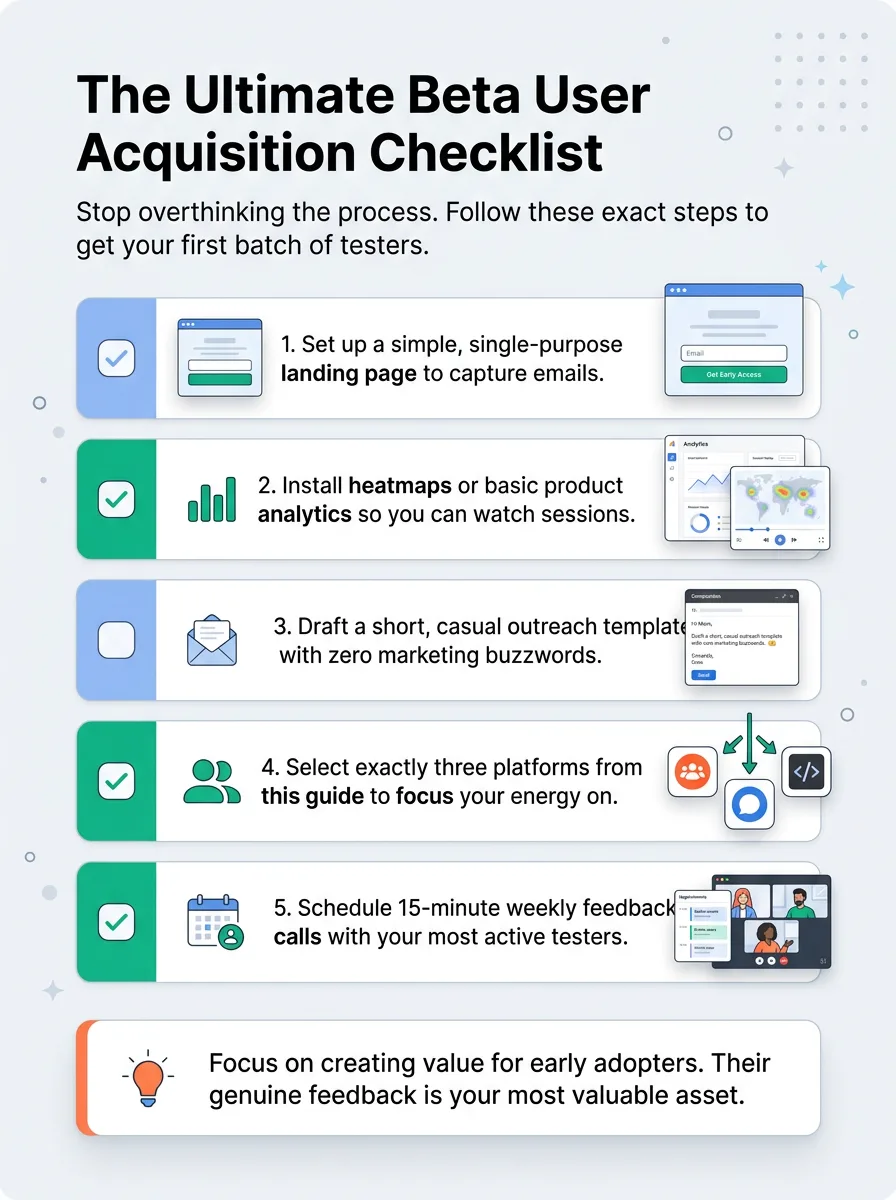
Key takeaways at a glance Install heatmaps or basic product analytics so you can watch sessions.
Draft a short, casual outreach template with zero marketing buzzwords.
Select exactly three platforms from this guide to focus your energy on.
Schedule 15-minute weekly feedback calls with your most active testers.
Frequently Asked Questions
How many beta users do I actually need?
For a B2B SaaS, 10 to 50 active users is the sweet spot. You want enough people to find weird edge-case bugs, but a small enough group that you can personally email every single one of them. For consumer apps, aim a bit higher, around 100 to 200 testers.
Should I charge for my beta?
It depends entirely on your goals. Free betas get you more volume and faster UX feedback. Paid betas, even at a massive lifetime discount, validate that your product actually solves a painful problem. If you charge from day one, you weed out the tire-kickers.
How long should a beta period last?
Usually four to eight weeks. Anything longer and you risk losing momentum. The goal is to patch the critical bugs, validate the core value proposition, and move to a public launch. Don't stay in beta forever just because you are scared to ship.
Conclusion: Turning Feedback into Growth
Figuring out how to get beta users is not a one-time event. It is a muscle you build. The founders who win are the ones who treat early users like co-creators, not just free QA testers. Take their brutal feedback, fix the friction points, and ship updates fast. Once you are ready to show your polished product to the world, submitting it to an active community makes the transition from private beta to public launch a whole lot smoother. Now close this tab and go talk to a user.
Written by

Jan Orsula
Serial maker and founder of WeekHack, SocialCal, and SocialOrbit. Builds tools that help creators launch side projects, schedule social media, and generate content — so they can focus on what matters.
Related Articles
How to Get Comments on Product Hunt: 5 Proven Launch Strategies
Most makers obsess over Product Hunt upvotes, but comments are what actually drive the ranking algorithm. Learn how to craft the perfect maker story, run feedback-first outreach, and dominate the first 4 hours of your launch.
How to Improve Your Launch Conversion Rate Step-by-Step
Struggling to turn product launch traffic into actual sales? Discover a practical, step-by-step framework to fix your messaging, remove friction, and drastically improve your conversion rates.
How to Collect User Feedback Before Launch: A Beginner's Plan
Stop guessing what your users want. Learn how to systematically collect pre-launch feedback using smoke tests, problem interviews, and lo-fi prototypes before writing a single line of code.