
The Ultimate SaaS Launch Plan Template: Get Your First 100 Users
 Jan Orsula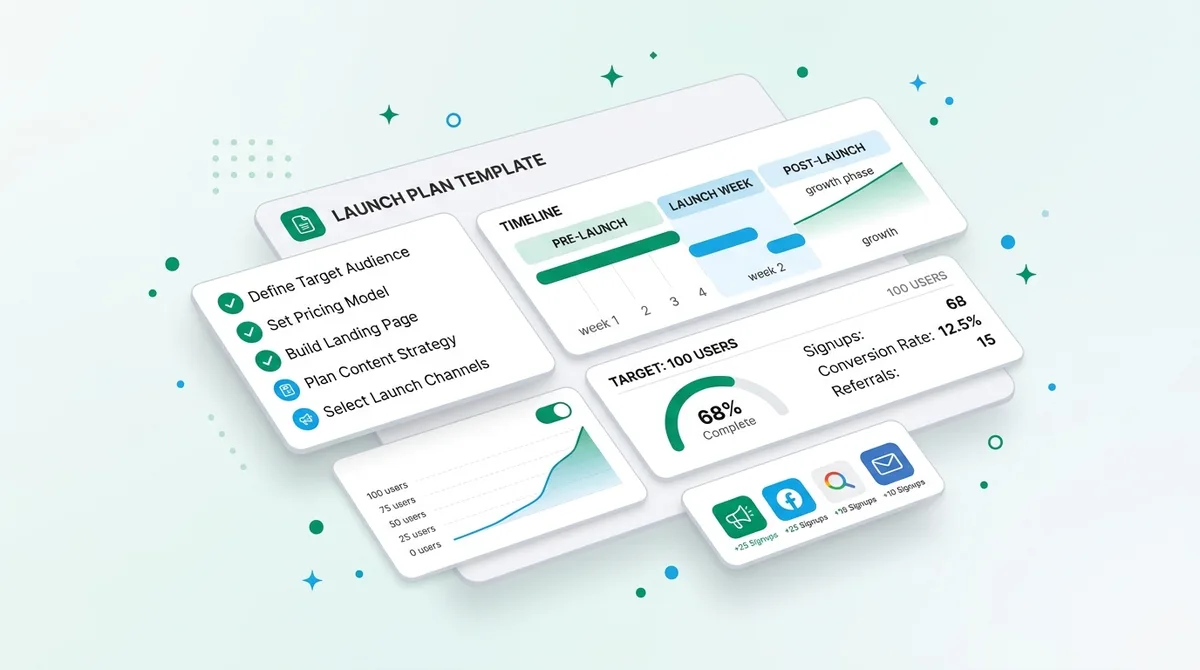
The Definitive Blueprint for Your SaaS Debut
Most SaaS products do not die because the code is bad. They die in complete silence. You push to production, tweet a link to your ten followers, and watch the Google Analytics real-time user count stay glued to zero. Sound familiar?
Getting from zero to 100 paying users is a brutal filter. It breaks most founders. You need a reliable SaaS launch plan template. Not a theoretical marketing thesis written by someone who has never shipped an app. You need a gritty, step-by-step playbook that indie hackers actually use to get traction.
I have seen decent products blow up just by nailing their distribution, and I have watched brilliant engineering marvels rot on GitHub because the founder thought marketing was beneath them. Let us map out exactly how to get those first crucial users without burning out or wasting thousands on ads.
What is a SaaS Launch Plan Template?
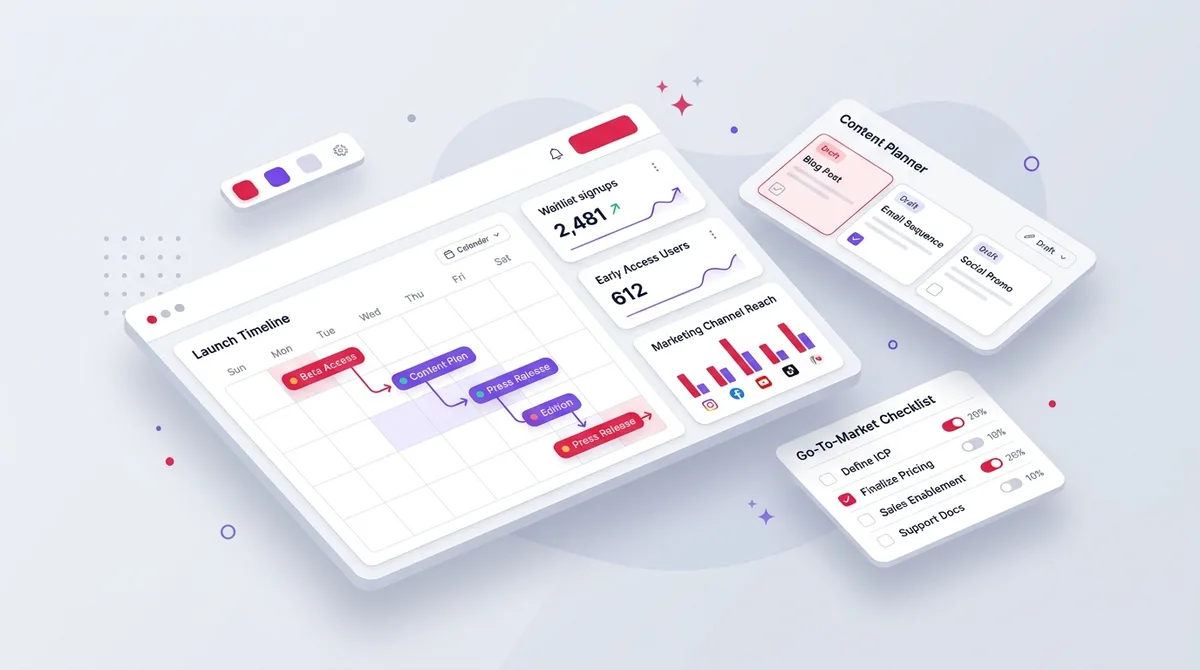
A SaaS launch plan template is a structured framework that sequences your pre-launch, distribution, and user acquisition strategies into actionable steps. It moves founders away from random marketing tactics and organizes product validation, initial manual outreach, and public platform debuts into a cohesive timeline aimed at acquiring your first 100 active users.
Why a Strategic SaaS Launch Plan Template is Your Startup's Lifeblood
"Build it and they will come" is the biggest lie in tech.
The barrier to building software has dropped to essentially zero. AI writes code. No-code tools let anyone build an interface in a weekend. This means the market is entirely saturated with "good enough" tools. Distribution is your only real moat now.
If you don't have a plan for how to push your product into the world, your startup is already a ghost. Your code doesn't matter if nobody knows it exists. A structured launch forces you to think about distribution on day one, not day one hundred.
In practice, founders who follow a rigid launch sequence secure their early feedback loops faster. They iterate quicker. They hit break-even before their server bills catch up to them.
Phase 1: The Pre-Launch Foundation (Weeks 1-4)
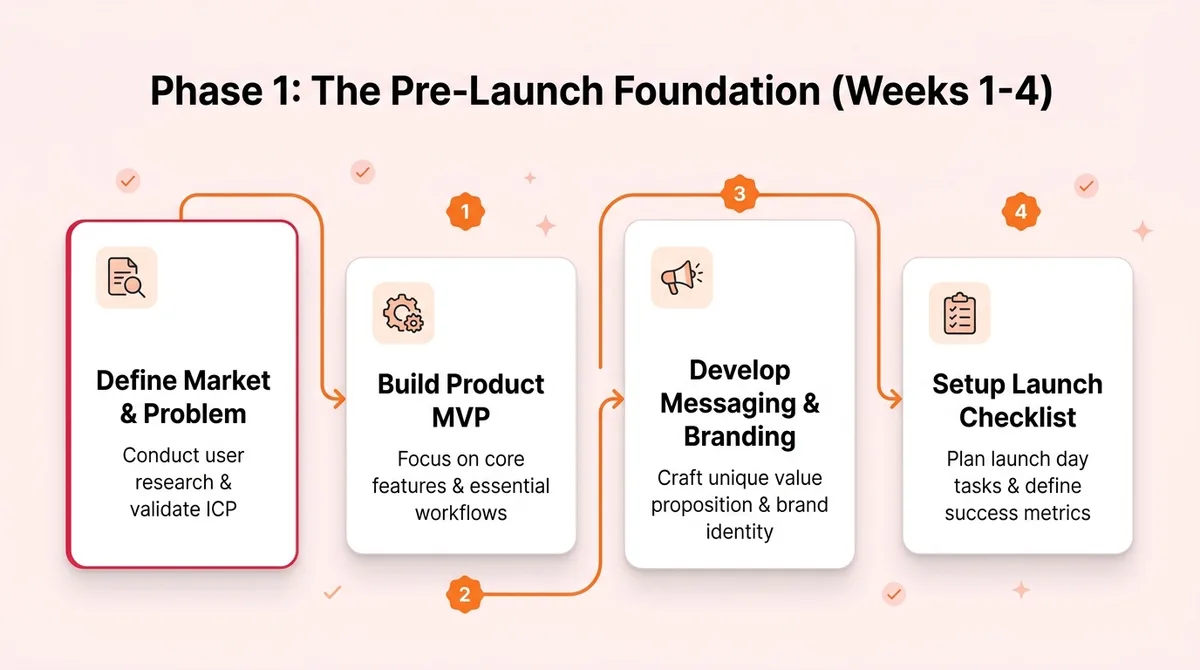
This is the invisible work. The stuff nobody claps for on social media. Do not skip this phase.
Defining Your Ideal Customer Profile (ICP) for Initial Traction
Most founders get this wrong. Ask a maker who their product is for, and they usually say something like "small businesses" or "content creators."
That is way too broad.
You cannot market to "small businesses." You have no budget for that. You need to find desperate users. Narrow your focus until it hurts. "B2B SaaS marketers who spend over $10k a month on Facebook ads and are actively complaining about attribution errors" is a real target. You can find those people.
Your MVP does not need to serve the whole market. It needs to serve a tiny fraction of the market so well that they forgive your bugs.
Crafting Your 'Irresistible' Value Proposition
Stop talking about your tech stack. Nobody cares that you used Next.js or Rust.
Early adopters buy outcomes, not features. Translate your technical features into raw benefits that resonate with that hyper-specific ICP you just defined. If your app processes data 50% faster, your value prop isn't "Lightning-fast data processing." It is "Go home at 5 PM instead of waiting for spreadsheets to load."
Write it down in a single sentence. If it takes a paragraph to explain what your app does, you are going to lose every visitor who lands on your site.
The Tech Readiness Audit: Is Your Infrastructure Scalable?
Nothing kills launch momentum like a 502 Bad Gateway error.
You finally get traffic, and your database falls over because you forgot to set up connection pooling. Run a basic audit before you invite the public in.
Set up error tracking (Sentry is standard).
Ensure your database won't lock up under a minor traffic spike.
Test your payment webhooks. Do this twice.
Check your transactional emails. Are your welcome emails actually landing in the inbox, or are they going straight to spam?
Phase 2: Building the Hype Engine
You should be collecting emails weeks before you write your last line of code.
Designing a High-Converting Landing Page
Your pre-launch landing page only needs to do one thing: capture intent. Keep it stupidly simple.
The hero section needs a bold claim (your value prop) and an email input box. Do not ask for their first name, last name, and company size. Every extra field halves your conversion rate. Just get the email.
You also need a placeholder for social proof. Even if you don't have paying users, put up a quote from a beta tester or an industry peer who has seen the prototype. Humans are pack animals. We want to know someone else thinks this is a good idea before we hand over our email address.
Building an Audience on X, LinkedIn, or Threads
Building in public is widely misunderstood.
Most founders just post screenshots of their code or complain about Vercel deployments. That builds an audience of other indie hackers. Other indie hackers are notoriously cheap and probably won't buy your B2B SaaS.
Share the problems you are solving for your actual industry. If you are building a tool for real estate agents, post about the inefficiencies in property management. Show the messy middle. Post screenshots of early UI designs and ask your target audience for their opinion. People love to correct others on the internet. Use that psychology to get product feedback and build a warm waitlist simultaneously.
Phase 3: The 'First 10 Users' Manual Method
Do things that don't scale. Paul Graham famously wrote about this years ago, and it is still the absolute truth for early software startups.
The Power of Cold Outreach and Direct Messaging
Forget automated email sequences for a minute. Your first 10 users will come from hand-to-hand combat.
Find your ICP on LinkedIn or X. Send them a direct message. Be painfully honest and brief.
"Hey [Name], I'm a developer building a tool that fixes [Specific Problem]. I noticed you work in [Industry]. Would you be open to clicking around my prototype for 5 minutes and telling me why it sucks? I'm not selling anything yet."
Notice the tone. You aren't pitching a life-changing paradigm shift. You are asking an expert for their opinion on a specific problem. People are surprisingly generous with their time if you approach them with humility and respect.
Tapping Into Niche Communities (Reddit, Slack, Discord)
Dropping a link to your landing page in a subreddit is a great way to get banned.
You have to earn the right to promote. Spend two weeks answering questions in targeted communities. Write high-effort comments. When you finally mention your product, frame it as a resource, not an advertisement.
If you don't know where to look, there are 10 proven places to find beta users for your SaaS that you can start mining today. The trick is to add value first and pitch second. Write a massive "how-to" guide native to the platform, and quietly mention that you built a tool to automate step three.
Phase 4: Scaling to 100 Users (The Multi-Channel Push)
Once you have 10 users manually, your product is somewhat validated. The core loop works. Now it is time to turn on the bigger faucets.
The Product Hunt & Hacker News Launch Strategy
A Product Hunt launch requires orchestration. You cannot just submit a link at noon on a Thursday and expect magic.
Prepare your assets meticulously. You need a sharp, energetic demo video under two minutes. You need a maker comment that tells a story—why did you build this? What personal pain led you here?
Timing is everything. Product Hunt resets at 12:01 AM PST. If you want to rank in the top three, you need to post exactly then and drive your pre-built audience to support you in those first critical hours. The algorithm heavily favors early momentum.
Hacker News is a different beast. Do not use marketing speak there. Use a "Show HN:" tag, explain the technical architecture, and be prepared for brutal, unfiltered feedback.
Directory Submission: The SEO Long Game
While you are chasing the dopamine hit of launch day spikes, you also need to plant seeds for recurring traffic.
Submitting your tool to high-authority directories provides valuable backlinks. This signals to Google that your site exists and has some baseline authority. Many founders skip this because it is tedious data entry. Do not skip it. I recently reviewed I Tested 50 Platforms: 7 SaaS Directories That Send Real Traffic, and the compounding SEO benefits from just a handful of these submissions will slowly build your baseline organic traffic months down the line.
Content Marketing: Creating Your First SEO Moat
Ads will burn through your runway fast. If you want to figure out how to launch a SaaS product without any ad spend, you must embrace content.
Find the low-hanging fruit. Look for keywords with 10-50 monthly searches that your massive competitors ignore because the volume is "too low." Write the definitive, 2000-word guide for that exact query. When someone searches for that ultra-niche problem, your tool will be the only logical answer.
Phase 5: Onboarding and Retention Mechanics
Acquisition is vanity. Retention is sanity.
Designing the 'Time to Value' (TTV) Experience
The empty state is the killer of SaaS products.
A user signs up, lands on a blank dashboard, and has no idea what to click next. They leave and never come back. You must design an onboarding flow that pushes the user to the "Aha!" moment as fast as humanly possible.
Pre-load dummy data into their account so they can see what the app looks like when it is active. Give them exactly one clear task to complete when they log in. Reduce friction ruthlessly.
The Feedback Loop: Turning Early Users into Product Co-Designers
Those first 100 users are your unofficial advisory board.
Embed a live chat widget like Crisp or set up automated check-in emails. When a user churns, personally email them. "Hey, I noticed you canceled. I'm the solo developer here. Could you tell me exactly what made you leave so I can fix it?"
You will get incredibly blunt answers. This hurts your ego, but it saves your business.
Implementation Plan: Your 8-Week Launch Calendar
Ideas are useless without a timeline. Here is exactly how to sequence this strategy.
Weeks 1-2: Internal Polish and Alpha Testing
Code freeze. Stop adding features. Spend these two weeks squashing bugs and polishing the core workflow. Give access to 3-5 close friends or peers. Tell them to try and break the app. Fix the onboarding flow based on where they get confused.
Weeks 3-4: The Beta Invite Period
Start letting people in from your waitlist in batches of 10. Monitor your server load. Watch the error logs in Sentry. This gated rollout prevents a catastrophic public failure. Start teasing the upcoming public launch on your social channels.
Weeks 5-8: Public Launch and Aggressive Outreach
Push the button. Launch on Product Hunt, Hacker News, and every relevant community you have been warming up. Execute your directory submissions. Send personalized cold emails daily. For an entire month, you are no longer a developer. You are a full-time distributor.
5 Common SaaS Launch Mistakes to Avoid
I have seen hundreds of launches. The failures usually follow the same predictable patterns.
Over-engineering the MVP: Spending six months building a robust permissions system for an app that doesn't have a single paying user. Ship the core feature. Hardcode the rest.
Ignoring Analytics: Launching without PostHog or GA4 installed. You get 2,000 visitors, zero conversions, and you have absolutely no idea where they dropped off. Blindness is deadly.
Pricing Too Low: Charging $3/month because you lack confidence. You cannot build a sustainable business on $3 subscriptions unless you have massive consumer scale. Start at $15 or $29. You can always lower it later.
The "One and Done" Launch Mentality: Treating launch day as the finish line. A launch is just the starting gun. If day two is quiet, you have a massive problem.
Building in a Vacuum: Hiding your app until it is "perfect." Perfect never comes. If you aren't embarrassed by your first release, you launched too late.
The Ultimate SaaS Launch Plan Template Tech Stack
You don't need 50 tools. You need a few reliable ones that don't drain your wallet.
Project Management: Organizing Your Launch with WeekHack
Look, you do not need Jira. Jira is where startup dreams go to die in an avalanche of story points and sub-tasks.
I track my sprint tasks and launch milestones using WeekHack. It is designed for indie hackers who work in fast, weekly cycles. Plus, pushing weekly updates on WeekHack builds a public habit of shipping. The community voting feature actually gets you eyeballs from other active builders who might become your early adopters or integration partners.
Analytics and Growth Tools: PostHog, Mixpanel, or GA4?
Skip Google Analytics 4 for SaaS. It is built for e-commerce and media sites. Go with PostHog.
PostHog gives you session replays right out of the box. Watching a video of a real user clicking wildly around your dashboard because they can't find the "Save" button is the most humbling, actionable data you will ever get.
Customer Support and Engagement: Building Relationships
Don't buy expensive Zendesk licenses. Drop a free Crisp chat widget on your site. When you are just starting, being able to reply to a user's question via an app on your phone while you are out getting coffee is a massive competitive advantage. Big companies cannot offer that level of personalized speed.
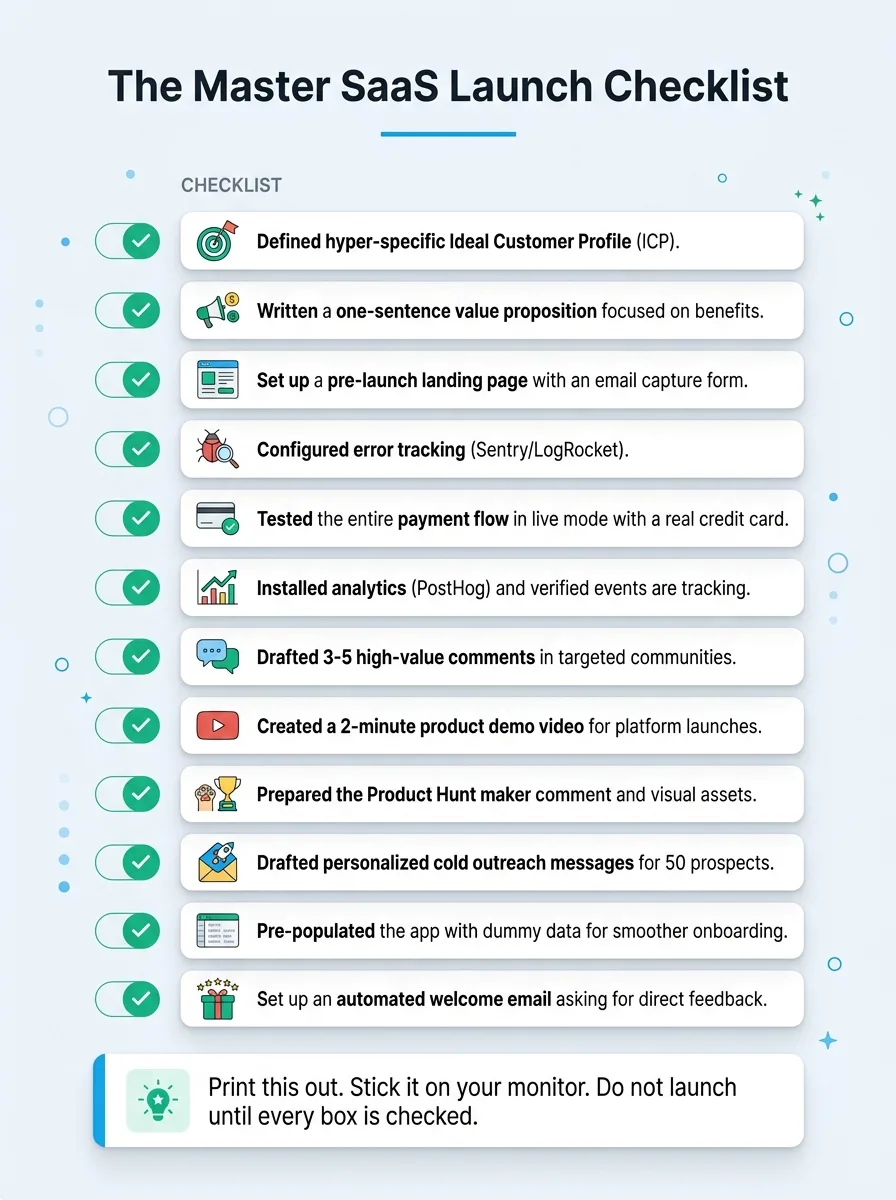
The Master SaaS Launch Checklist
Print this out. Stick it on your monitor. Do not launch until every box is checked.
Defined hyper-specific Ideal Customer Profile (ICP).
Written a one-sentence value proposition focused on benefits.
Set up a pre-launch landing page with an email capture form.
Configured error tracking (Sentry/LogRocket).
Tested the entire payment flow in live mode with a real credit card.
Installed analytics (PostHog) and verified events are tracking.
Drafted 3-5 high-value comments in targeted communities.
Created a 2-minute product demo video for platform launches.
Prepared the Product Hunt maker comment and visual assets.
Drafted personalized cold outreach messages for 50 prospects.
Pre-populated the app with dummy data for smoother onboarding.
Set up an automated welcome email asking for direct feedback.
SaaS Launch FAQ
How much does a typical SaaS launch cost?
You can launch a SaaS for under $100. Your main costs will be domain registration, basic hosting (Vercel/Heroku), and maybe a database tier upgrade. Marketing should cost zero dollars initially. Rely on manual outreach, community engagement, and platforms like WeekHack and Product Hunt.
When is the best time of week to launch on Product Hunt?
Tuesdays and Wednesdays typically have the highest traffic, meaning more potential users, but also the fiercest competition from venture-backed companies. If you are a solo indie hacker looking to secure a "Top Product of the Day" badge for social proof, launching on a Saturday or Sunday offers lower traffic but significantly less competition.
Should I offer a lifetime deal (LTD) for my first 100 users?
LTDs are a double-edged sword. They inject immediate cash flow and guarantee early feedback, which is fantastic for morale. However, supporting those users forever with no recurring revenue can become a nightmare as server costs scale. If you do an LTD, cap it strictly at 50 or 100 seats to create urgency without destroying your future business model.
From Launch Day to Growth Mode
Getting your first 100 users is a massive milestone. Take a breath and celebrate. Most people never even ship the code.
But the work changes now. The manual tactics that got you to 100 users will break when you try to reach 1,000. You will transition from hand-to-hand combat to building systemic growth channels like SEO, partnerships, and automated funnels.
Keep your momentum alive. Document your journey on WeekHack to hold yourself accountable to weekly shipping goals. The indie hacker community is watching. Your launch plan template worked. Now go execute.
Written by

Jan Orsula
Serial maker and founder of WeekHack, SocialCal, and SocialOrbit. Builds tools that help creators launch side projects, schedule social media, and generate content — so they can focus on what matters.
Related Articles
How to Get Comments on Product Hunt: 5 Proven Launch Strategies
Most makers obsess over Product Hunt upvotes, but comments are what actually drive the ranking algorithm. Learn how to craft the perfect maker story, run feedback-first outreach, and dominate the first 4 hours of your launch.
How to Plan a Startup Launch That Gains Real Traction
Learn how to plan a startup launch that actually gets traction. From finding your early users to engineering a launch day spike, here is the exact playbook indie hackers use.
How to Launch an AI Tool and Rank #1 on Product Hunt
Learn exactly how to launch an AI tool on Product Hunt and claim the top spot. This practical guide covers pre-launch community building, high-converting asset optimization, and a 24-hour tactical sprint.