
I Tested 50 Platforms: 7 SaaS Directories That Send Real Traffic
 Jan Orsula
Best SaaS Directories in 2024: The Quick Answer
Stop wasting your weekend submitting to 100 dead websites. If you are looking for SaaS directories that send real traffic, focus your energy on three main players. Use Product Hunt for massive single-day launch spikes, G2 to capture high-intent B2B leads actively comparing tools, and WeekHack to get your product in front of an engaged community of indie founders and early adopters.
Why Most Are Ghost Towns (And How to Find SaaS Directories That Send Real Traffic)
I spent an entire weekend doing the grunt work for my last micro-SaaS. You know the drill. Copying and pasting taglines, resizing logos to exactly 400x400 pixels, clicking confirmation links in my email. I submitted my app to 50 different startup directories.
Guess how many actually sent users who created an account?
Seven.
Most directories are built for one reason: to sell you a "featured" spot that no actual human will ever click. They are ghost towns populated entirely by other founders submitting their apps. They boast about high Domain Rating (DR) to trick you into thinking a backlink will magically rank your site. In practice, a nofollow link on page 400 of a dead site does absolutely nothing for your SEO or your user base.
The only directories worth your time have built-in distribution. They have an active email list, a thriving community forum, or absolute dominance in Google search results for specific software categories. Those are the only SaaS directories that send real traffic.
Comparison Table: Traffic, Difficulty, and ROI
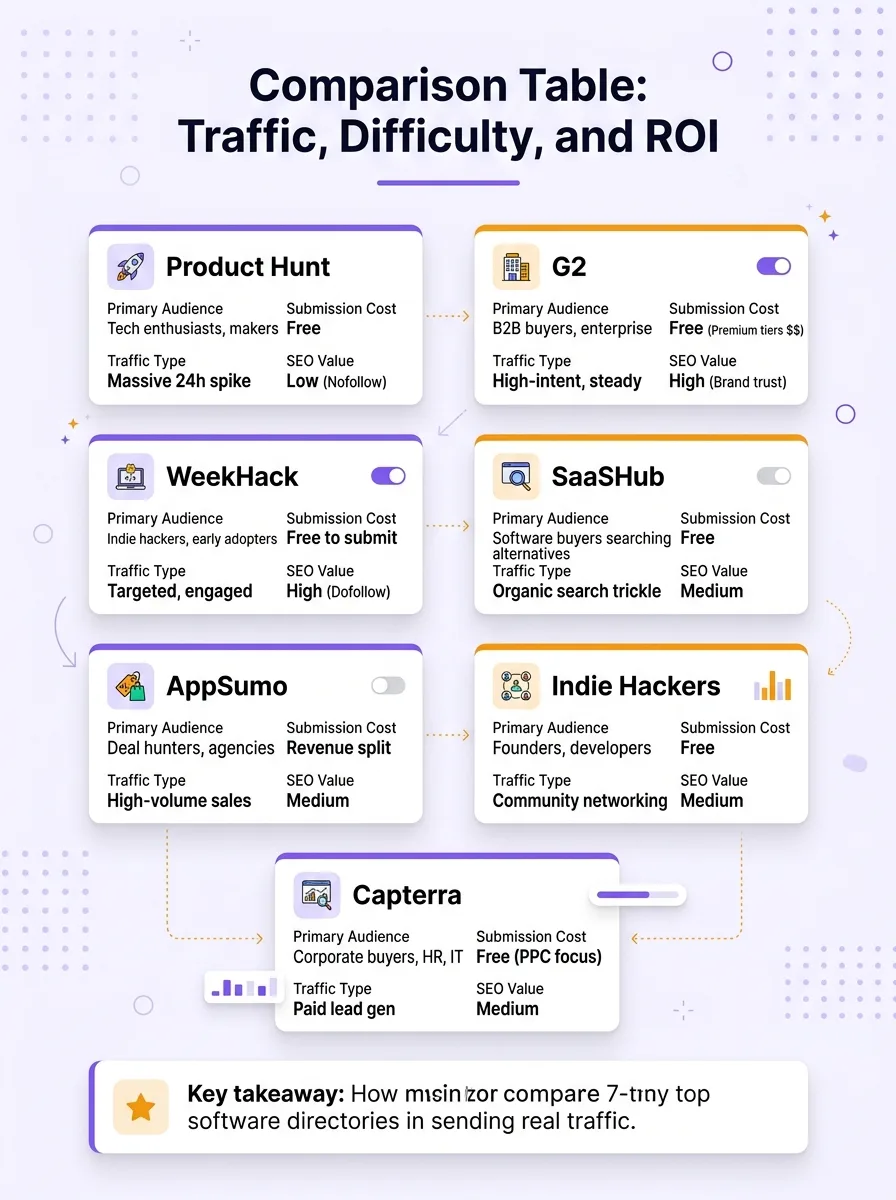
Here is how the top seven stack up when you look at the raw data.
Directory | Primary Audience | Submission Cost | Traffic Type | SEO Value |
|---|---|---|---|---|
Product Hunt | Tech enthusiasts, makers | Free | Massive 24h spike | Low (Nofollow) |
G2 | B2B buyers, enterprise | Free (Premium tiers $$) | High-intent, steady | High (Brand trust) |
WeekHack | Indie hackers, early adopters | Free to submit | Targeted, engaged | High (Dofollow) |
SaaSHub | Software buyers searching alternatives | Free | Organic search trickle | Medium |
AppSumo | Deal hunters, agencies | Revenue split | High-volume sales | Medium |
Indie Hackers | Founders, developers | Free | Community networking | Medium |
Capterra | Corporate buyers, HR, IT | Free (PPC focus) | Paid lead gen | Medium |
1. Product Hunt: The Gold Standard for Launch Traffic
Everyone knows Product Hunt. It is still the undisputed king of launch day visibility. If you build software, this is your rite of passage.
A top-five finish on Product Hunt can easily send 1,000 to 5,000 unique visitors to your landing page in 24 hours. I've seen decent products blow up overnight just because the right hunter posted them at the right time. But the traffic is notoriously top-of-funnel. These are people who like looking at new tools, not necessarily people with out-of-control pain points trying to buy a solution right now. Figuring out how to turn launch traffic into paying users - step by step is entirely on you.
Product Hunt: Pros, Cons, and Pricing
Pros: Unmatched potential for a massive single-day traffic spike. High visibility to tech journalists and investors.
Cons: Highly competitive. If you launch on a day when a massive company drops a huge update, you get buried immediately. The links are nofollow.
Pricing: 100% free to launch.
2. G2: High-Intent Buyer Traffic for B2B SaaS
G2 is a different beast entirely. You do not launch on G2. You build a presence there over months.
If you search "best CRM software" or "alternatives to Slack," G2 is almost always sitting in the top three results on Google. According to Gartner's research on B2B buying, the vast majority of enterprise buyers read peer reviews before ever speaking to sales. G2 captures that exact search intent. People browsing G2 have their corporate credit cards out. They know what problem they have. They are just trying to decide who to pay.
G2: Pros, Cons, and Pricing
Pros: Traffic converts at a massive rate. Having a "High Performer" badge on your site legitimately increases conversion trust.
Cons: Getting initial reviews is brutal. They verify users via LinkedIn or business email, which creates friction. Your competitors are likely already entrenched.
Pricing: Free to list your product and collect reviews. To access buyer intent data or add custom calls-to-action, you are looking at enterprise-level annual contracts.
3. WeekHack: Targeted Exposure for Indie Products
Full disclosure, you are reading the WeekHack blog. But I am putting us on this list because the model is built specifically to fix the "ghost town" problem most founders face.
WeekHack focuses entirely on the indie maker and micro-SaaS ecosystem. Instead of letting products rot on a page nobody visits, the platform ties listings directly to a weekly newsletter and community voting system. You are getting your tool in front of actual builders who understand early-stage products and are willing to give constructive feedback. Plus, the platform provides guaranteed dofollow backlinks, which gives you actual SEO momentum while you hunt for your first users.
WeekHack: Pros, Cons, and Pricing
Pros: Highly targeted audience of early adopters. Clean dofollow backlinks for domain authority. Zero noise from massive VC-backed enterprise launches.
Cons: Lower raw traffic volume compared to a massive Product Hunt launch. The audience is mostly other founders.
Pricing: Free to submit, with clear, transparent pricing for featured newsletter placements.
4. SaaSHub: The 'Alternative To' SEO Powerhouse
SaaSHub is quietly brilliant. They built an entire directory around organic search patterns.
Their pages rank incredibly well for "[Competitor] alternatives." If you are building a smaller, cheaper alternative to a massive incumbent like Mailchimp or Notion, SaaSHub automatically generates comparison pages pitting you against them. Over time, this creates a slow but steady trickle of users who are actively trying to leave your biggest competitor. That is pure gold for a bootstrapped founder.
SaaSHub: Pros, Cons, and Pricing
Pros: Excellent for long-tail SEO. Automatically associates your product with major players in your niche.
Cons: You won't see a launch day spike. It requires patience. The free tier requires you to place a SaaSHub badge on your website.
Pricing: Free basic submission. Paid tiers remove the badge requirement and boost your ranking on their internal category pages.
5. AppSumo: High-Volume Transactional Traffic
Most people think of AppSumo strictly as a lifetime deal marketplace. That is true, but it is also one of the most effective SaaS directories that send real traffic if you treat it as a marketing channel rather than a revenue channel.
When you run a campaign on AppSumo, they blast your product out to millions of deal-hungry buyers. You can literally acquire 5,000 paying users in two weeks. The catch? They are paying a one-time fee, and you are splitting that money with AppSumo. It is an intense stress test for your servers and your support inbox.
AppSumo: Pros, Cons, and Pricing
Pros: Massive influx of cash and users. Incredible source of early feedback and bug reports. Great way to validate product-market fit.
Cons: Lifetime deal users are notoriously demanding. You sacrifice recurring revenue.
Pricing: No upfront cost. You split the revenue generated from the deals, typically giving AppSumo a significant percentage.
6. Indie Hackers: Community-Driven Awareness
Indie Hackers isn't just a forum. Their Products section acts as an ongoing directory intertwined with founder milestones.
You list your product, but you also attach revenue updates, server milestones, and personal struggles directly to the listing. People don't just find your software. They follow your journey. If you want to figure out how to launch a SaaS product without any ad spend, this is exactly where you start. The traffic here is slower, but the quality of feedback is unmatched.
Indie Hackers: Pros, Cons, and Pricing
Pros: Amazing for networking. Users will often point out UX flaws and pricing issues constructively before you launch to the wider public.
Cons: B2B buyers don't hang out here. You are pitching to other software developers, who are famously reluctant to pay for things they think they can build in a weekend.
Pricing: Completely free.
7. Capterra: The PPC and Reviews Giant
Capterra is owned by Gartner, and they dominate search alongside G2. But Capterra leans heavily into a Pay-Per-Click (PPC) model for visibility.
If you have a marketing budget, Capterra allows you to bid for placement at the top of category pages. It operates very similarly to Google Ads. A user searches for "HR management software," clicks your sponsored listing on Capterra, and you pay for that lead. The free listing exists, but without reviews or ad spend, you will be buried on page twelve.
Capterra: Pros, Cons, and Pricing
Pros: Predictable, scalable lead generation if you have your customer acquisition cost dialed in. Excellent international reach.
Cons: Very expensive for highly competitive niches. The free listing drives almost zero traffic.
Pricing: Free basic listing. PPC campaigns vary wildly by category, often costing several dollars per click.
Best For Recommendations: Matching Your Goal to the Right Site
Stop trying to be everywhere. Pick the platform that actually aligns with the stage of your company right now.
Best for Bootstrapped Founders: WeekHack and SaaSHub. Focus on targeted communities and long-tail SEO alternatives.
Best for Your Big Launch Day: Product Hunt. Prepare your team for an exhausting 24 hours.
Best for Funded B2B Startups: G2 and Capterra. Use your capital to aggressively acquire reviews and buy premium placement.
Best for Immediate Cash Injection: AppSumo. Just be ready to handle the support tickets.
How to Choose: The 4-Step SaaS Submission Framework
Before you fill out another submission form, run the site through this quick checklist.
Check the active distribution. Do they have a newsletter? A lively Twitter account? If they only rely on passive search traffic, skip them.
Look at the link type. Use a browser extension to see if outbound links are dofollow or nofollow. If a directory has zero traffic and gives a nofollow link, it is literally useless.
Search your competitors. Type your biggest competitor's name plus "reviews" or "alternatives" into Google. Whatever directories show up on page one are the ones you need to be on.
Optimize before hitting submit. Don't just paste your homepage copy. Take time to learn 5 ways to optimize a SaaS directory listing for clicks so you actually capture the attention of browsers.
Frequently Asked Questions About SaaS Directories
Do SaaS directories actually help with SEO?
Yes, but only a select few. Directories that offer dofollow links pass domain authority to your site. Even directories with nofollow links can help by generating brand mentions and diversifying your backlink profile, but you shouldn't rely on them as your entire SEO strategy.
Should I pay someone on Fiverr to submit my app to 100 directories?
Absolutely not. Bulk submission services usually blast your link to spammy, low-quality sites. Google's algorithm is smart enough to ignore these links, and in some cases, a massive influx of spammy backlinks can actually trigger a penalty.
How often should I launch my product on directories?
Most directories have strict rules about this. Product Hunt usually requires a massive feature update (often dubbed a 2.0 launch) and a six-month waiting period before you can post the same product again. Always check the platform guidelines before re-submitting.
Final Verdict: Which Directories Actually Move the Needle?
There is no silver bullet in SaaS marketing. Getting your first hundred users requires grinding.
But there is absolutely no reason to waste hours submitting to platforms that died in 2018. The truth about SaaS directories that send real traffic is simple. Focus on the big players. Put a thoughtful, well-designed launch together for Product Hunt. Nurture your B2B profile on G2. And tap into the active maker community on WeekHack. Spend the rest of your time talking to actual customers and building a product they want to pay for.
Written by

Jan Orsula
Serial maker and founder of WeekHack, SocialCal, and SocialOrbit. Builds tools that help creators launch side projects, schedule social media, and generate content — so they can focus on what matters.
Related Articles
Do Backlinks From Directories Still Help SEO?
Wondering if directory submissions still work? High-quality, niche directories build essential brand signals, but automated link farms can actually harm your site. Here is how founders should handle directory backlinks today.
How to Turn Launch Traffic Into Paying Users - Step by Step
A huge traffic spike means nothing if your visitors immediately bounce. Learn how to fix your leaky funnel, capture intent, and convert launch day traffic into paying users.
How the Instagram Algorithm Works - Your 2026 Action Plan
In 2026, understanding the Instagram algorithm isn’t optional—it’s the difference between growth and invisibility. You’ve probably noticed it: some creators see