
How to Relaunch a SaaS After Failure: Step-by-Step
 Jan Orsula
The Silent Launch: Why Most SaaS Relaunches Fail Before They Begin
You spent three months coding in a dark room. You wired up the database, perfected the landing page copy, and hit deploy. You posted your grand announcement on Twitter and sat back, waiting for the Stripe notifications to roll in.
Crickets.
Maybe you got a dozen pity upvotes from friends. Maybe one person signed up for a free trial and never logged back in. It happens to almost every founder. The first launch is often a spectacular dud. But figuring out how to relaunch a SaaS after no success is what separates serial makers from one-hit quitters. A second chance requires an actual strategy. Sending another tweet won't save you.
Most founders get this entirely wrong. They think a relaunch just means submitting to a new directory or adding a dark mode toggle. They refuse to address the underlying rot. If you want to actually gain traction this time around, you have to treat your failed version as a very expensive, painful prototype.
What Does It Mean to Relaunch a SaaS After No Success?
Relaunching a SaaS is a strategic pivot that involves aggressively pruning dead features, re-validating the core market problem, and executing a fresh, sustainable distribution plan. It is not a rebrand or a cosmetic update. A true relaunch requires tearing down the assumptions that led to your initial failure and building a new growth engine based on real user data.
Step 1: Conduct a Brutal Post-Mortem of Your First Failure
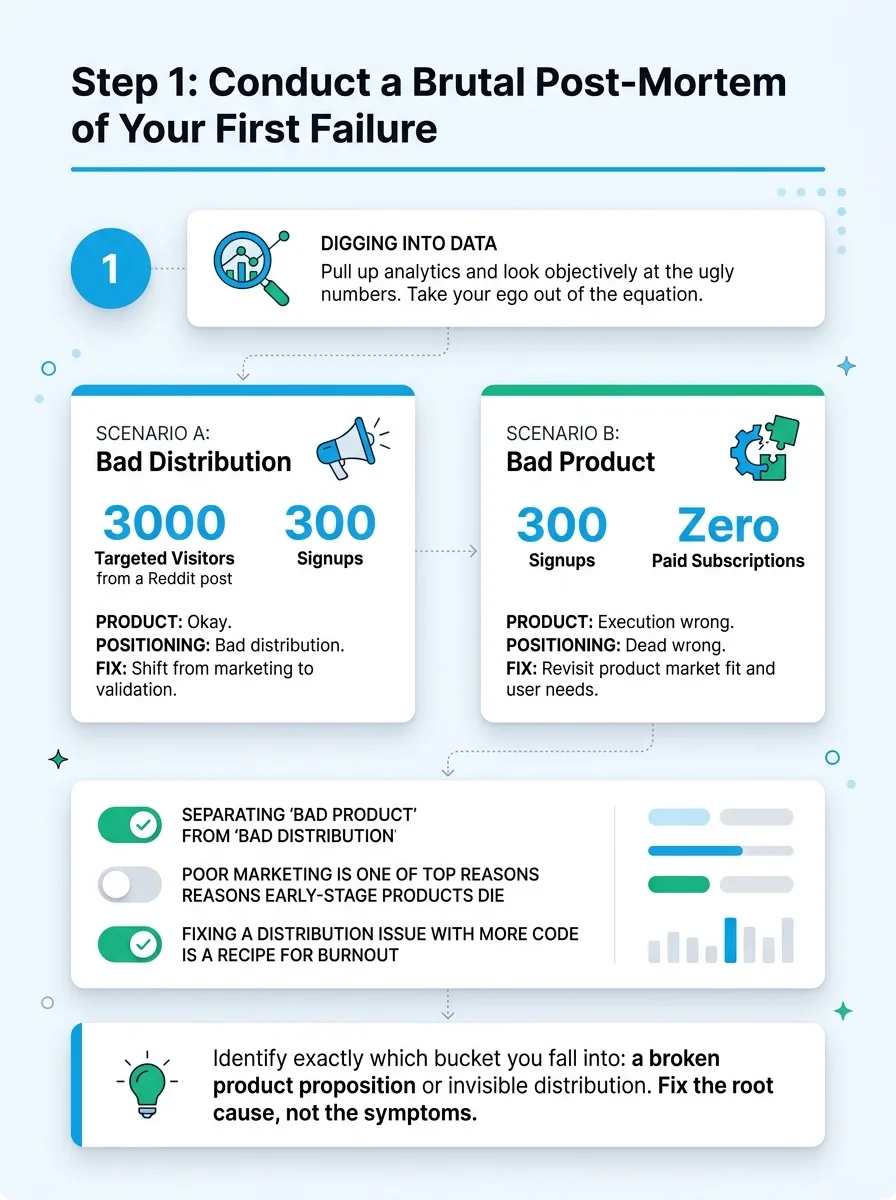
Before writing another line of code, you need to figure out what actually went wrong. It is incredibly easy to take a failed launch personally and assume your coding skills are terrible. Take your ego out of the equation. Look at the data objectively.
You have to pull up your analytics and stare the ugly numbers in the face. Did people land on your site and bounce within five seconds? Did they create an account, poke around the dashboard, and immediately close the tab? These two scenarios point to completely different existential crises.
Separating 'Bad Product' from 'Bad Distribution'
Usually, a flatlined launch comes down to either a broken product proposition or invisible distribution. You need to know which disease you are curing.
Imagine you built a phenomenal tool for automating freelance tax invoices. The UX is butter. It works perfectly. But if your entire marketing strategy consisted of a single post to your 400 LinkedIn connections, you do not have a product problem. You have a distribution problem. According to a Failory startup report, poor marketing is one of the top reasons early-stage products die.
On the flip side, what if you managed to drive 3,000 targeted visitors to your landing page from a viral Reddit post? Three hundred of them signed up, but exactly zero paid for a premium subscription. Your distribution is completely fine. Your product positioning is dead wrong. People liked the idea, but the execution wasn't worth their money.
Identify exactly which bucket you fall into. Fixing a distribution issue with more code is a recipe for burnout.
Step 2: Re-Validate Your Core Value Proposition with Real Data
You cannot guess your way out of a failed launch. The days of trusting your gut are over. You need to go back to the market and talk to humans.
Does the problem you are trying to solve actually exist in the real world? Is it painful enough that someone will pull out a credit card to make it go away? Often, makers build solutions for minor annoyances rather than bleeding neck problems.
Interrogating the 'Churned' and the 'Never-Boughts'
Your absolute best source of truth is the group of people who almost used your product but ultimately walked away. Find the users who churned after day one. Email them directly.
Do not send an automated corporate survey. Send a plain-text email from your personal address. Say something like, "Hey, I noticed you signed up but didn't stick around. I'm the solo developer behind this. Was the app too confusing, or did it just not solve your specific problem?" You will be shocked by how many people reply to raw honesty.
If you didn't get any signups the first time around, you have to do things manually. You need to find beta users for your SaaS in highly specific, niche communities. Get them on a quick call and literally watch them try to navigate your software while sharing their screen. As Paul Graham famously wrote in his essay Do Things That Don't Scale, founders need to recruit users manually and give them an insanely attentive onboarding experience. Listen to where they click, where they hesitate, and where they complain. That friction is your new roadmap.
Step 3: Aggressively Prune Features to Find the 'Minimum Lovable Product'
Founders love building features. Writing code feels like making progress. But here is the harsh reality: complex software scares away new users.
If your first launch failed, your app is almost certainly doing too much. You need to simplify the UI and ruthlessly rip out the noise. Delete the fluff. Find the single feature that actually provides immediate value and make it the absolute center of your application.
Sunk cost fallacy will kick in here. You will hate deleting code you spent three weeks writing. Delete it anyway.
The 80/20 Rule of SaaS Functionality
I once watched an indie hacker build a massive, all-in-one CRM tailored for real estate agents. It had email open tracking, automated property listings, a calendar sync tool, and an AI-powered copywriter. Nobody bought it. The dashboard looked like the cockpit of a commercial jet.
He finally dug into his database and noticed a strange pattern. The three active users he did have were completely ignoring the CRM features. They were only logging in to use the AI copywriter to generate property descriptions. He deleted 80% of the codebase, rebranded the app as a dead-simple property description generator, and hit $5k MRR in two months.
Cut the fat. Make your core value painfully obvious.
Step 4: Architect a Multi-Channel Distribution Engine
The "launch day" mindset is a massive trap. You submit your app to a directory, get a nice little spike in traffic, feel like a genius for 24 hours, and then watch the analytics flatline back to zero by Tuesday.
If you genuinely want to know how to relaunch a SaaS after no success, you have to accept that sustained growth requires a durable engine, not a one-off event. You need channels that consistently bring in targeted traffic while you sleep.
Scaling with Programmatic SEO and Cold Outreach
Instead of relying on a single viral moment on social media, start building reliable systems. A programmatic SEO strategy can capture hundreds of highly specific, long-tail keyword searches over a period of months. It takes time, but the compound interest is real.
Combine that inbound strategy with highly targeted cold email outreach. If you don't have a massive marketing budget, learning how to launch a SaaS product without any ad spend using organic content and personalized cold DMs is mandatory. This creates a baseline of daily visitors. Future relaunch events just become the cherry on top of an already functioning machine.
4 Common Pitfalls to Avoid When Relaunching Your Startup
A second attempt isn't magically immune to the mistakes of the first. Here is what usually trips makers up the second time around.
Ignoring the actual feedback you gathered. Don't ask users why they left and then just build whatever you originally wanted to build anyway. It completely defeats the purpose of the post-mortem.
Failing to change the positioning. If you sell a generic "productivity tool," you are competing with Notion and a billion other VC-funded giants. If you sell a "keyboard-first focus timer for ADHD programmers," you suddenly have a monopoly. Change the angle.
Pretending the first launch didn't happen. Be transparent with your audience. People inherently root for a comeback story. Tell Twitter you failed, explain exactly what you learned, and show them how the new version fixes those mistakes.
Obsessing over the domain name. Your URL didn't cause the failure. Spending a week debating whether to switch from a .co to a .com will not fix a broken conversion rate.
The 'Just One More Feature' Trap
This is the deadliest pitfall of them all. You convince yourself that users will finally pull out their wallets once you add a Zapier integration. Then it becomes a Slack bot. Then it's a mobile app.
More code rarely fixes a fundamental marketing or positioning problem. Stop building and start actively selling what you already have.
The SaaS Relaunch Readiness Checklist
Before you hit the launch button again, run through this final sanity check. Don't skip items just because you're eager to get it over with.
Have I clearly identified why the first launch failed using actual analytics or user feedback?
Did I speak to at least 10 real people in my target market about the new positioning?
Is the core value proposition immediately obvious above the fold on the landing page?
Have I aggressively removed all non-essential features that confuse new users?
Is the onboarding process seamless and free of unnecessary friction?
Do I have an active distribution channel planned beyond just the 24-hour launch window?
Am I clear on the rules for the platforms I'm using? For instance, understanding if you can relaunch on Product Hunt without violating their duplicate submission guidelines.
Is my analytics setup tracking exactly where users drop off in the funnel?
Frequently Asked Questions About SaaS Relaunches
Should I change my product's name when relaunching?
Only if the original name carries severe negative baggage, or if it no longer makes sense for the pivoted version of your tool. Otherwise, keep the original domain and lean into the comeback narrative. A new logo won't bring you customers.
How long should I wait before relaunching?
There is no strict timeline, but you need enough time to meaningfully alter the product or the distribution strategy. Relaunching three days later with a different H1 tag isn't a relaunch. It's just a website update.
Do I need to offer a massive discount to get people back?
No. Discounting a product that nobody wanted at full price rarely solves the underlying demand issue. Focus on proving the value first. If the product solves a real pain point, users will pay full price.
Conclusion: Turning Past Failures Into Future Growth
Figuring out how to relaunch a SaaS after no success simply comes down to swallowing your pride and letting the data lead the way. Your first version wasn't a waste of time; it was just the brutal cost of figuring out what the market actually wants.
Strip away the bloat, talk to real humans, and build a distribution engine that outlasts the launch day hype. Keep iterating based on reality. And when you are ready to share your revamped product with a community of makers, dropping it on WeekHack is an excellent way to get guaranteed eyes and honest feedback from founders who have been exactly where you are.
Written by

Jan Orsula
Serial maker and founder of WeekHack, SocialCal, and SocialOrbit. Builds tools that help creators launch side projects, schedule social media, and generate content — so they can focus on what matters.
Related Articles
How to Get Comments on Product Hunt: 5 Proven Launch Strategies
Most makers obsess over Product Hunt upvotes, but comments are what actually drive the ranking algorithm. Learn how to craft the perfect maker story, run feedback-first outreach, and dominate the first 4 hours of your launch.
How to Improve Your Launch Conversion Rate Step-by-Step
Struggling to turn product launch traffic into actual sales? Discover a practical, step-by-step framework to fix your messaging, remove friction, and drastically improve your conversion rates.
How to Collect User Feedback Before Launch: A Beginner's Plan
Stop guessing what your users want. Learn how to systematically collect pre-launch feedback using smoke tests, problem interviews, and lo-fi prototypes before writing a single line of code.