
How to Collect User Feedback Before Launch: A Beginner's Plan
 Jan Orsula
Stop Guessing: Why Pre-Launch Feedback is Your Best Insurance Policy
You have an idea. You sit down at your desk and start coding. Six months later, you push the repository to production, announce it on Twitter, and wait for the stripe notifications to roll in. Crickets. Sound familiar? Most founders make this exact mistake. They lock themselves in a dark room building out massive feature sets, terrified of showing anyone an unfinished product.
I get the hesitation. There is a deep, irrational fear that someone will steal your idea if you talk about it too early. Or maybe you are just embarrassed by how ugly your version-one interface looks. Look, the reality is much harsher. Nobody cares enough to steal your idea yet. Your biggest risk is not theft. Your biggest risk is building something nobody actually wants to buy.
Figuring out how to collect user feedback before launch is your best insurance policy against building a ghost town. When you test concepts early, you stop relying on gut feelings and start operating on actual data. The good news is that validating an idea does not require a finished product, a massive budget, or a marketing team. It just requires a systematic approach to talking to strangers.
How to Collect User Feedback Before Launch
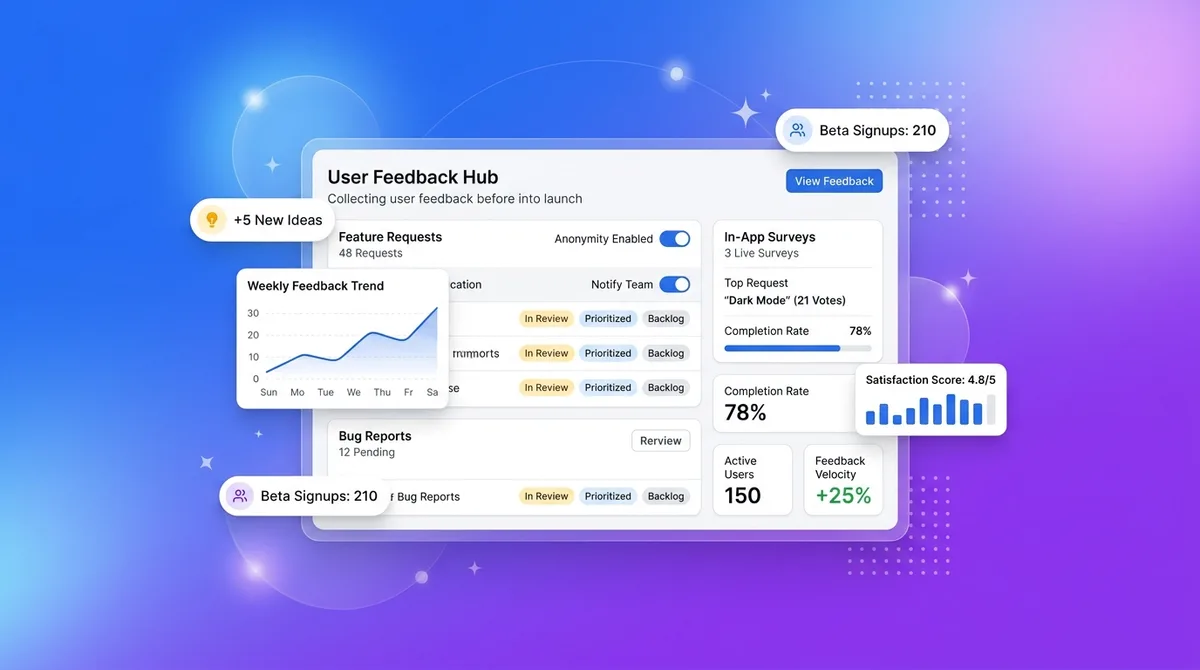
Collecting user feedback before launch is a systematic process of gathering qualitative and quantitative data from potential users to validate product-market fit before writing final code. Founders achieve this by setting up smoke test landing pages, conducting problem-focused interviews, and running usability sessions with low-fidelity prototypes. This approach prevents wasted development time by ensuring the core problem actually exists and users are willing to solve it.
Phase 1: The 'Smoke Test' Landing Page
Writing code is expensive. Writing copy is cheap. That is why your first move shouldn't be spinning up a new Next.js project. Instead, throw up a simple one-page site to see if people even care about the problem you are trying to solve.
A smoke test landing page exists for one reason. You want to see if your core value proposition resonates enough to make someone hand over their email address. If they will not give you a free email address today, they certainly will not give you thirty dollars a month tomorrow.
Designing the 'Coming Soon' Page for Conversion
Skip the massive feature lists. Your page needs three things: a clear headline that names the pain point, a specific promise, and a way to capture emails. Most makers try to sound too clever here. Being clear is always better than being clever.
Imagine you are building a tool that helps YouTube creators split royalty payments. Your headline should not be 'AI-Powered Revenue Optimization Protocol.' It should be 'Stop fighting over YouTube revenue splits.' That instantly tells the reader what pain you cure. Follow that up with a short subheadline and a waitlist opt-in box. Keep the design minimal so the focus remains entirely on your value proposition.
Using 'Fake Door' Tests to Measure Intent
People lie on surveys all the time. Behavior rarely lies. If you want the most honest form of feedback, watch what people click. A fake door test involves adding a button or a pricing tier for a feature that does not exist yet.
Put a 'Buy Early Access for $29' button on your waitlist page. When a user clicks it, show a polite modal explaining that the payment gateway isn't quite ready, but their interest guarantees them a discount when the product goes live. Measuring how many people attempt to pull out their credit card provides an incredibly strong signal of purchase intent.
Phase 2: Targeted 1-on-1 Problem Interviews
Getting a hundred emails on a waitlist feels great. Now you need to talk to the humans behind those addresses. Passive data collection stops here. At this stage, ten deep conversations will give you infinitely more value than a thousand random survey responses.
Where to Find Your 'Early Adopter' Micro-Niche
Finding people willing to talk takes hustle. Please do not blast generic DMs to everyone in a massive tech Slack channel. Go directly to where your specific niche already complains about their problems.
If you are building an invoicing tool for freelance writers, hang out in the r/freelanceWriters subreddit. Look for threads where people are venting about chasing down unpaid invoices. Leave helpful comments. Once you have established a bit of trust, send a polite message asking for fifteen minutes of their time. If you struggle to source these initial conversations, exploring 10 proven places to find beta users for your SaaS can save you weeks of dead ends.
The Mom Test: Asking Questions That Can't Be Lied To
Founders are terrible at asking questions. They usually ask, 'Would you use a tool that does X?' The user, trying to be polite, smiles and says yes. You walk away thinking you have a validated business. You do not.
To get real data, you must follow the core principles outlined in Rob Fitzpatrick's The Mom Test. This means asking about actual past behavior rather than hypothetical futures. Here are the specific questions you should use in your interviews.
Tell me about the last time you tried to solve [Specific Problem].
What current manual workarounds are you using right now?
How much time or money did you spend trying to fix this exact issue last month?
Why did that previous software solution fall short for you?
If they cannot give you a specific example of when they recently tried to solve the problem, the pain point is not severe enough to build a business around.
Phase 3: Interactive Wireframes and Lo-Fi Prototyping
Okay, so you know the problem exists. Now you need to figure out how to collect user feedback before launch on your actual solution. Put the code editor away for a few more days. Open Figma. Or better yet, grab a notebook and a thick marker.
Sketching out the core user flow takes a few hours and costs nothing. You want to test the mechanics of your solution, not the border-radius of your buttons.
Running a 'Think-Aloud' Usability Session
Get your early adopters on a quick Zoom call. Send them a link to your clickable Figma prototype. Give them a specific, scenario-based task. 'Show me how you would generate your monthly tax report using this interface.'
Then ask them to narrate every single thought going through their head as they move the mouse. Do not help them. Let them click the wrong thing. Let them get frustrated. Seeing a user completely miss your primary navigation button because it blends into the background is painful to watch. Finding that out now is infinitely cheaper than discovering it after your launch day fails.
Phase 4: Micro-Surveys for Quantitative Validation
Qualitative interviews give you depth. Surveys give you breadth. Once you start noticing patterns in your one-on-one Zoom calls, you can test those assumptions at scale across a larger group.
Keep these surveys incredibly short. If a user sees a progress bar indicating there are twenty questions left, they will abandon the tab immediately. Keep it under two minutes.
Scaling Your Insights with Typeform or Tally
Use a clean form builder to construct a three-question survey. Focus entirely on the severity of the pain point and their current spending habits.
Ask them how many hours they lose to this specific headache each week. Then ask what paid tools they currently subscribe to for their general workflow. This reveals their overall price sensitivity without awkwardly asking 'What would you pay for my app?' Send this micro-survey directly to the waitlist you built during phase one.
4 Critical Mistakes That Will Ruin Your Feedback
A lot of makers sabotage their own validation efforts. They go through the motions but collect garbage data. Here are the traps you must actively avoid.
Mistake 1: Relying on friends and family. Your mom loves you. Your friends want you to succeed. Their feedback on your complex B2B logistics software is completely useless. They suffer from politeness bias and will tell you what you want to hear.
Mistake 2: Pitching instead of listening. You are on a call to understand their broken workflow, not to sell them your grand vision. If you are doing more than twenty percent of the talking during an interview, you are failing the process.
Mistake 3: Asking hypothetical pricing questions. Asking someone if they would pay ten dollars a month is a trap. Everyone says yes to hypothetical money. You only know they will pay when they actually hand over a credit card or commit to an annual contract.
Mistake 4: Discarding negative signals. When a user tells a founder they wouldn't use the tool, founders often write them off as 'just not the target market.' That is dangerous thinking. Listen to the friction. If multiple people bring up the same objection, the flaw is in your product, not the user.
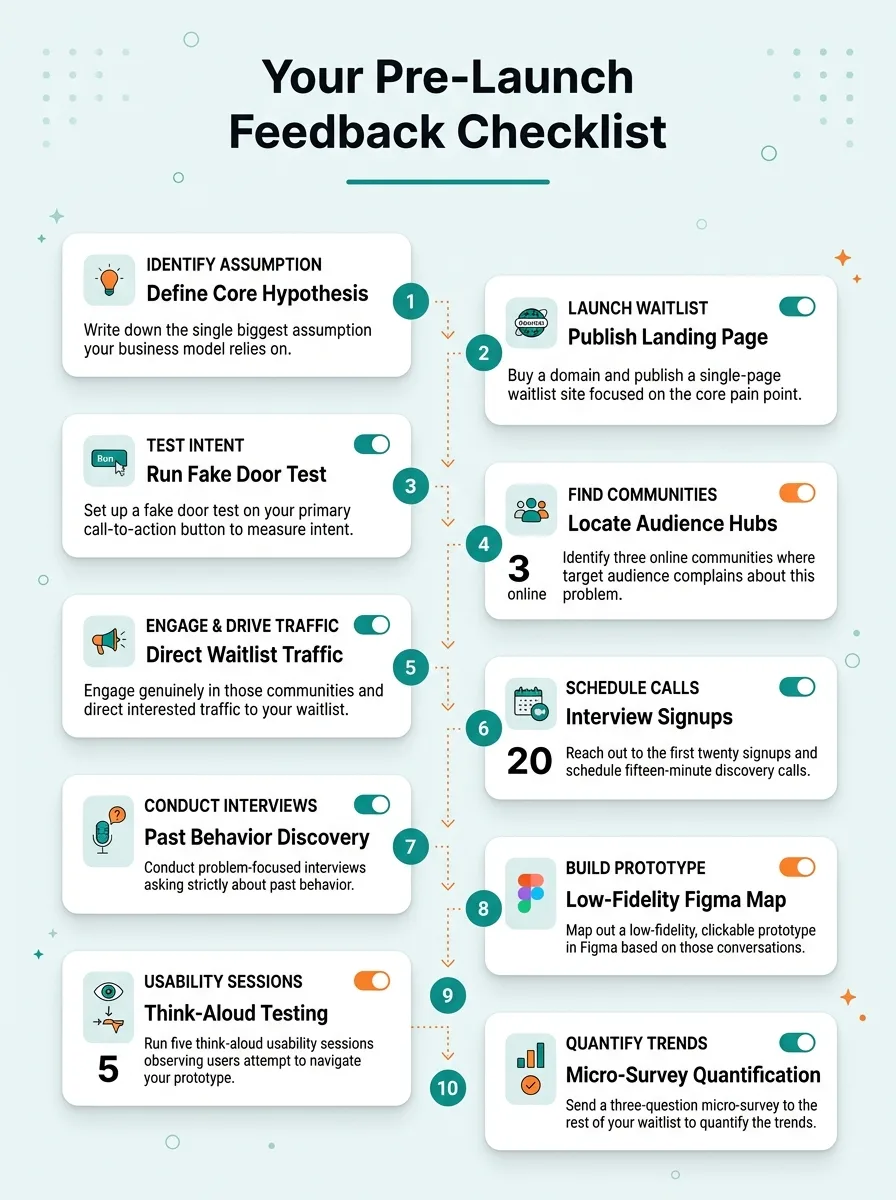
Your Pre-Launch Feedback Checklist
Theory is useless without execution. Follow these exact steps to systematically validate your next product idea.
Write down the single biggest assumption your business model relies on.
Buy a domain and publish a single-page waitlist site focused on the core pain point.
Set up a fake door test on your primary call-to-action button to measure intent.
Identify three online communities where your target audience complains about this problem.
Engage genuinely in those communities and direct interested traffic to your waitlist.
Reach out to the first twenty signups and schedule fifteen-minute discovery calls.
Conduct problem-focused interviews asking strictly about past behavior.
Map out a low-fidelity, clickable prototype in Figma based on those conversations.
Run five think-aloud usability sessions observing users attempt to navigate your prototype.
Send a three-question micro-survey to the rest of your waitlist to quantify the trends.
Frequently Asked Questions About Pre-Launch Feedback
How many users do I actually need to talk to?
You do not need hundreds of conversations to spot a broken workflow. Five to ten deep usability sessions will uncover about eighty percent of your core interface issues according to research by the Nielsen Norman Group. Focus on quality conversations over sheer volume.
Should I pay participants for their time?
For consumer apps, a small twenty-dollar Amazon gift card works wonders for getting people to show up to a Zoom call. For B2B software targeting busy professionals, cash is often less appealing. Offering them lifetime early access, dedicated onboarding, or a steep discount is usually a far better incentive.
What happens if everyone hates my idea?
Celebrate. You just saved yourself six months of useless coding and thousands of dollars in server costs. Take a step back and pivot your concept based on the actual, painful problems they complained about during your interviews.
Turning Insights into a Successful Launch
Getting feedback is not a box you check off once. It is a continuous loop that runs right up to launch day and extends far beyond it. The insights you gather during this pre-launch phase will directly shape your marketing copy, your feature prioritization, and your pricing strategy.
Having a rigorously validated idea makes executing the ultimate SaaS launch plan template drastically easier because you already know the exact vocabulary your users use to describe their problems. Keep the momentum high by building in public. When you regularly share your progress and feature updates on platforms like WeekHack, you turn those early interview participants into your most vocal launch day champions. They watched the product evolve based on their direct input. They feel ownership. That is how you guarantee a successful launch.
Written by

Jan Orsula
Serial maker and founder of WeekHack, SocialCal, and SocialOrbit. Builds tools that help creators launch side projects, schedule social media, and generate content — so they can focus on what matters.
Related Articles
The Startup Directory Submission Checklist for More Visibility
A complete, actionable guide to submitting your startup to directories. Learn how to boost domain authority, secure early users, and build a backlink profile that drives sustainable growth.
How to Write a Product Listing That Converts
Stop losing sales to bad copy. Learn how to translate your technical features into undeniable buyer benefits with this practical, maker-focused guide.
How to Write a Product Hunt Tagline That Converts
Your Product Hunt tagline is the difference between a click and a scroll. Learn how to write a 60-character pitch that converts, using proven frameworks and real examples.