
Can You Relaunch on Product Hunt? The Official Rules
 Jan Orsula
Can You Relaunch on Product Hunt? The Short Answer
Yes, you can absolutely relaunch on Product Hunt. But you only get to do it for massive, version-shifting updates like a v2.0 or a complete product pivot. You must also leave at least a six-month gap between your posts. Minor bug fixes or tiny UI tweaks will not get past the moderation team.
Why Product Hunt Limits Relaunches
Most founders hit the dreaded 'trough of sorrow' about three months after their initial launch. Traffic dries up. MRR flatlines. The temptation to just post the product again to grab another traffic spike is incredibly high.
Product Hunt knows this. The platform is a discovery engine, and it survives entirely on novelty. If makers could simply hit a repost button every time growth stalled, the homepage would become an unreadable graveyard of the exact same ten SaaS apps cycling endlessly. That ruins the experience for the early adopters who actually drive the platform's value.
To protect the feed, moderators manually review submissions to filter out duplicates. They want to see genuine innovation. They want a reason for the community to care again.
Rule 1: The 'Major Update' Requirement
So what actually counts as a major update? This is where most founders get things completely wrong.
You might spend three grueling months migrating your entire codebase from Vue to Next.js. You feel like a hero. But to the end user? Absolutely nothing changed. The buttons look the same, the core utility is the same, and the value proposition is untouched. That is not a valid relaunch.
A true v2.0 requires a paradigm shift. Think about a complete visual redesign coupled with a brand new revenue model. Think about a pivot from a B2C productivity app to a B2B enterprise tool. Or imagine taking a basic writing app and injecting a massive generative text suite, which naturally changes the whole use case. If you're wondering where to announce your AI tool, a major v2.0 Product Hunt launch is a solid bet, provided the feature actually changes how people use your software.
Product Hunt explicitly states in their official guidelines that the new version needs to offer substantial new functionality. If you cannot easily explain the difference between the old version and the new version in one sentence, you aren't ready.
Rule 2: The 6-Month Minimum Interval
Time is the second hard constraint. Even if you pivoted your product entirely, you cannot launch a v2.0 just eight weeks after your v1.0.
The unwritten but universally accepted rule in the maker community is the six-month cooling-off period. In practice, waiting eight to twelve months is much safer. Building a genuinely massive update takes time anyway. If you claim to have built a game-changing v2.0 in just forty days, the community will be deeply skeptical.
I've seen founders try to rush this. They push a rushed v2.0 at month four because they are desperate for signups. The algorithm catches the proximity to the previous post, the post gets flagged, and the launch completely flops. Sometimes, a poorly timed second launch just highlights why your product launch failed (and how to fix it) in the first place: you're relying too much on one channel instead of building a sustainable growth engine.
Rule 3: Avoiding Duplicate Submissions When You Relaunch on Product Hunt
Here is a frustrating technical hurdle. If you just paste your exact homepage URL into the submit box, Product Hunt will block it. The system will tell you the link has already been hunted.
To get around this, you have to use distinct versioning. The easiest way is to append a UTM parameter or a simple tracking tag to the end of your URL, like yourdomain.com/?ref=v2. Better yet, create a dedicated landing page for the new release, like yourdomain.com/v2.
You also need to update the product name in your submission. If your original launch was "TaskMaster", your relaunch should be "TaskMaster 2.0" or "TaskMaster AI". This clearly signals to both the algorithm and the human moderators that this is a deliberate new version, not a spammy duplicate.
What Happens if You Break the Relaunch Rules?
Trying to sneak a minor update past the moderators is a terrible idea. If they catch you attempting to spam the feed, your post will simply be removed from the homepage.
Worse, your product might get 'grey-listed'. This means your post remains live on the site, but it is entirely hidden from the main feed and search results. You won't get an email telling you this happened. You will just sit there watching your dashboard, wondering why zero traffic is coming in.
Repeated offenses can lead to your personal account getting suspended. It just isn't worth burning your domain's reputation for a cheap traffic grab.
The Pre-Relaunch Action Checklist
If you have hit the six-month mark and genuinely built a massive update, you need to prepare properly. A relaunch is not a lazy Friday afternoon task.
Write a completely new maker comment. Address the fact that this is a v2.0 right away. Thank the community for the feedback on v1.0, and list exactly what you built based on their complaints.
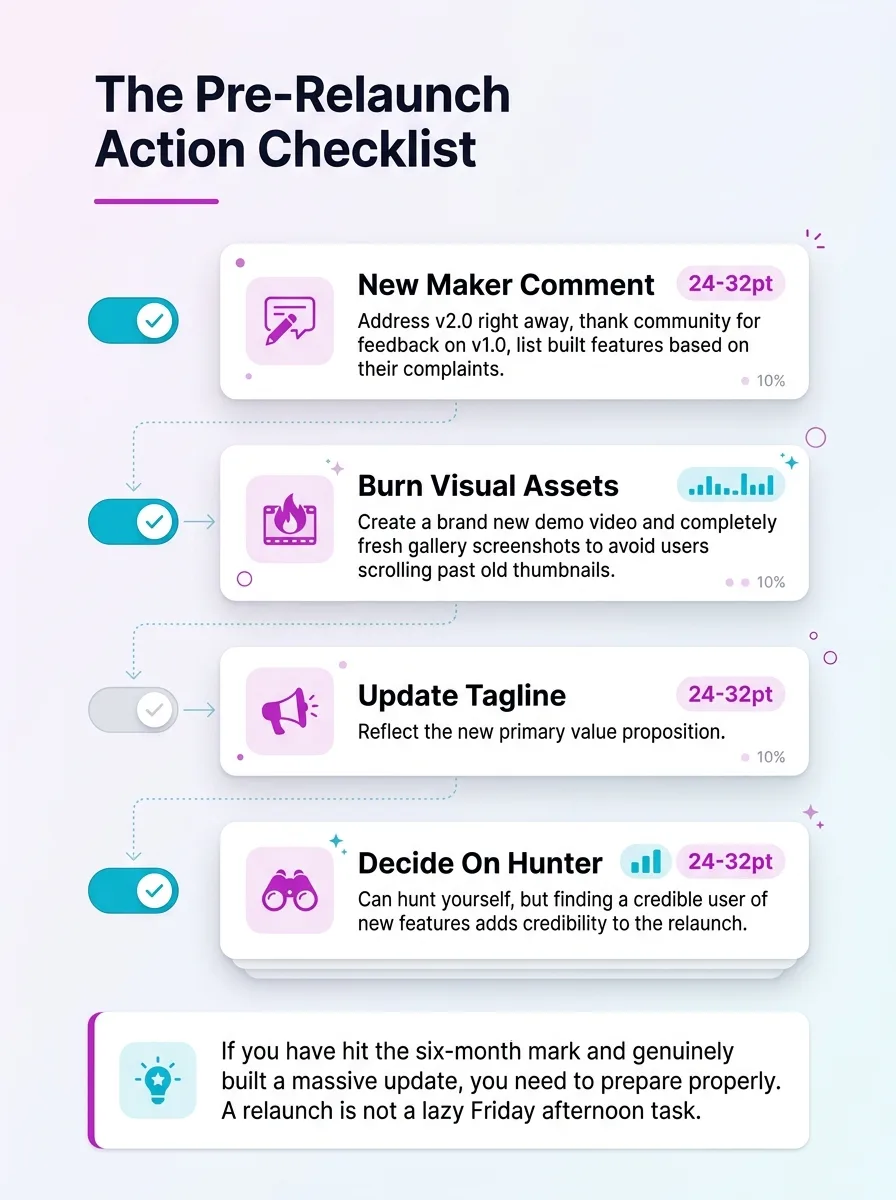
Burn your old visual assets. Create a brand new demo video and completely fresh gallery screenshots. If users see the same thumbnail from last year, they will scroll past.
Update your tagline to reflect the new primary value proposition.
Decide on your hunter. You can hunt it yourself, but finding someone who actually uses the new features can add a layer of credibility to the relaunch narrative.
Relaunching FAQ
Can I just delete my old launch and post again?
No. Product Hunt does not allow users to delete old products to clear the slate. The history remains attached to your domain permanently.
Do my old upvotes carry over to the new launch?
They do not. A v2.0 launch starts at zero upvotes, just like a brand new product. You still need to put in the hard work of driving initial traction. If you struggled the first time, you should brush up on how to get your first upvotes on Product Hunt before hitting submit.
What if my first launch was a complete disaster?
Even if your first launch got three upvotes and zero comments, it still counts as a launch. You still have to wait six months and build a significant update to try again.
Conclusion: Is Your Product Ready to Go Again?
Quality updates will always win over frequent, spammy posting. If your product is genuinely better than it was six months ago, structure your launch narrative around that growth and the community will support it. Use WeekHack to map out your feature timeline, stay patient, and only hit submit when you have a story worth telling.
Written by

Jan Orsula
Serial maker and founder of WeekHack, SocialCal, and SocialOrbit. Builds tools that help creators launch side projects, schedule social media, and generate content — so they can focus on what matters.
Related Articles
How to Get Comments on Product Hunt: 5 Proven Launch Strategies
Most makers obsess over Product Hunt upvotes, but comments are what actually drive the ranking algorithm. Learn how to craft the perfect maker story, run feedback-first outreach, and dominate the first 4 hours of your launch.
How to Improve Your Launch Conversion Rate Step-by-Step
Struggling to turn product launch traffic into actual sales? Discover a practical, step-by-step framework to fix your messaging, remove friction, and drastically improve your conversion rates.
How to Collect User Feedback Before Launch: A Beginner's Plan
Stop guessing what your users want. Learn how to systematically collect pre-launch feedback using smoke tests, problem interviews, and lo-fi prototypes before writing a single line of code.