
Where to Announce Your AI Tool: A Simple First-Day Guide
 Jan Orsula
The "Quiet Launch" Paradox: Why Your AI Tool Needs a Loud Day One
Most founders spend three weeks building an AI wrapper and three minutes thinking about distribution. You finally push code to production, hit publish, and wait for the users to roll in.
Silence.
The transition from builder to marketer is brutal. Knowing exactly where to announce your AI tool dictates whether you get those first ten paying users or an expiring domain name twelve months from now. Look, building a great product is only half the battle. If nobody knows it exists, your code does not matter. Let us map out a day-one strategy that actually works.
Where Should You Announce Your AI Tool?
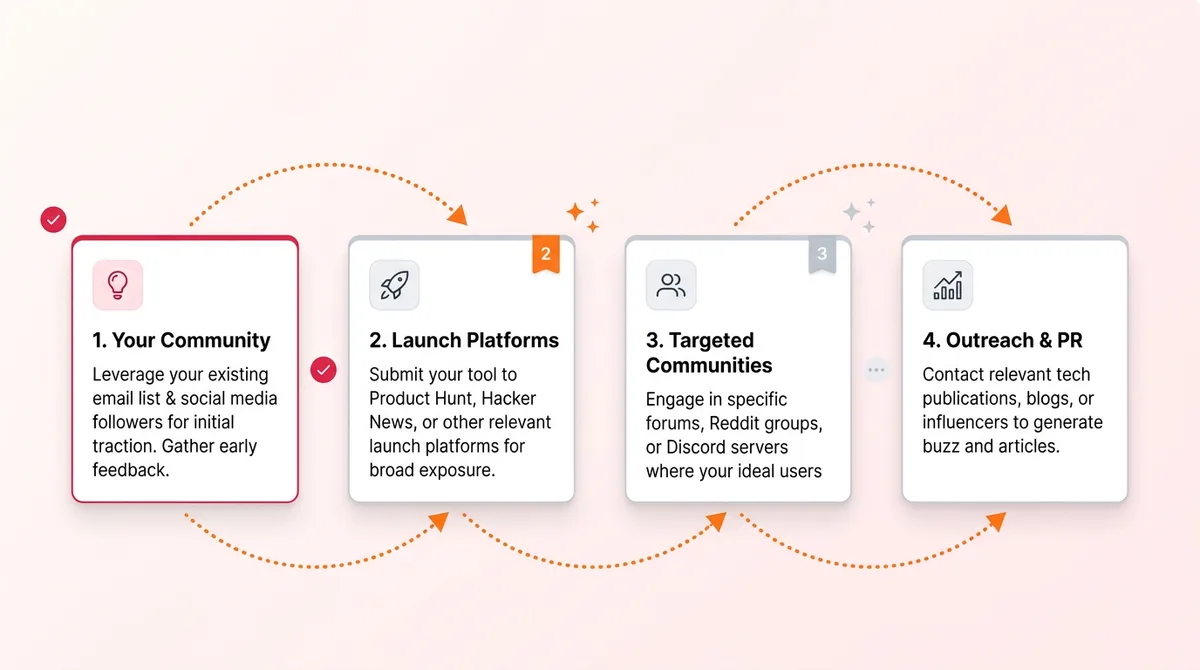
The best places to announce an AI tool are high-intent platforms like Product Hunt, X (Twitter), WeekHack, specialized AI directories, and niche Reddit communities. Instead of blasting a link everywhere at once, you should sequence your announcements across these channels to build sustained momentum and capture different segments of early adopters.
Phase 1: Activating Your Social Distribution Channels
Before hitting the massive aggregators, start with the people who already know you exist. Social platforms give you immediate feedback and a warm audience.
Mastering the X (Twitter) Launch Thread
Do not just post a link and ask for signups.
Twitter rewards storytelling. Your launch thread needs a strong hook, a compressed demo video under 60 seconds, and a clear call to action. I have seen products blow up just by showing a simple side-by-side comparison of a manual task versus their AI automating it in real time.
Start with the problem. Explain why existing solutions failed you. Then show the product. Keep your sentences tight and punchy.
Using LinkedIn to Reach B2B Early Adopters
Developers often ignore LinkedIn. That is a massive mistake.
If you are building B2B software, your buyers are actively hanging out here. Frame your announcement around a professional pain point rather than technical specs. Business owners are constantly looking for free tools and resources for startups to cut operational costs, so position your AI as a direct solution to their overhead. Instead of talking about the specific LLM architecture you used, talk about the hours of busywork your tool eliminates for their team.
Phase 2: High-Traffic Launch Platforms and Communities
Once your social circle is engaged, you move to the big stages. This is where the heavy traffic lives.
The Product Hunt Playbook for AI Founders
Product Hunt remains the primary launchpad for new software. Getting this right takes serious preparation.
Post at 12:01 AM Pacific Time to maximize your exposure window. Have your maker comment ready to go immediately. Keep your taglines clear and ditch the startup jargon. According to the official Product Hunt launch guide, explaining the genuine "why" behind your product drives far more engagement than just listing out features.
Reply to every single comment in the first few hours. Momentum compounds quickly on the front page.
Navigating Hacker News Without Getting Flagged
Hacker News hates marketing.
If you write your "Show HN" post like a standard sales pitch, you will get buried instantly by the moderators and the community. Focus entirely on the technical challenges. Did you build a custom RAG pipeline? Explain exactly how you handled chunking and document retrieval. The YC community respects technical transparency above all else. Expect harsh feedback, but know that surviving the crucible often leads to incredibly sticky early users.
Phase 3: AI-Specific Directories for Long-Tail Traffic
Social media spikes disappear in 48 hours. Directories provide a slow, steady drip of visitors for months. Knowing where to announce your AI tool for the long haul is what keeps your traffic baseline healthy while you build new features.
Submitting to 'There is an AI for That' and Top Directories
Submit to the major aggregators immediately. Sites like "There is an AI for That" and Toolify are virtually mandatory at this point.
Here is the real trick. Do not just copy and paste your website hero text. Optimize your directory description for their internal search engines. Use the exact keywords your target users type into search bars when looking for a solution like yours.
Finding Your Tribe in Niche Subreddits
Reddit can drive insane traffic if you respect the local culture. Drop into r/SideProject or r/OpenAI with pure value.
Share a tough lesson you learned while building. Give away a free template. If your AI helps social media managers, you might naturally mention how it integrates with other free Instagram tools to streamline their daily workflow. Put the link to your actual product at the very bottom of the post, almost as an afterthought. Give first, ask second.
4 Common Mistakes That Kill Your Launch Momentum
Most founders sabotage their own launches. Avoid these specific traps.
First is the spray and pray approach. Submitting your link to fifty random sites at the exact same time dilutes your focus and prevents you from engaging in the comments where it actually matters.
Second, ignoring the first 10 comments. Those early interactions signal to platform algorithms that your post is worth pushing higher up the feed.
Third is a broken landing page. Test your signup flow on mobile. Test it on different browsers. If your authentication flow breaks under load, all that hard-earned launch traffic is entirely wasted.
Finally, failing to capture emails. Not everyone is ready to buy or sign up on day one. Have a simple email capture form for a newsletter so you can retarget them later.
Your 'Day One' Announcement Checklist
Keep it simple. Follow this exact order on launch day.
Verify your analytics and error tracking are live and functioning.
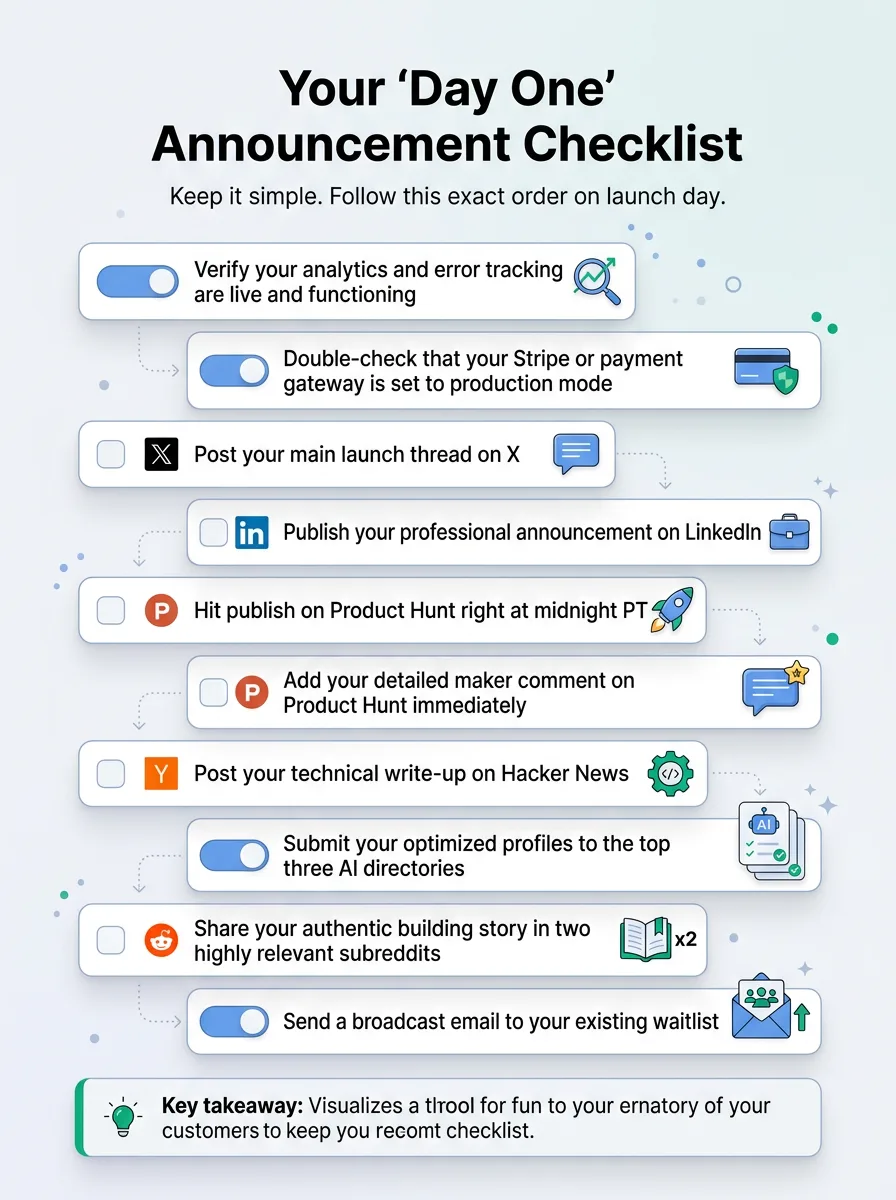
Double-check that your Stripe or payment gateway is set to production mode.
Post your main launch thread on X.
Publish your professional announcement on LinkedIn.
Hit publish on Product Hunt right at midnight PT.
Add your detailed maker comment on Product Hunt immediately.
Post your technical write-up on Hacker News.
Submit your optimized profiles to the top three AI directories.
Share your authentic building story in two highly relevant subreddits.
Send a broadcast email to your existing waitlist.
Frequently Asked Questions About AI Launches
Should I pay for directory listings?
Usually, no. Unless you have a massive marketing budget, the free tiers are enough to get your initial backlinks and SEO traction. Wait for actual product revenue before paying for expedited reviews.
What time of day is best to post?
For global platforms like Product Hunt, midnight Pacific Time gives you the full 24-hour cycle to collect upvotes. For social media like X or LinkedIn, post around 8 AM or 9 AM Eastern Time to catch the morning scroll.
How do I handle negative feedback?
Acknowledge it directly. If a user points out a bug, thank them publicly and fix it. Defensiveness kills your credibility much faster than a broken feature ever could.
From Announcement to Sustainable Growth
Day one is just the beginning. The real work is showing up on day two, day thirty, and day one hundred.
Keep talking to your early users and shipping updates. Finding exactly where to announce your AI tool is a solid start, but consistency is what builds a real business. If you need a supportive space to share updates, get honest feedback from other founders, and secure a dofollow backlink, launching your iterations on WeekHack is a smart move to maintain that momentum. Now close this tab and get back to shipping.
Written by

Jan Orsula
Serial maker and founder of WeekHack, SocialCal, and SocialOrbit. Builds tools that help creators launch side projects, schedule social media, and generate content — so they can focus on what matters.
Related Articles
How to Collect User Feedback Before Launch: A Beginner's Plan
Stop guessing what your users want. Learn how to systematically collect pre-launch feedback using smoke tests, problem interviews, and lo-fi prototypes before writing a single line of code.
The Startup Directory Submission Checklist for More Visibility
A complete, actionable guide to submitting your startup to directories. Learn how to boost domain authority, secure early users, and build a backlink profile that drives sustainable growth.
How to Write a Product Listing That Converts
Stop losing sales to bad copy. Learn how to translate your technical features into undeniable buyer benefits with this practical, maker-focused guide.