
5 Ways to Optimize a SaaS Directory Listing for Clicks
 Jan Orsula
Stop Being Just Another Entry in the SaaS Crowd
You spend three hours filling out forms on G2, Capterra, and Product Hunt. You meticulously paste your logo, add a boilerplate description, and hit publish. Then you wait.
Crickets.
A week later, your analytics dashboard shows zero referring traffic. Sound familiar? Most founders treat directories like a dusty yellow pages entry. They just want to exist on the platform. But existing isn't enough when your category has 400 identical competitors. If you want to know how to optimize a SaaS directory listing, you have to stop acting like a digital brochure. Here is the framework for turning those dead-end profiles into actual acquisition channels.
How to Optimize a SaaS Directory Listing (Quick Answer)
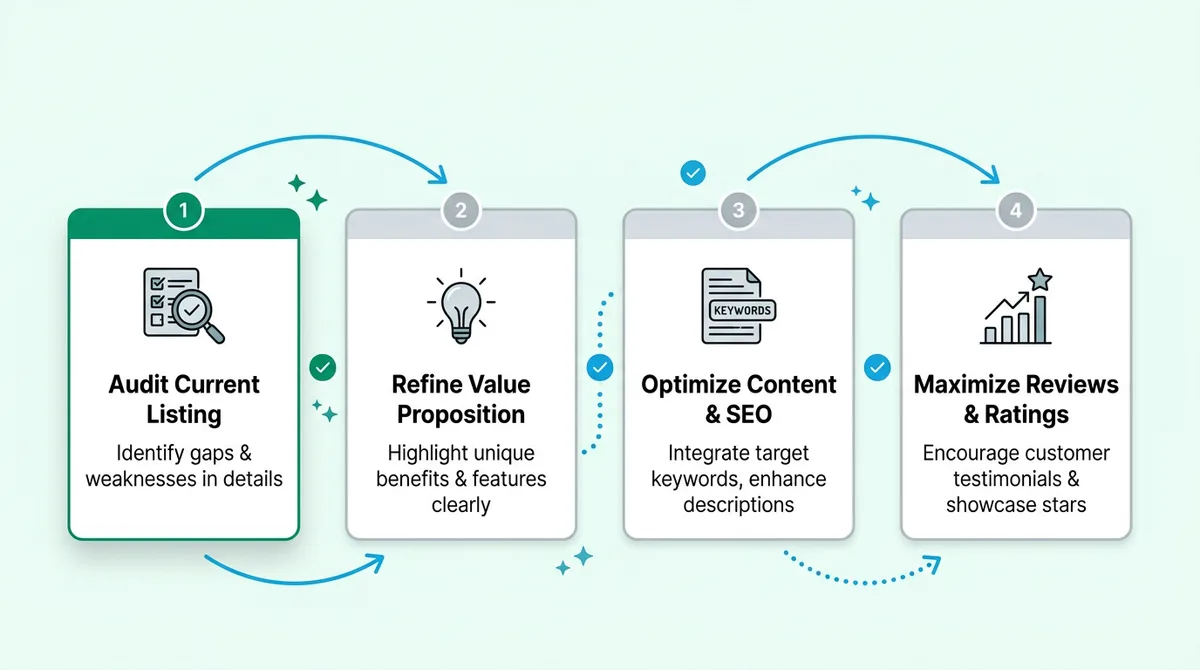
Optimizing a SaaS directory listing means actively designing your profile to capture attention and drive clicks rather than just stating what your software does. You achieve this by writing benefit-driven taglines, using heavily annotated dashboard screenshots, generating a steady stream of recent reviews, and offering directory-specific calls to action. It is about proving your value in three seconds or less.
1. Craft a Benefit-First Tagline that Halts the Scroll
Buyers scrolling through Capterra are tired. They have looked at twenty different "cloud-based CRM solutions" in the last ten minutes. If your headline reads like a technical manual, they will skip right past you.
Most founders get this wrong. They lead with what the product is. "We are a B2B task manager." Nobody cares. What actually works is leading with the exact pain you eliminate.
Action Step: The 'So What?' Test for Your Headline
Take your current tagline. Read it out loud. Then ask yourself, "So what?"
If your tagline is "Automated invoice tracking for freelancers," ask the question. So what? "So they don't have to chase clients for money." Keep going. So what? "So they get paid a week faster."
That is your new tagline. "Get your freelance invoices paid a week faster." It forces the reader to stop scrolling because you are speaking directly to their wallet, not their software stack. If you are figuring out how to launch a SaaS product without any ad spend, this kind of sharp, benefit-driven copy is basically mandatory.
2. Maximize Conversion with 'Proof-Heavy' Visuals
Here is a hard truth about directory browsing. Nobody reads your 500-word product description. They glance at your star rating and immediately click through your image carousel.
According to usability studies from groups like the Nielsen Norman Group, users skim text but fixate heavily on informative visuals. If your screenshots are just zoomed-out, blurry pictures of your dashboard, you are wasting your best real estate. A dense UI with tiny text does not sell software.
Example: Comparing Raw Screenshots vs. Annotated Feature Highlights
Imagine a raw screenshot of an analytics dashboard. It looks like every other dashboard on earth. Now imagine that same screenshot, but the background is slightly darkened. A bright red box highlights a specific metric. A text overlay points to it, saying: "See churn risk before the customer cancels."
You just turned a boring UI shot into a sales pitch. Use tools like CleanShot or Canva to add arrows, highlight boxes, and short text blurbs to your images. Show the prospect exactly where the magic happens.
3. Increase 'Proof Density' Through Strategic Reviews
Directory algorithms are simple search engines at their core. They don't just care about your total number of reviews. They care deeply about recency and velocity.
A product with 50 reviews from 2019 will often rank lower than a product with 15 reviews from the last two months. Directories want to recommend active, well-maintained software. This means you can't just run one review campaign and stop.
Action Step: How to Request Reviews that Convert
Stop asking users to "leave a review if you like the product." That generates lazy, one-sentence feedback. Instead, ask them a specific question you want them to answer in the review.
Send an email like this: "Hey [Name], I noticed you used our bulk-export feature three times this week. Would you mind leaving a quick review mentioning how much time that specific feature saves you?"
When potential buyers read reviews, they look for specific use cases that match their own. Dense, detailed reviews act as secondary sales copy.
4. High-Intent Call to Actions: Beyond 'Visit Website'
The default call to action on almost every SaaS directory is a plain link to your homepage. That is a massive missed opportunity.
When a user clicks your link from G2, they already have high intent. They are actively evaluating software. Sending them to your generic homepage forces them to start their journey over. You need to maintain the context of their click.
Example: 'Start Free Trial' vs. 'Get 20% Off for G2 Users'
Create a dedicated landing page specifically for traffic coming from that directory. If they click from Capterra, the headline on your landing page should say, "Welcome Capterra Users."
Take it a step further by offering an exclusive perk. A CTA that says "Get 20% off your first 3 months (Exclusive for G2 users)" creates immediate urgency. It makes the prospect feel like they found a secret deal. Plus, it makes tracking your directory ROI incredibly simple.
5. Optimize for Internal Directory SEO and Category Placement
If you categorize your niche CRM under the massive "CRM Software" bucket, you will be buried on page 40 behind Salesforce and HubSpot. You will never see a single click.
Understanding how to optimize a SaaS directory listing means playing the internal SEO game. You need to be a big fish in a small, highly specific pond.
Action Step: Identifying High-Intent, Low-Competition Categories
Look at your main competitors. See which secondary and tertiary categories they ignored. Maybe they are dominating "Project Management," but they forgot to list themselves under "Agency Workflow Software" or "Time Tracking for Creatives."
Claim the niche categories where buyers have specific, high-intent needs. Ranking #1 in a category with 500 monthly searches is infinitely better than ranking #85 in a category with 50,000.
This is exactly why finding the right early audience matters so much. If you are looking for 10 proven places to find beta users for your SaaS, niche directory categories are a goldmine for highly specific, problem-aware testers.
4 Common Mistakes to Avoid When Listing Your SaaS
Even smart founders shoot themselves in the foot with basic listing errors. Here is what to avoid in practice.
Using marketing jargon. Phrases like "synergistic cloud-based paradigm" mean nothing. Speak plain English. If a fifth-grader cannot understand what your tool does, rewrite it.
Ignoring negative reviews. A bad review isn't the end of the world. Leaving it unaddressed is. Reply calmly, explain how you fixed the issue, and show future buyers that you actually care about customer support.
Leaving the pricing section blank. Buyers hate "Contact us for pricing" when they are just trying to browse. If you hide your prices, they will assume they can't afford you and click the next listing.
Setting it and forgetting it. Software evolves. If your screenshots show a UI from three years ago, prospects will think the product is dead.
The 10-Point SaaS Directory Optimization Checklist
Ready to update your profiles? Follow these exact steps.
Rewrite your main headline to focus on a specific customer outcome.
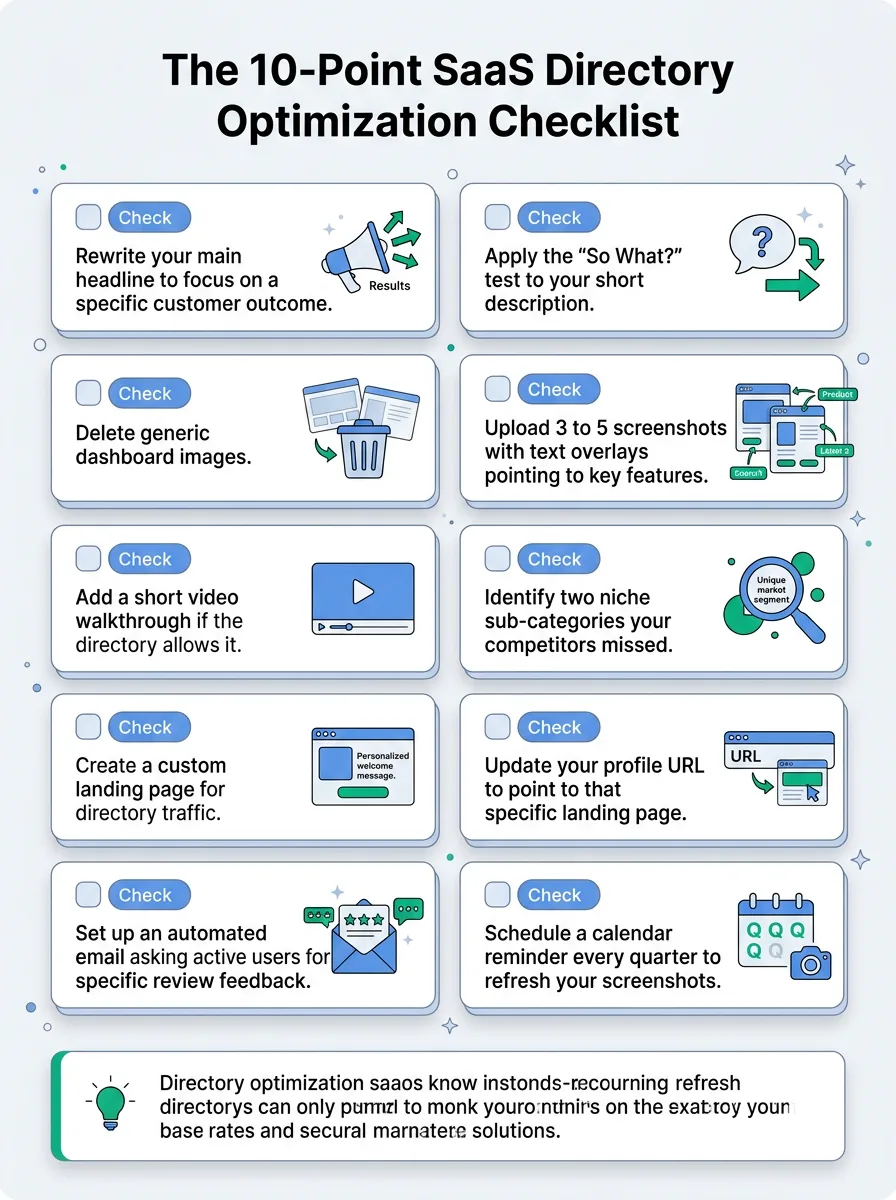
Key takeaways at a glance Apply the "So What?" test to your short description.
Delete generic dashboard images.
Upload 3 to 5 screenshots with text overlays pointing to key features.
Add a short video walkthrough if the directory allows it.
Identify two niche sub-categories your competitors missed.
Create a custom landing page for directory traffic.
Update your profile URL to point to that specific landing page.
Set up an automated email asking active users for specific review feedback.
Schedule a calendar reminder every quarter to refresh your screenshots.
Frequently Asked Questions
Is it worth paying for featured directory listings?
Usually not in the early days. Paid placements are expensive and only yield a positive ROI if your profile is already converting organic traffic well. Fix your copy and visuals first. Once you have a proven conversion rate, then consider paying for placement.
How often should I update my profile screenshots?
Whenever you do a major UI overhaul, or at least every six months. Old screenshots make your software look abandoned. Fresh visuals signal active development.
Do backlinks from directories help my website's SEO?
They help establish basic domain trust. Most major directories use nofollow links, which do not pass massive amounts of authority, but they do diversify your link profile. The real value is the direct referral traffic, not the SEO juice.
Final Thoughts: Building a Sustainable Lead Channel
Directories are not a magic bullet. You can't just optimize your listing once and expect a flood of enterprise leads to drop into your lap.
It takes iterative testing. Swap your headline next month. Test a different exclusive offer. See what drives the most qualified traffic. If you want more ways to get eyes on your product without fighting directory algorithms all day, launching on WeekHack gets you guaranteed dofollow backlinks and puts your tool directly in front of an active community of indie makers. Treat your directory listings like a living part of your funnel, and they will start pulling their weight.
Written by

Jan Orsula
Serial maker and founder of WeekHack, SocialCal, and SocialOrbit. Builds tools that help creators launch side projects, schedule social media, and generate content — so they can focus on what matters.
Related Articles
How to Get Comments on Product Hunt: 5 Proven Launch Strategies
Most makers obsess over Product Hunt upvotes, but comments are what actually drive the ranking algorithm. Learn how to craft the perfect maker story, run feedback-first outreach, and dominate the first 4 hours of your launch.
How to Plan a Startup Launch That Gains Real Traction
Learn how to plan a startup launch that actually gets traction. From finding your early users to engineering a launch day spike, here is the exact playbook indie hackers use.
How to Launch an AI Tool and Rank #1 on Product Hunt
Learn exactly how to launch an AI tool on Product Hunt and claim the top spot. This practical guide covers pre-launch community building, high-converting asset optimization, and a 24-hour tactical sprint.