
How to Launch Without an Audience: A 4 Step Framework
 Jan Orsula
The Myth of the 'Audience-First' Launch
We have all seen the screenshots. A big Twitter personality ships a weekend side project and immediately bags ten grand in presales. You look at your own dashboard, sitting at exactly zero active visitors, and wonder what you are doing wrong.
Nothing is more demotivating than building a solid product and realizing nobody is there to see it when you hit publish. Most traditional advice tells you to spend six months writing threads to build a personal brand before writing a single line of code. That rarely works for solo founders. You have limited time and a product that needs users right now. What actually works is learning how to launch without an audience by hijacking existing attention.
Here is exactly how to do it.
Can You Launch a Product Without an Audience?
Wondering how to launch without an audience? The short answer is that you don't generate traffic from thin air—you borrow it from established communities, execute highly targeted direct outreach, and engineer viral referral loops to bridge the gap. By providing upfront value in niche forums and partnering with micro-curators, you can manufacture a successful launch day even with zero followers.
Step 1: Tap Into Existing 'Niche Watering Holes'
You do not need to build a massive following if you know where your target users already spend their time. I call this ecosystem hijacking. Instead of shouting into the void on your personal timeline, you go directly to the places where your ideal customers are actively complaining about their problems.
Finding High-Density Communities
Start by hunting down specific platforms. Subreddits, Discord servers, and private Slack groups are absolute goldmines. If you built a custom template builder for Notion creators, do not just post a vague link on X. Go straight to r/Notion or the largest Notion Facebook groups.
Search for the exact problem your app solves. These digital spaces have thousands of highly engaged people just waiting for someone to hand them a fix.
The 'Value-First' Posting Strategy
Look, most founders get this horribly wrong.
They drop a raw URL that says "Hey guys I built this thing check it out" and immediately get banned by moderators for self-promotion. You have to earn the right to share your link. Write a detailed post explaining a specific technical lesson you learned while building. Solve a common problem directly in the text.
Only drop your product URL at the very end as a quiet side note. I've seen indie products blow up just by sharing a highly transparent revenue teardown on Reddit. If you provide genuine value first, the community naturally wants to support what you built. Once you get that initial traffic spike, figuring out how to turn launch traffic into paying users becomes your next real challenge.
Step 2: Use Other People’s Audiences (OPA)
If you are figuring out how to launch without an audience, the absolute easiest shortcut is to borrow someone else's trust. Forget massive influencers. You want micro-influencers and niche newsletter curators who have spent years building credibility with a few thousand highly relevant readers.
Reaching Out to Micro-Curators
Find newsletters with 1,000 to 5,000 active subscribers. These writers are constantly desperate for fresh content to share. Pitch your product to them as a potential tool of the week feature.
Keep your email brutally short. Tell them exactly why their specific audience will care, give the writer free lifetime access, and ask for nothing in return. Often, they will feature you simply because your tool makes their weekly send look professional and curated.
Creating Win-Win Affiliate Partnerships
Give early supporters a financial reason to talk about you.
Set up a simple referral commission using software like Rewardful or Lemon Squeezy's built-in affiliate tools. When you email these micro-curators, casually mention that they can use an affiliate link if they decide to share it. A 30 percent recurring commission is standard for SaaS. Suddenly, sharing your project isn't a favor. It becomes a permanent revenue stream for them.
Step 3: Engineer a Viral Referral Loop
Getting your first 10 users manually is a grind. Getting the next 90 should be easier. You need to build growth mechanics directly into your onboarding flow so that every single sign-up naturally brings in another person.
The 'Waitlist' Psychological Trigger
People want what they cannot easily have.
Creating a custom waitlist introduces artificial scarcity. Tools like KickoffLabs make this incredibly easy to bolt onto your landing page. When a user joins your pre-launch list, show them they are number 4,500 in line. Then hand them a unique URL and explain they can jump into the top 100 instantly if they invite three friends.
This psychological trigger works shockingly well for consumer apps and B2B tools alike.
Incentivizing the 'Share' Action
People will rarely share your app just because you ask nicely. You have to bribe them.
Offer a tangible, immediate reward for a social share or a direct email invite. Give them an extended 60-day free trial. Unlock a premium feature that usually sits behind a steep paywall. Make the reward so compelling that it feels foolish not to send a quick text to a coworker. The cost to you is zero, but the resulting word-of-mouth marketing is priceless.
Step 4: Execute High-Touch Direct Outreach
You cannot skip the unscalable work. If you have zero followers, you must manually drag your first 50 users through the front door. This means spending hours sending personalized messages one by one to total strangers.
As the classic startup advice goes, you must do things that don't scale.
Personalizing the Beta Invite
Stop sending generic copy-paste DMs on Twitter or LinkedIn. Everyone ignores them.
Find individuals who are actively complaining about the exact problem you solve. If someone tweeted about how much they hate formatting dirty CSV files, reply directly to them. Tell them you saw their complaint, built a tiny tool to fix it, and would love their brutal feedback. Focus entirely on their pain points rather than listing your fancy features.
Converting Feedback into Social Proof
These early direct conversations are your secret weapon.
When one of these early beta testers replies saying they genuinely love the tool, immediately ask if you can put their quote on your landing page. Gather five strong testimonials this way. Now, when cold traffic hits your site from Reddit or Hacker News, it looks like an established product rather than a ghost town. This is especially vital if you are trying to figure out how to relaunch a SaaS after failure, where rebuilding trust from absolute zero is your primary goal.
Common Pitfalls When Launching to Zero
Knowing how to launch without an audience also means knowing what kills your momentum. Most founders make the exact same unforced errors.
First, they over-automate their outreach. Using a scraping bot to grab 5,000 emails and blasting them all at once will destroy your domain reputation. You need actual conversations, not bulk spam.
Second, ignoring strict community rules. Dropping a raw URL into a moderated subreddit will get you permanently banned within ten minutes. Always read the sidebar before you post.
Third, launching way too late. I see makers polishing code for six months, waiting for the stars to align. There is no perfect moment when nobody knows who you are. Just ship the ugly version and start talking to humans. If you are building a browser add-on, just run through a Chrome extension launch checklist and push it live.
The Zero-Audience Launch Checklist
Here is the exact step-by-step list to follow before you share your product.
Find 10 high-density online communities where your specific users hang out.
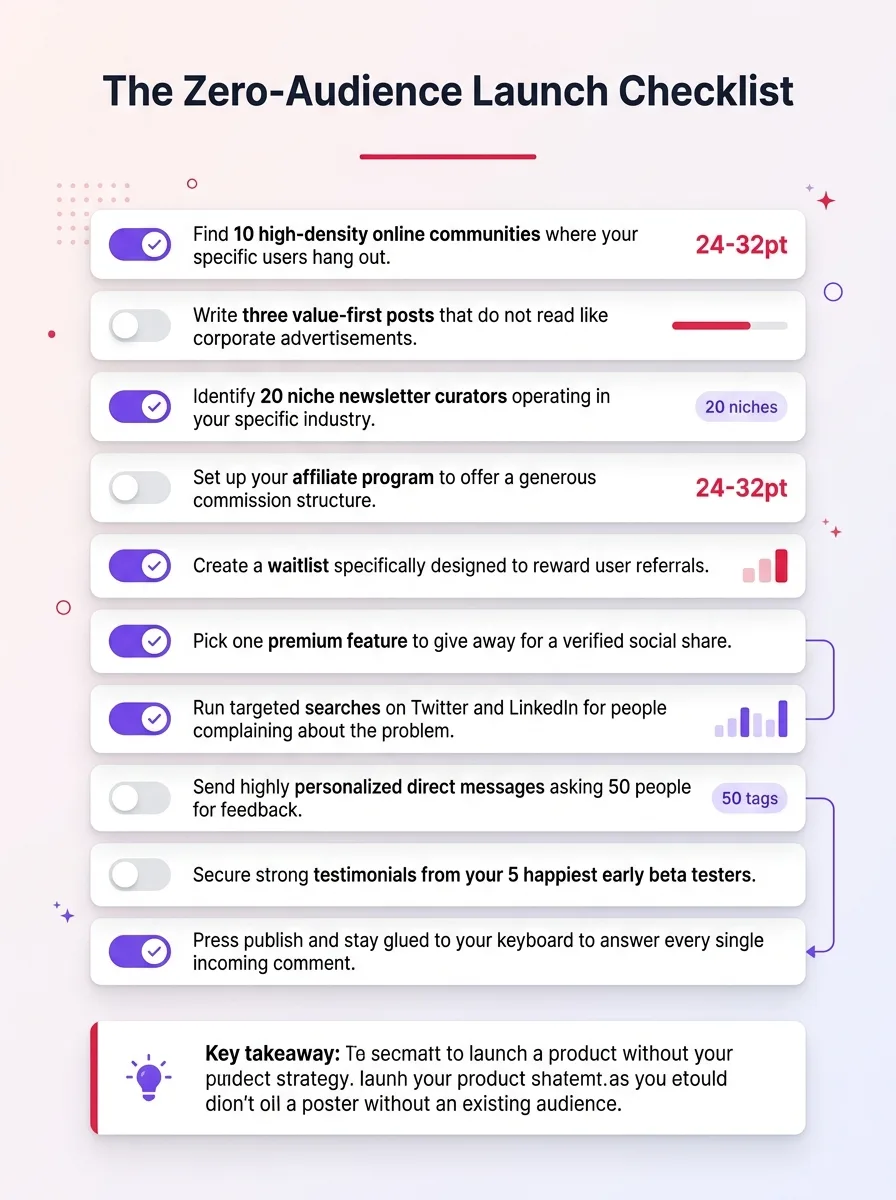
Key takeaways at a glance Write three value-first posts that do not read like corporate advertisements.
Identify 20 niche newsletter curators operating in your specific industry.
Set up your affiliate program to offer a generous commission structure.
Create a waitlist specifically designed to reward user referrals.
Pick one premium feature to give away for a verified social share.
Run targeted searches on Twitter and LinkedIn for people complaining about the problem.
Send highly personalized direct messages asking 50 people for feedback.
Secure strong testimonials from your 5 happiest early beta testers.
Press publish and stay glued to your keyboard to answer every single incoming comment.
Frequently Asked Questions
Can you successfully launch a product with zero followers?
Yes. Having followers makes distribution easier, but it is never a strict requirement. You just have to swap the convenience of a large audience for the manual labor of direct outreach and community engagement.
Do I need a big budget to launch without an audience?
Not at all. You can execute this entire framework for zero dollars. Your only real cost is time and energy. You are trading your hours for other people's attention.
What is the best day of the week to launch?
In practice, this rarely matters as much as founders think. Tuesday and Wednesday are generally good for B2B tools, while weekends can work great for consumer apps. Consistent promotion always beats picking a magic day on the calendar.
Building Momentum After the Initial Spark
A launch is a process, not a singular event. The day you hit publish is just day one of a long game. The real challenge is keeping the noise going over the next six months.
You have to keep participating in those niche watering holes and talking to new users every single day. One easy way to maintain your rhythm is to plug into active maker communities. Launching your updates on WeekHack gives you a dedicated space to get community feedback and earn guaranteed dofollow backlinks without feeling like you are shouting into the void alone. Keep shipping, keep talking to people, and eventually, that zero-audience launch turns into a massive, loyal user base.
Written by

Jan Orsula
Serial maker and founder of WeekHack, SocialCal, and SocialOrbit. Builds tools that help creators launch side projects, schedule social media, and generate content — so they can focus on what matters.
Related Articles
How to Get Comments on Product Hunt: 5 Proven Launch Strategies
Most makers obsess over Product Hunt upvotes, but comments are what actually drive the ranking algorithm. Learn how to craft the perfect maker story, run feedback-first outreach, and dominate the first 4 hours of your launch.
How to Plan a Startup Launch That Gains Real Traction
Learn how to plan a startup launch that actually gets traction. From finding your early users to engineering a launch day spike, here is the exact playbook indie hackers use.
How to Launch an AI Tool and Rank #1 on Product Hunt
Learn exactly how to launch an AI tool on Product Hunt and claim the top spot. This practical guide covers pre-launch community building, high-converting asset optimization, and a 24-hour tactical sprint.