
How to Turn Launch Traffic Into Paying Users - Step by Step
 Jan Orsula
You just hit the front page. The Google Analytics real-time dashboard is lighting up like a Christmas tree. Hundreds of concurrent visitors are browsing your site. Your Twitter notifications are completely broken. Then, you check your Stripe dashboard. Zero new subscriptions. Crickets. This is the launch day hangover.
Figuring out exactly how to turn launch traffic into users is the difference between building a sustainable software business and just throwing a really stressful internet party. Most founders assume a traffic spike automatically translates to revenue. That is entirely wrong. Before you stress about how to get your first upvotes on Product Hunt, you need to fix your leaky bucket. Here is exactly how you do it.
What Does It Mean to Turn Launch Traffic Into Users?
Turning launch traffic into users means optimizing your entire conversion funnel so that casual, curious visitors transform into active customers. It requires designing a seamless, low-friction journey from the moment someone lands on your site to their first "Aha" moment inside your product. Ultimately, it is about capturing intent rather than just counting pageviews.
Step 1: Optimize Your 'Bucket' Before the Pour
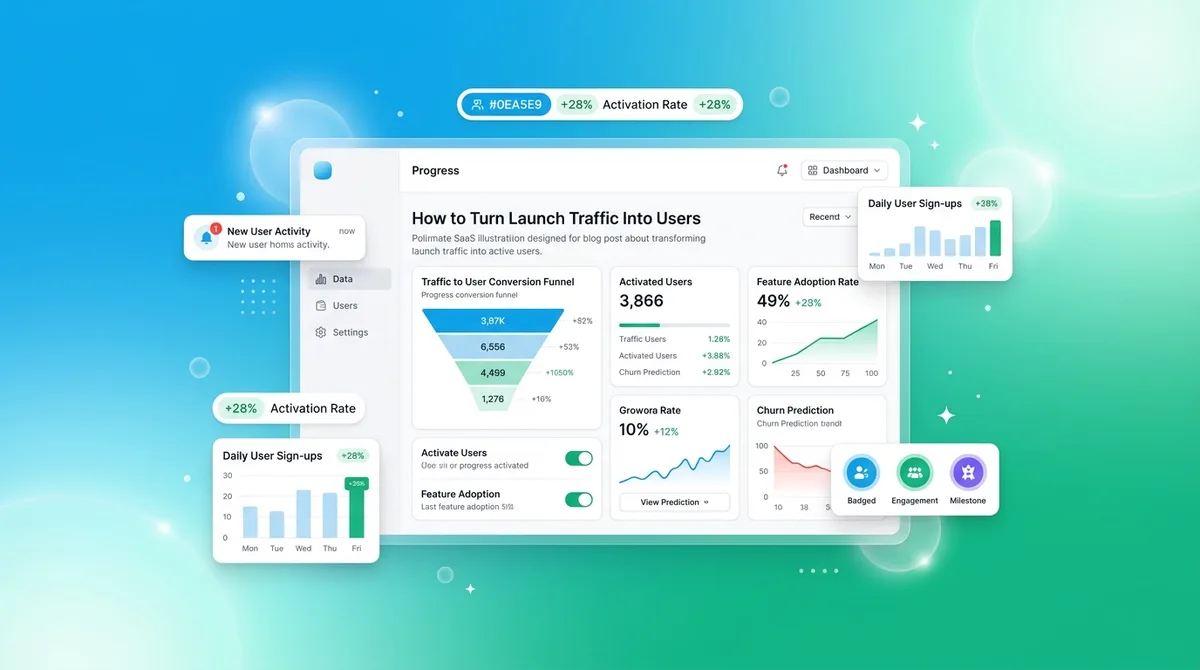
Traffic is basically water. If you pour a gallon of water into a bucket full of holes, you end up with wet shoes and an empty bucket. Most founders obsess over the pour. They spend weeks prepping their social media assets and networking with influencers, but they completely ignore the bucket itself.
Your landing page needs to be ruthless about clarity. Clever copy kills conversions. If a visitor has to read a paragraph twice to understand what your app does, they are already gone.
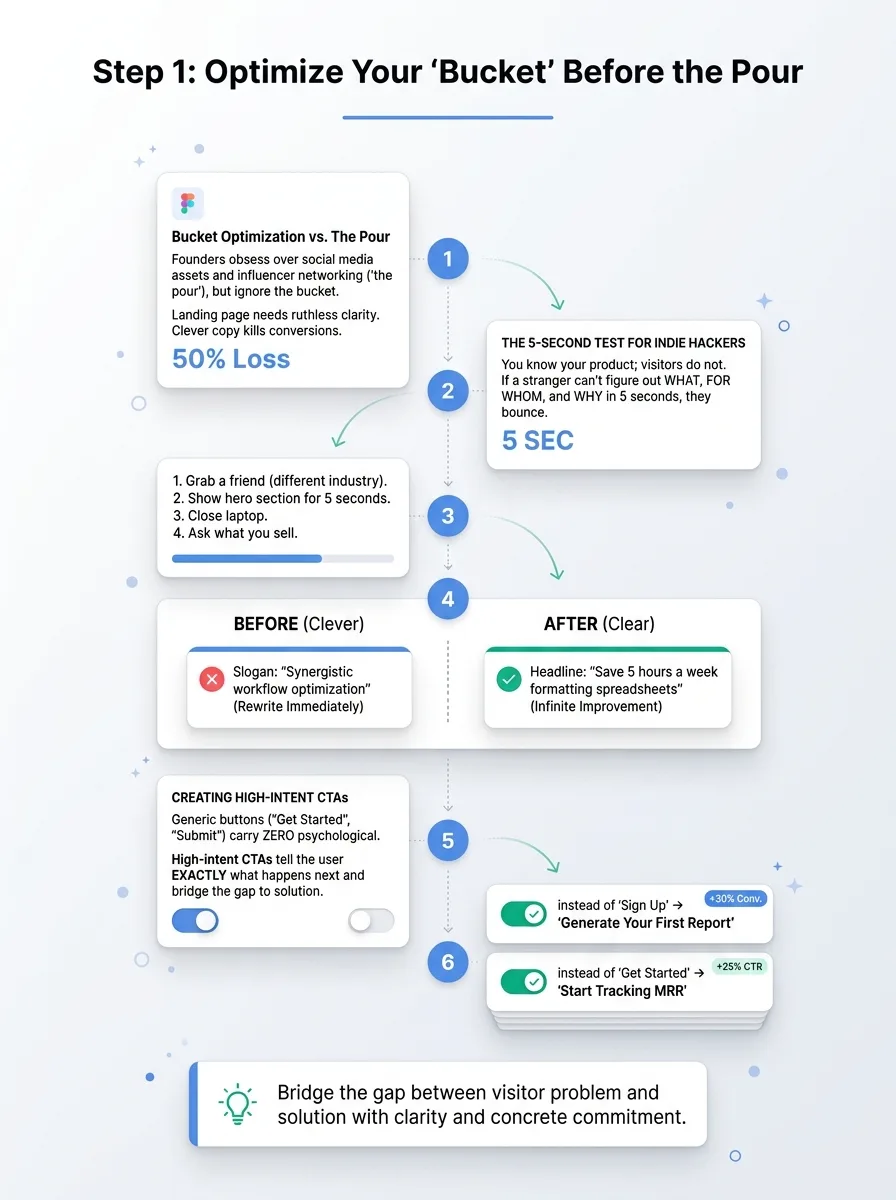
The 5-Second Test for Indie Hackers
You know exactly what your product does because you built it. Your visitors do not. If a stranger cannot figure out what you are selling, who it is for, and why they should care in five seconds, they hit the back button.
Grab a friend who works in a totally different industry. Show them your hero section for five seconds. Close the laptop. Ask them what you sell. If they stutter, rewrite your headline immediately. Stop trying to sound like a massive enterprise company with slogans like "Synergistic workflow optimization." State exactly what the software does in plain English. "Save 5 hours a week formatting spreadsheets" works infinitely better.
Creating High-Intent Call to Actions (CTAs)
Generic buttons like "Get Started" or "Submit" carry zero psychological weight. High-intent CTAs tell the user exactly what happens next. It sets an expectation.
Instead of "Sign Up", try "Generate Your First Report". Instead of "Get Started", use "Start Tracking MRR". This tiny shift bridges the gap between a visitor's problem and your solution. It makes the commitment feel concrete. Nailing this messaging is crucial. If you are still refining your core value prop, read up on how to launch a SaaS product to get your positioning right before the traffic hits.
Step 2: Capture Intent with 'Soft Conversions'
Not everyone who clicks your link on launch day is ready to buy. Most are just browsing on their lunch break. If your only options are "Pay me $29 a month" or "Leave forever", you are burning cash.
You need a middle ground.
The Power of the Lead Magnet or Waitlist
Soft conversions capture intent without requiring a credit card or a massive time commitment. If you are launching an AI writing tool, offer a free cheat sheet on prompt engineering. If you built a personal finance app, give away a Google Sheets budget template in exchange for an email address.
You get the contact info. They get immediate value. Later, you can email them when they actually have the time to sit down and try your software properly.
Action Step: Setting Up an Exit-Intent Popup
Exit-intent popups feel annoying when you are the one browsing, but the data does not lie. They work. When a user's mouse cursor breaks the plane of the browser window moving toward the close button, trigger a simple modal.
Keep it heavily text-based and simple. "Not ready to try us yet? Drop your email and I will send you our weekly indie hacker case studies." Tools like MailerLite or ConvertKit let you embed this in ten minutes. It acts as a safety net for your hard-earned launch traffic.
Step 3: Engineer the 'Aha! Moment' Within 60 Seconds
Getting a signup is just step one. Figuring out how to turn launch traffic into users means getting them to experience the core magic of your product immediately. If they sign up and stare at a blank dashboard, you failed.
Reducing Friction: The Death of the 10-Field Form
Nothing kills enthusiasm faster than a giant registration form. You do not need their phone number, company size, and job title just to let them try a to-do list app.
Implement Google or GitHub single sign-on. Use magic links. If you absolutely must use a password, drop the ridiculous verification rules requiring a special character and a number. Make the barrier to entry microscopic. The worst offender is the "Check your email to verify your account" screen. That is a dead end. Let them into the app first, and ask for verification later.
Example: Progressive Profiling in Action
Instead of demanding data upfront, ask for it naturally as they use the product. Let them create a project first. Then ask for the project name. When they try to invite a teammate, that is when you ask for their company details.
This is called progressive profiling. It keeps the momentum high during that crucial first minute of the user journey.
Step 4: The 7-Day Post-Launch Retargeting Sequence
The launch spike usually lasts 48 hours. The real money is made in the follow-up. Sadly, most founders send zero emails after a user creates a free account.
Automating the 'Did You Forget Something?' Email
Set up a simple three-email sequence in your marketing platform. Day one: A plain text welcome email from the founder asking what they are trying to achieve. Day three: A quick tip on how to use your most popular feature. Day seven: A check-in asking if they are stuck.
According to research from Klaviyo, automated welcome series emails have massively higher open rates compared to standard newsletters. Do not overcomplicate the design. Text-based emails from a real human convert best. "Hey, I am the founder. Why did you sign up today? Hit reply and let me know." That single email will give you better user feedback than any analytics tool.
Common Mistakes: Why Your Launch Traffic is Bouncing
Even with a solid funnel, minor technical or psychological misses will ruin your conversion rate. Here is what usually goes wrong during a high-traffic event.
The 'One-Size-Fits-All' Landing Page Trap
Traffic from Reddit hates marketing speak. Traffic from LinkedIn expects professionalism. Traffic from Product Hunt wants to see raw innovation. If you send all these distinct groups to the exact same generic landing page, nobody feels at home.
Create dedicated landing pages for your biggest traffic sources. A simple "Welcome Product Hunt Community" banner at the top of the page increases trust instantly. It shows you actually care about where they came from.
Ignoring Mobile Optimization
We build on desktop monitors. We test on desktop monitors. But half of your launch day visitors are scrolling Twitter on their phones while in line for coffee. If your mobile hero image is broken, or your CTA button requires side-scrolling to click, they will bounce.
Test your site on an actual physical phone. Do not just use Chrome's responsive inspector. Real thumbs are thicker than mouse cursors. Watch out for Safari's bottom address bar covering up your sticky CTA buttons.
The 10-Point Launch Conversion Checklist
Do these ten things before you post your launch link anywhere.
Verify your headline passes the 5-second test with a stranger.
Change your primary CTA to reflect a specific action rather than a generic click.
Set up an exit-intent popup offering a free resource.
Implement single sign-on to reduce signup friction.
Remove at least two non-essential fields from your registration form.
Draft a plain-text welcome email from the founder.
Write and schedule your 3-day and 7-day automated follow-up emails.
Test the entire signup flow on a physical mobile device.
Create custom URL parameters or landing pages for specific communities.
Ensure your analytics are firing correctly so you can track where people drop off.
Frequently Asked Questions
What is a good conversion rate for a launch?
For a standard SaaS product, converting 2-5% of unique launch visitors into free trial users is solid. Upgrading 10-15% of those trials to paid is a great baseline. Do not panic if your numbers start lower. Launch traffic is notoriously lower-intent than organic search traffic.
Should I offer a discount to launch traffic?
Yes, but tie it to strict urgency. A "20% off for the first 48 hours" code gives idle browsers a reason to pull out their credit card today instead of bookmarking your site for later.
Is it worth paying for ads during a product launch?
Not usually. Paid traffic behaves very differently than organic community traffic. Nail your organic conversions and fix your funnel leaks before you ever spend a dollar on advertising.
Conclusion: Building for the Long Haul
A successful launch is not the finish line. It is the starting gun. Mastering how to turn launch traffic into users takes patience, a lot of A/B testing, and a willingness to talk directly to the people dropping out of your funnel.
Treat every lost visitor as a data point. Tweak the messaging. Fix the bugs. Keep iterating. If you are looking for a reliable place to launch your next feature, test your messaging, and get dofollow backlinks while building alongside other indie hackers, check out WeekHack. Launching is a muscle. The more reps you do, the stronger your conversions will get.
Written by

Jan Orsula
Serial maker and founder of WeekHack, SocialCal, and SocialOrbit. Builds tools that help creators launch side projects, schedule social media, and generate content — so they can focus on what matters.
Related Articles
Do Backlinks From Directories Still Help SEO?
Wondering if directory submissions still work? High-quality, niche directories build essential brand signals, but automated link farms can actually harm your site. Here is how founders should handle directory backlinks today.
I Tested 50 Platforms: 7 SaaS Directories That Send Real Traffic
Stop submitting your startup to ghost towns. Here is the honest truth about the 7 SaaS directories that actually send real traffic, based on real submission data.
How the Instagram Algorithm Works - Your 2026 Action Plan
In 2026, understanding the Instagram algorithm isn’t optional—it’s the difference between growth and invisibility. You’ve probably noticed it: some creators see