
How to Get Testimonials After Launch Without Chasing Users
 Jan Orsula
The Post-Launch Dilemma: Why Chasing Users for Testimonials Doesn't Work
You hit launch. The upvotes roll in. You get a handful of paying users. It feels great. But a week later, your landing page is still rocking the same two placeholder quotes from your beta testing buddies. Sound familiar?
You know you need social proof to convert cold traffic. So what do you actually do? You send out an awkward mass email begging for reviews. Crickets.
If you followed The 3-Tier Pre-Launch Checklist Every Maker Needs, you already know preparation is everything. But learning how to get testimonials after launch without annoying your users is an entirely different skill than building a product. Let's fix your approach.
How to Get Testimonials After Launch (Quick Answer)
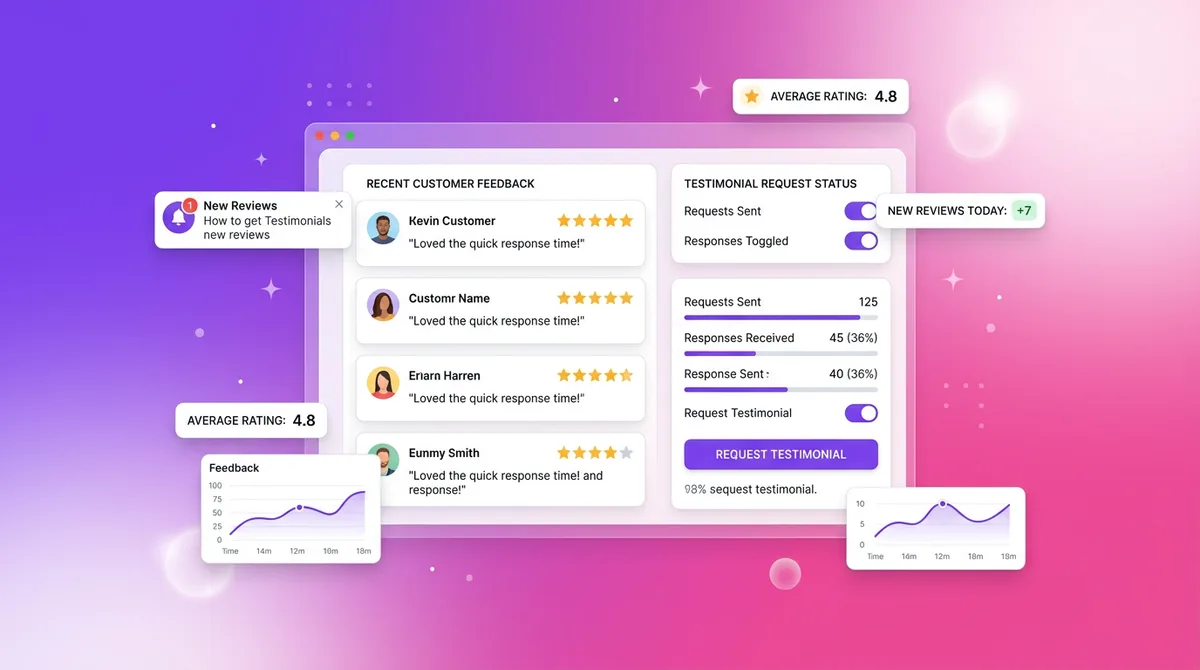
How to get testimonials after launch? Stop asking for them manually. The secret is building a passive collection system. Set up automated triggers that capture feedback exactly when a user experiences peak satisfaction with your product. You catch them at their happiest, making the request feel like a natural extension of the user experience rather than a chore.
Strategy 1: Triggering the Ask at the 'Aha Moment'
Most founders ask for reviews based on time. They send an automated email seven days after signup. That is entirely the wrong approach. Seven days in, your user might be stuck on an onboarding step or maybe they haven't even logged back in. You need utility-based timing.
Identifying Your App’s Peak Utility Point
Instead of counting days, track actions. Find the exact moment your user thinks they just saved an hour of their day. That is when you strike.
If you built an invoicing app, the peak utility point is the moment their client actually pays an invoice. If you built an AI writing app, it is right after they export their third finished article. If you run a SaaS boilerplate, it is the moment they successfully deploy to Vercel. Identify that single success event. That is your trigger point.
Setting Up Automated In-App Prompts
Once you know the trigger, automate the capture. You can wire this up quickly with a custom modal or a simple in-app widget.
I usually trigger a basic Intercom or Crisp popup right after the success metric fires. Keep it entirely inside your app. If you make them click a link, open a new tab, and log into a third-party review site, you have already lost them. Every extra step in a user flow drastically cuts conversion rates. Make the ask completely seamless. If you're using SocialCal, my social media scheduler, you can see it in real time.
Strategy 2: The 'Low-Friction' Micro-Survey Method
Asking someone to write a quick testimonial gives them homework. Nobody wants homework. If you want to figure out how to get testimonials after launch consistently, you have to drastically lower the effort required to give one.
Replacing Open-Ended Questions with Fill-in-the-Blanks
Staring at a blank text box is intimidating. Most users will just close the tab. Instead, guide them. Ask specific, localized questions.
What was the main problem you had before using our app?
How much time did you save this week?
Did this replace another tool for you?
You take those raw, authentic answers and stitch them together into a high-converting quote. Send it back to them and ask if you can use it on the homepage. They just have to say yes. In practice, this rarely fails.
Using the 'One-Click' Email Response
If you must use email, use the one-click rating trick. Send a message asking how things are going, with five clickable stars directly in the email body.
If they click 1 to 3 stars, route them to a private support form to fix their issue. If they click 4 or 5 stars, route them to a success page that asks them to write one simple sentence about why they like the product. It works beautifully because you have already secured their micro-commitment.
Strategy 3: Turning Organic Conversations into Assets
People are probably already saying nice things about your product. You just aren't treating those casual comments as testimonials. If you are active in indie hacker communities, or launching on platforms like WeekHack Launches, makers will often drop supportive comments that make perfect social proof.
The 'Screenshot-to-Permission' Workflow
When a user drops a compliment in your Slack channel or replies to a support ticket saying your tool is fast, take a screenshot.
Reply immediately asking if you can quote them on that for the landing page. I have seen products blow up just by building a massive wall of love from literal social media screenshots. It feels raw. It feels authentic. Nobody thinks a messy screenshot is faked by a marketing team.
Monitoring Unstructured Social Proof
Keep an ear to the ground. Set up simple alerts using tools like F5Bot or Google Alerts for your exact brand name. If someone mentions your tool organically on Reddit or a niche forum, jump into the thread. Thank them for the kind words, and gently ask if you can feature their comment on your site.
Strategy 4: The 'Wall of Love' Incentive Loop
Here is the thing about indie hackers and early adopters. They want traffic just as much as you do. You can use that mutual desire to your advantage.
Offering Featured Backlinks or User Spotlights
Do not frame the request as a favor to you. Frame it as targeted exposure for them.
When you reach out to a successful power user, tell them you want to do a maker spotlight on your blog or feature their company logo with a backlink on your homepage. Ask them for a quick quote about their experience to include in the feature. A Spiegel Research Center study actually proved that displaying authentic reviews can boost conversion rates by over 270 percent, so acquiring these is worth the effort of giving up a backlink. Suddenly, it is a win-win scenario. They get SEO value. You get a stellar testimonial.
Common Mistakes: 4 Pitfalls That Kill Your Social Proof
Even with a good system in place, I see founders sabotage their own social proof all the time. If you want to master how to get testimonials after launch, avoid these unforced errors.
Asking before the user gets value. Hitting someone up for a review 24 hours after they sign up is completely useless. They do not know if your app is good yet. They barely remember your brand name.
Ignoring negative feedback. Not every review will be glowing. Sometimes a brutal piece of criticism is exactly what you need to realize why your product launch failed. Use it to fix the core app experience, then turn that unhappy user into a loyal advocate.
Faking corporate speak. Real humans do not talk about maximizing synergistic KPIs. Leave the grammar mistakes and slang in the quote. It proves the review is from a real person.
Forgetting the headshot. A glowing quote with a gray placeholder avatar looks fabricated. Always try to get a real photo, full name, and social handle.
The Post-Launch Testimonial Checklist
Stop guessing. Here is exactly how to set up your collection engine today.
Figure out your app's core value moment.
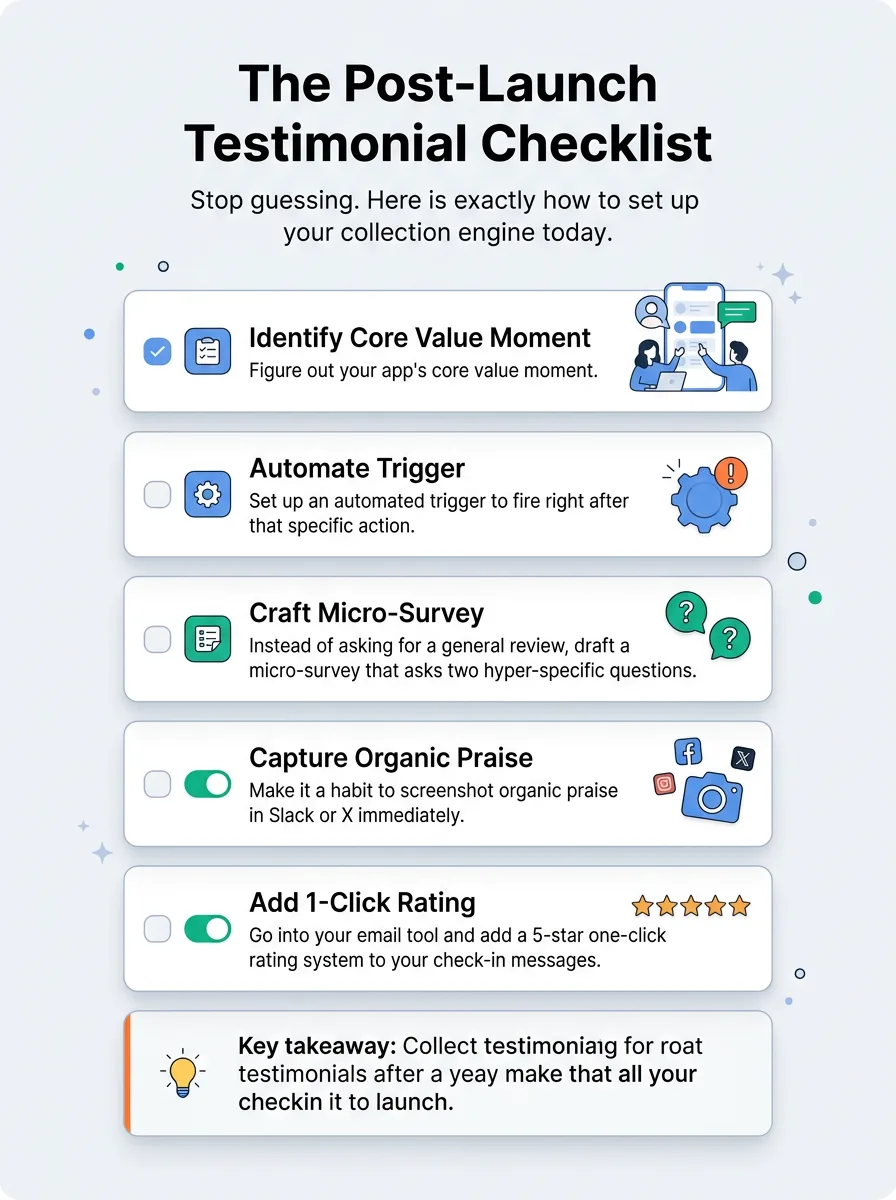
Key takeaways at a glance Set up an automated trigger to fire right after that specific action.
Instead of asking for a general review, draft a micro-survey that asks two hyper-specific questions.
Make it a habit to screenshot organic praise in Slack or X immediately.
Go into your email tool and add a 5-star one-click rating system to your check-in messages.
Frequently Asked Questions
Should I pay users for testimonials?
Absolutely not. Paid reviews are unethical and often violate FTC guidelines. Offer reciprocal value like a backlink or a profile feature instead of cash.
How do I get video reviews?
Start with text first. Once a user gives you a great written quote, reply and ask if they would be willing to record a 30-second webcam video using a tool like Testimonial.to or Senja. Keep the friction extremely low.
What if I only have 10 users?
Then you have up to 10 potential quotes. Get on a quick feedback call with every single one of them. Write down their exact words, send it back to them, and ask for permission to use it.
Building a Self-Sustaining Feedback Loop
Stop writing awkward emails begging for praise. Shift your mindset from chasing users to simply capturing the good experiences they are already having. Once you figure out how to get testimonials after launch using automated triggers, your landing page will practically update itself. That is how you build a product that sells itself while you sleep.
Written by

Jan Orsula
Serial maker and founder of WeekHack, SocialCal, and SocialOrbit. Builds tools that help creators launch side projects, schedule social media, and generate content — so they can focus on what matters.
Related Articles
How to Get Comments on Product Hunt: 5 Proven Launch Strategies
Most makers obsess over Product Hunt upvotes, but comments are what actually drive the ranking algorithm. Learn how to craft the perfect maker story, run feedback-first outreach, and dominate the first 4 hours of your launch.
How to Improve Your Launch Conversion Rate Step-by-Step
Struggling to turn product launch traffic into actual sales? Discover a practical, step-by-step framework to fix your messaging, remove friction, and drastically improve your conversion rates.
How to Collect User Feedback Before Launch: A Beginner's Plan
Stop guessing what your users want. Learn how to systematically collect pre-launch feedback using smoke tests, problem interviews, and lo-fi prototypes before writing a single line of code.