
Do Backlinks From Directories Still Help SEO?
 Jan Orsula
Do Backlinks From Directories Help SEO?
Do backlinks from directories help SEO? Yes, but only if you use the right ones. High-quality, niche-relevant directories give new products foundational authority. Low-quality, mass-submitted web directories are completely useless or even harmful. Stop treating them like magic SEO juice. Start treating them as digital footprints.
Why the Context of Directory Links Has Changed
Let's step back for a second. Ten years ago, you could pay a random freelancer five bucks to blast your fresh domain to 5,000 generic web directories. Your rankings would spike overnight. It was ridiculous, but it worked.
Those days are completely dead.
Search algorithms got smarter. Updates like Google's SpamBrain system gutted the raw volume game entirely. Now, the search engine looks at contextual relevance and site trust to figure out if a link actually matters. If a link comes from a page built exclusively to house links, Google just ignores it. Or worse, they penalize you.
Think about it. Why would a general "global web directory" from 2004 care about your brand new AI copywriting tool? It wouldn't. Search engines know this. Modern SEO is about proving to algorithms that your product exists in the real world. That means getting links from places where actual humans hang out to discover software. You need context, not just raw URLs.
1. Niche Relevance and Topical Authority
Let's talk about topical authority. This is what actually moves the needle today. If you build a specialized dev tool, getting listed on an obscure small business directory does absolutely nothing. But if you secure a spot on a curated list of top developer tools, you send a massive signal to search engines.
It tells them exactly what category you belong in.
I see founders ask all the time: do backlinks from directories help SEO if the directory itself doesn't have a massive domain rating? Absolutely, if they are hyper-relevant. Niche relevance beats raw domain authority almost every time. You want to be clustered with your direct competitors.
When a crawler hits a directory and sees your SaaS sitting right next to established players in your exact niche, it starts connecting the dots. It builds a map in its database. You go from being a random URL to being a recognized entity in a specific industry. That is how you win.
2. Building Foundational Brand Signals
Most indie hackers launch a landing page and expect traffic to just show up. Not going to happen. You need to establish a digital footprint that proves your business is legitimate.
This is where top-tier platforms come in. Profiles on Product Hunt, G2, Capterra, or Clutch aren't just about passing link authority. They build essential brand signals. They tell algorithms that you are a real company with real users. In practice, this is how you start ranking for your own brand name.
Imagine searching for your newly minted startup and finding zero results. It hurts. You build a product, put it on WeekHack — Launch Your Product, and slowly expand to other trusted review sites. When potential customers search for your tool, they see a full page of reputable profiles instead of an empty void. That builds instant trust. It shows you aren't a fly-by-night operation that will disappear next week.
3. The Danger of Automated 'Link Farm' Directories
You've probably seen the emails. "Submit your site to 1,000+ directories for guaranteed SEO rankings."
Delete them immediately.
These are link farms. They are automated, spun-up domains with zero traffic, zero editorial standards, and zero human readers. If you're still wondering if do backlinks from directories help SEO when they come from these mass submission sites—the answer is a hard no. In fact, they can actively drag down your site's reputation.
Algorithms are smart enough to see a sudden influx of a hundred junk links and flag your domain as highly suspicious. Imagine you spend a whole week submitting to 300 generic platforms instead of talking to 10 potential users. Not only did you waste your time, but you might also get shadowbanned because you bought a cheap package. It happens more than you think. Build your links manually. Put in the actual work.
The Founder’s Quick Directory Checklist
Before you spend an hour filling out a tedious submission form, run the site through this quick reality check.
Does it get real traffic? Plug the URL into Ahrefs or Similarweb. If nobody visits the site, the link is practically worthless. I recently wrote about this when I Tested 50 Platforms: 7 SaaS Directories That Send Real Traffic. Most are total ghost towns.
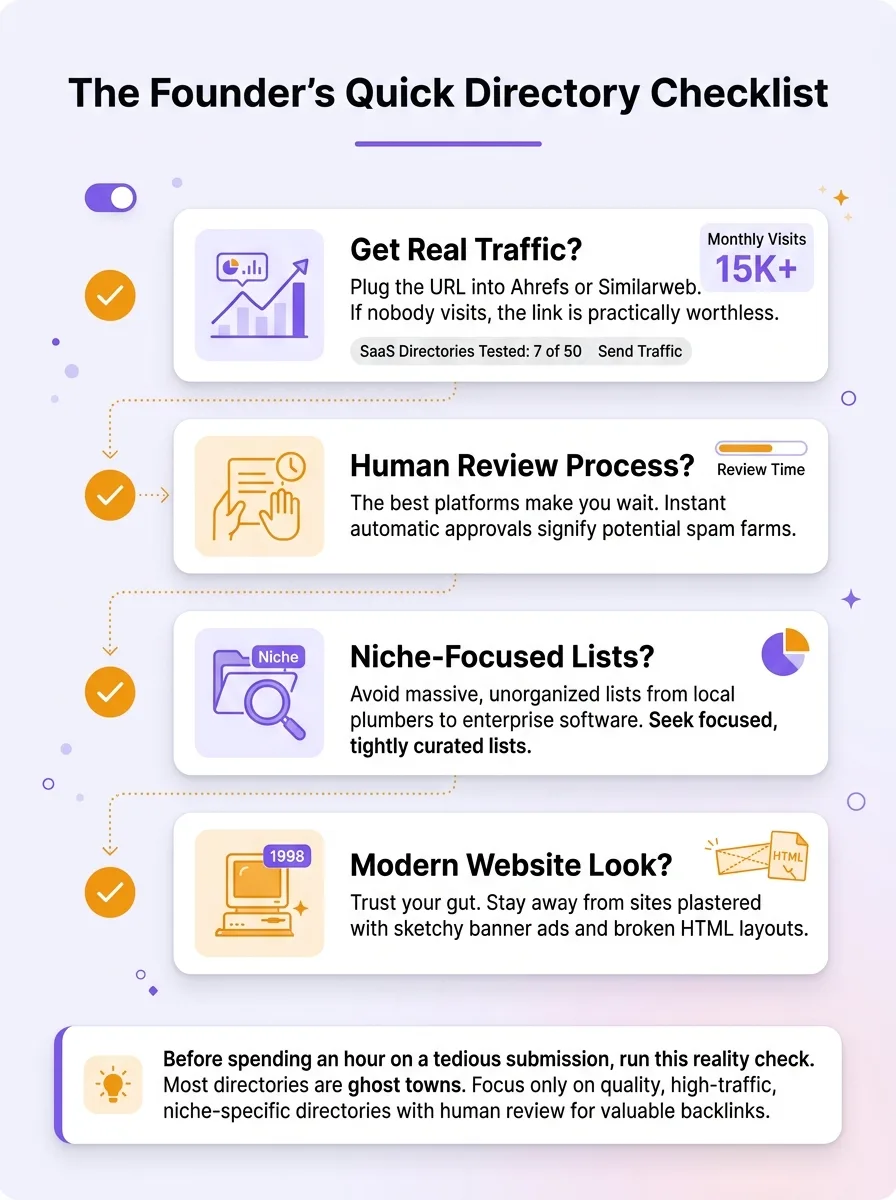
Is there a human review process? The best platforms make you wait. If they automatically approve your submission the exact second you hit submit, you are probably looking at a spam farm.
Look at the niche focus. Is it just a massive, unorganized list of everything from local plumbers to enterprise software? Skip it. You want focused, tightly curated lists.
Does it look like it was built in 1998? Trust your gut. If the site is plastered with sketchy banner ads and broken HTML layouts, stay away.
Should I pay for a directory listing?
There's a big difference between paying an editor to review your product and buying a shady backlink. Many legitimate platforms charge an expedited review fee because they have huge backlogs of submissions. That is completely fine. You are paying for their time, not the link itself.
But if a site explicitly offers a "DoFollow SEO Link" for fifty bucks, run away. Search engines consider that a paid link scheme, which directly violates their spam policies. Don't risk your entire domain over a cheap shortcut.
Do 'No-Follow' directory links still provide value?
Makers obsess way too much over "DoFollow" status. Yes, DoFollow passes direct authority. But NoFollow links from high-traffic directories are incredibly valuable. Why? Because they send actual human beings to your website.
Referral traffic can convert into paying users, which is the whole point of building a startup anyway! Plus, algorithms still register these links as brand mentions. A healthy site naturally has a solid mix of both. Stop ignoring a great traffic source just because of a meta tag.
How many directory links are considered 'natural'?
There is no magic ratio or perfect number. But if 90% of your entire backlink profile comes from software directories, that looks incredibly artificial.
A natural backlink profile is inherently messy. It has directory mentions, blog comments, guest posts, organic links from Reddit, and random newsletter shoutouts. Start with 10 or 20 high-quality directories to get your initial footprint established. After that, shift your focus to building a product that people actually want to talk about organically.
Final Verdict: Use Directories for Discovery, Not Just Rankings
Directories are a starting point for new startups to establish legitimacy and get their first few eyeballs, not a long-term growth lever. Claim your profiles on the major platforms, verify your brand, and then get back to actually building your product.
Written by

Jan Orsula
Serial maker and founder of WeekHack, SocialCal, and SocialOrbit. Builds tools that help creators launch side projects, schedule social media, and generate content — so they can focus on what matters.
Related Articles
I Tested 50 Platforms: 7 SaaS Directories That Send Real Traffic
Stop submitting your startup to ghost towns. Here is the honest truth about the 7 SaaS directories that actually send real traffic, based on real submission data.
How to Turn Launch Traffic Into Paying Users - Step by Step
A huge traffic spike means nothing if your visitors immediately bounce. Learn how to fix your leaky funnel, capture intent, and convert launch day traffic into paying users.
How the Instagram Algorithm Works - Your 2026 Action Plan
In 2026, understanding the Instagram algorithm isn’t optional—it’s the difference between growth and invisibility. You’ve probably noticed it: some creators see