
How Many Startup Directories Should You Submit To?
 Jan Orsula
The Direct Answer: How Many Startup Directories Should You Submit To?
If you are wondering how many startup directories should you submit to, the answer is 30 to 50. Anything less leaves easy backlinks and initial traffic on the table. Anything more is usually a waste of your time. Focus strictly on high-authority platforms that actually move the needle.
Why Quality Beats Quantity in Startup Submissions
Look, the temptation to blast your new app to 300 different websites is real. I get it. You just launched. You have zero traffic. Seeing your analytics dashboard flatline hurts, so you decide to brute-force your way to visibility.
But submitting your product is tedious work. Doing it hundreds of times takes days you should be spending talking to users or fixing bugs. What nobody tells you is that directory value drops off a cliff after the top tier.
Most of those massive spreadsheets floating around labeled "500 places to post your startup" are a trap. They are filled with dead domains, broken forms, and sites that get zero organic traffic. You might wonder do backlinks from directories still help SEO? Yes, but only if they come from sites search engines actually respect. A link from a spammy directory with a Domain Rating of 4 does absolutely nothing for your ranking. It just strokes your ego because you got a confirmation email.
I have seen founders spend a whole week acting like data-entry clerks. They fill out endless captchas for directories that have not been updated since 2018. That is a massive opportunity cost. Your time is your most scarce resource right now.
Focus on the 'Top 40': The Sweet Spot for SEO and Traffic
Let's talk about the math of how many startup directories should you submit to. The magic number really sits right around 40.
If you target this sweet spot, you capture 95% of the benefits of directory submissions without losing your mind. These are the platforms that pass real link equity. They give your fresh domain the initial trust signals it needs to start ranking for your own brand name. You want Google to see that legitimate, established tech hubs are pointing at your server.
I learned this the hard way on my second product. Early on, I spent a whole weekend manually filling out forms on obscure websites trying to get 100 listings. The result? Barely a trickle of visitors and zero customers. Later, I tested 50 platforms to find the SaaS directories that send real traffic. I realized only a handful actually deliver users who pull out their credit cards.
You want the heavy hitters. You want Product Hunt, BetaList, AlternativeTo, and the major niche-specific sites for your industry. A well-placed listing on a top-tier site with high traffic will out-perform 200 generic profile pages.
Categorizing Your List: Tier 1 vs. Tier 2 Directories
Not all directories deserve the same amount of effort. You need to split your list into distinct categories so you know exactly where to spend your energy.
Tier 1 directories are the kingmakers. Think Product Hunt, Hacker News, or AppSumo. These require customized copy, decent graphics, and a coordinated launch day strategy. You don't just quietly submit a form to these sites. You actively campaign on them. You reply to comments. You rally your existing network. A successful launch here can bring in thousands of visitors and your first real recurring revenue.
Then you have Tier 2. These are the standard database sites like StartupBase, SaaS Hub, or BetaPage. They are purely foundational. You go there for the do-follow backlink and the occasional stray visitor doing research.
Treat them completely differently. For Tier 1, spend an hour crafting the perfect pitch. Refine your screenshots. For Tier 2, copy-paste your standard elevator pitch, upload your logo, and move on. Don't overthink it. Just get the listing live.
The Danger of Over-Submission and 'Link Farms'
Here is a fast way to ruin your shiny new domain. Buy a cheap freelancer gig promising guaranteed submission to 1,000 startup directories for twenty bucks.
Search algorithms are ruthless about unnatural link-building patterns. If your brand-new domain suddenly gets 500 low-quality backlinks from weird overseas sites and generic web directories overnight, you trigger spam filters. Instead of boosting your ranking, you get penalized before you even start.
Google explicitly warns against this behavior in their spam policies regarding link schemes. They know exactly what a manipulated backlink profile looks like.
When you ask how many startup directories should you submit to, remember that sheer volume can actually hurt you. Stick to curated sites that manually review submissions. If a directory instantly accepts your link without a human looking at it, and the site is plastered with sketchy banner ads, it probably isn't worth being on. Quality control matters. Guard your domain reputation fiercely.
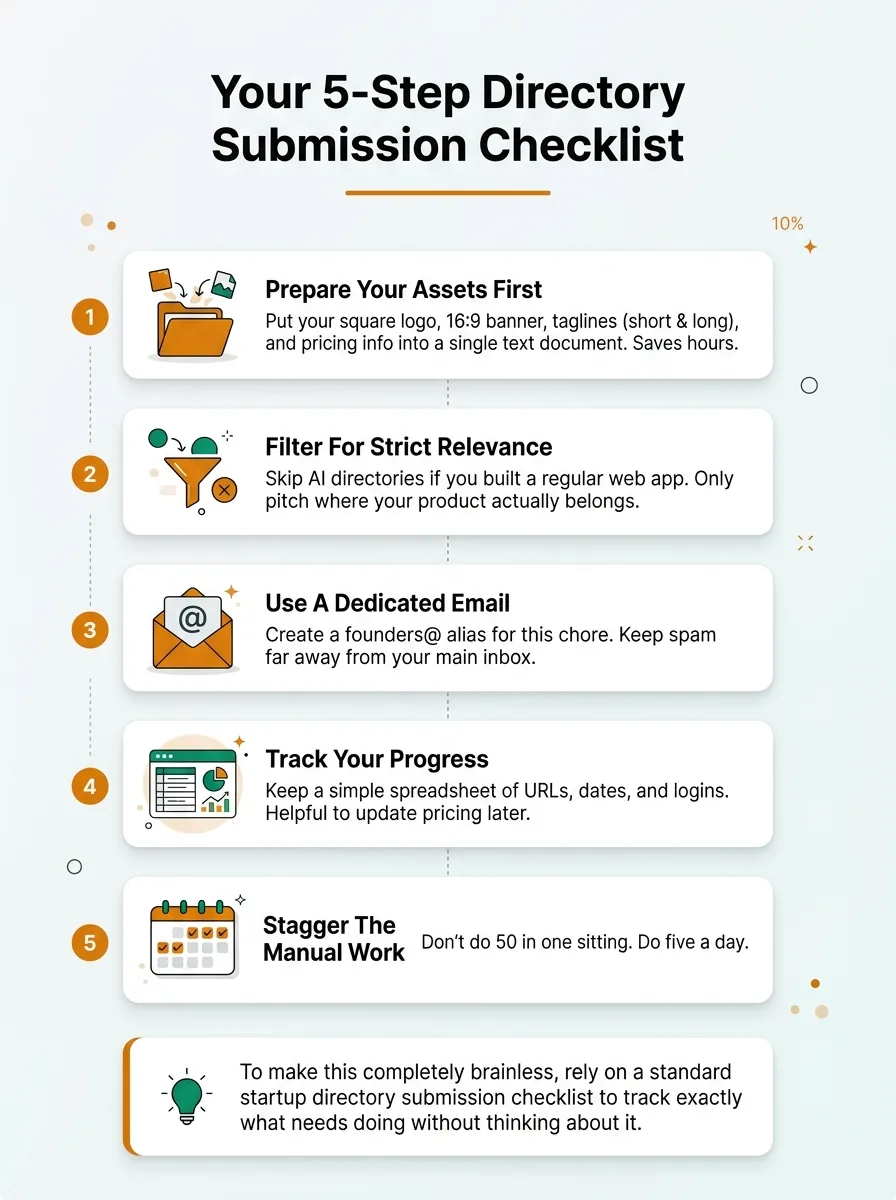
Your 5-Step Directory Submission Checklist
Ready to do the actual work? Grab a coffee and follow a system so you don't get bogged down.
Prepare your assets first: Put your square logo, a 16:9 banner, your taglines (a short and long version), and pricing info into a single text document. Having everything ready saves hours.
Filter for strict relevance: Skip AI directories if you built a regular web app. Only pitch where your product actually belongs.
Use a dedicated email: Create a founders@ alias specifically for this chore. You will inevitably get put on some terrible marketing lists, so keep that spam far away from your main inbox.
Track your progress: Keep a simple spreadsheet of URLs, dates, and logins. You might need them later to update pricing.
Stagger the manual work: Don't do 50 in one sitting. Do five a day.
To make this completely brainless, I rely on a standard startup directory submission checklist to track exactly what needs doing without thinking about it.
Frequently Asked Questions
Should I use automated submission tools?
Mostly, no. There are a few reputable services out there that handle the manual labor for you, but avoid purely automated software bots at all costs. Bots mess up formatting. They pick the wrong categories. They leave your profile looking like garbage.
Founders often think automation saves time, but cleaning up 40 broken listings takes longer than doing it right the first time. If you absolutely hate the work, pay a competent virtual assistant or a specialized maker service to do it manually. Let a human read the submission guidelines.
How much should I spend on paid directory listings?
Zero dollars at the start. Many directories offer a fast-track fee for fifty to a hundred bucks to skip the review queue.
Unless you have raised a massive seed round and have cash to burn, skip it. Wait the 30 days for the free approval. The only exception is if you have hard data showing a specific directory drives highly converting paying customers for your exact niche. Otherwise, keep your runway intact. Spend that money on decent hosting or your first few search ads instead.
Conclusion: Build Your Foundation and Get Back to Shipping
So, how many startup directories should you submit to? The rule stands. Target those 30 to 50 top-tier platforms and stop there.
Treat this process as a one-time chore to build your baseline SEO trust, get a handful of initial users, and establish your brand footprint on the web. It is a stepping stone. Once that list is done, close the spreadsheet. Get back to talking to your users, writing code, and building a product people actually want to pay for.
Written by

Jan Orsula
Serial maker and founder of WeekHack, SocialCal, and SocialOrbit. Builds tools that help creators launch side projects, schedule social media, and generate content — so they can focus on what matters.