
Why These Common Startup Launch Mistakes Kill Early Sales
 Jan Orsula
Why Most Startup Launches Result in Crickets (and How to Avoid It)
You spend three months coding on weekends. You skip social events, drink way too much coffee, and finally hit publish on Product Hunt. You sit back, refresh your Stripe dashboard, and wait. Nothing. Crickets.
The dreaded valley of death hits hard. I've been there. Most founders have. We fall into the trap of thinking "build it and they will come." They won't.
This post is about fixing that. If you want actual early sales instead of just vanity metrics, you need to understand the common startup launch mistakes that kill momentum before you even begin.
What Are the Most Common Startup Launch Mistakes?
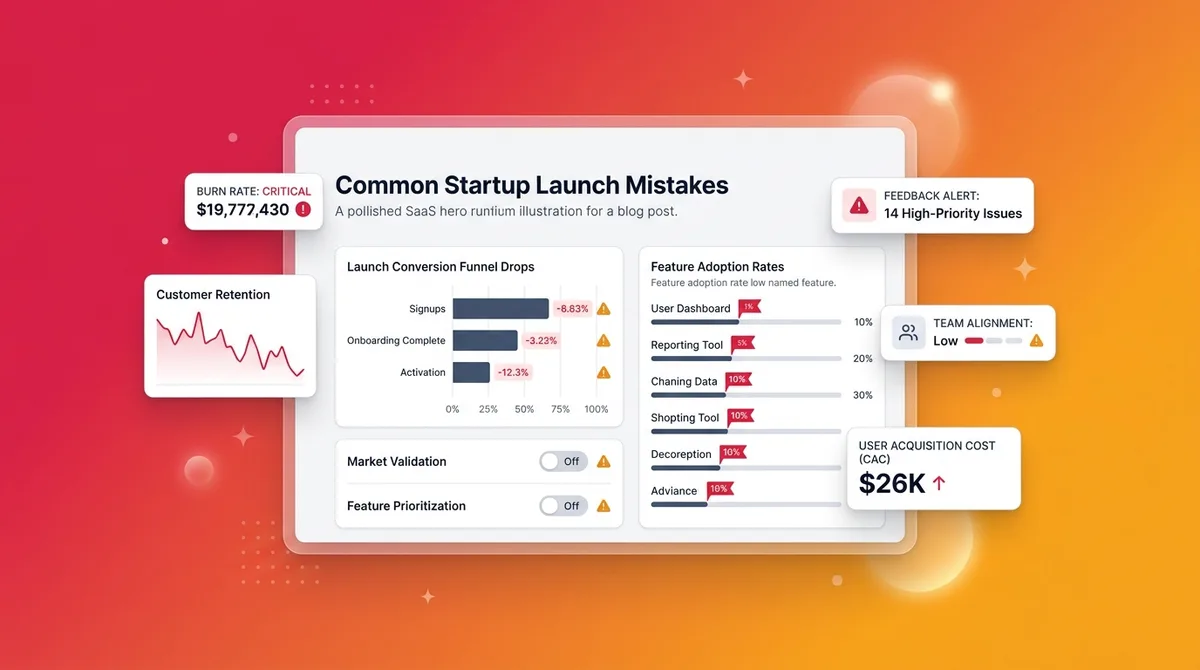
Common startup launch mistakes are fatal errors in validation, distribution, and messaging that block early revenue. They usually happen when founders build in isolation, price their product too low, or treat launch day as the finish line instead of the starting line. Avoiding these pitfalls is the difference between building a thriving cash-flow business and abandoning yet another GitHub repo.
Strategy 1: Move from ‘Building in Secret’ to Radical Validation
Isolation is the enemy of revenue. You think you are protecting your genius idea from copycats. In reality, you are just protecting yourself from knowing nobody actually wants it.
Building in secret feels safe because you don't have to face rejection. But rejection on day one is vastly cheaper than rejection on day ninety. Stop writing code and start talking to people!
Action step: Build a landing page right now. Put a 'buy now' or waitlist button on it. Drive a little traffic to it and see if anyone actually clicks.
Stop Prioritizing Features Over Feedback Loops
I once watched a founder spend six months building a complex AI resume parser. He didn't talk to a single recruiter during that entire build phase. When he finally launched, he found out recruiters already had enterprise tools for this exact problem. Zero sales.
Meanwhile, another maker I know mocked up a Figma design for a Notion template, threw up a Stripe payment link, and made $400 in 48 hours. Then she actually built the product. That is radical validation. Reviewing Common mistakes first time entrepreneurs and startups make usually points straight back to this exact issue: prioritizing cool features over harsh feedback.
Strategy 2: Establish Distribution Before the Product is Ready
Waiting until launch day to find your audience guarantees failure. You can't just show up in a Reddit or Facebook community, drop a link to your new app, and expect people to pull out their credit cards.
You need to be doing things that don't scale long before the software is finished. Participate in discussions. Answer questions. Become a familiar face.
Action step: Find three high-intent communities where your target users hang out. Engage daily for 30 days before you ever ask them to look at your product.
Building a 'Warm' Audience Through Transparency
Building in public works. But not if you just post generic updates like "Refactored my database today." Nobody cares about your database.
Document the struggle. Share your churn numbers. Talk about how you almost quit last Tuesday because a critical API integration broke. Transparency builds genuine trust. When people watch you bleed for a product, they root for you. More importantly, they buy from you.
Strategy 3: The 'Minimum Viable Sales' Framework
Forget the MVP. Focus on Minimum Viable Sales.
What is the absolute smallest thing you can build that someone will actually pay money for? Sometimes it isn't even software. It might be a spreadsheet, a PDF, or a manual consulting service disguised as a SaaS.
Action step: Define the single most valuable problem you solve. Put a price tag on it immediately. Do not offer a forever-free plan until you have validated that people are willing to pay.
Pricing for Value vs. Pricing for Survival
Founders love to underprice. You think a $5/month plan makes you competitive against the big players. It actually just signals that your product is cheap and probably unreliable.
Early adopters don't buy because you are the cheapest option on the market. They buy because they desperately need a solution to their highly specific problem. Charge based on the value you provide. If your tool saves a freelancer 10 hours a week, charging $9 a month is an insult to your own work.
Strategy 4: Optimizing for Conversion, Not Just Traffic
Traffic is a vanity metric. If you get 5,000 visitors from Hacker News and zero sales, your product isn't broken. Your messaging is.
When users land on your site, they give you about three seconds to explain what you do. If they have to scroll past vague headlines about "empowering synergy" to figure out you sell invoicing software, they will leave.
Action step: Look at your H1 heading. Does it say exactly what the product does, or is it trying to be clever? Clear always beats clever. Audit your call-to-action buttons to ensure they tell the user exactly what happens next.
Using Social Proof Before You Have Customers
How do you prove your product works before anyone buys it? You borrow credibility.
Use quotes from your beta testers. Mention the established tools your product integrates with. Show pre-launch performance stats. Anything to prove you aren't just some random person on the internet asking for money.
If you are wondering How to Plan a Startup Launch That Gains Real Traction, establishing this early social proof is completely non-negotiable.
Specific Pitfalls: The Silent Killers of Early Traction
Even if you nail distribution and messaging, there are a few subtle traps that catch almost everyone. These are the specific common startup launch mistakes that slowly bleed startups dry.
The Trap of ‘Just One More Feature’
Scope creep is deadly. You tell yourself you'll launch right after you add dark mode. Then you decide you need a built-in affiliate system. Then PDF exports.
Every week you delay is a week your competitors are talking to your potential users. Ship the ugly version. If users complain that it's missing dark mode, congratulations—you have users who care enough to complain.
Treating Launch Day as the Finish Line
A lot of makers treat launch day like a massive movie premiere. You roll out the red carpet, hit the top of a launch site, and think you've made it.
The next day, traffic drops by 90 percent. That is normal. The post-launch period is where actual businesses are built. Sending follow-up emails, doing one-on-one sales calls, writing SEO content. That's the real work. The launch was just the starting gun.
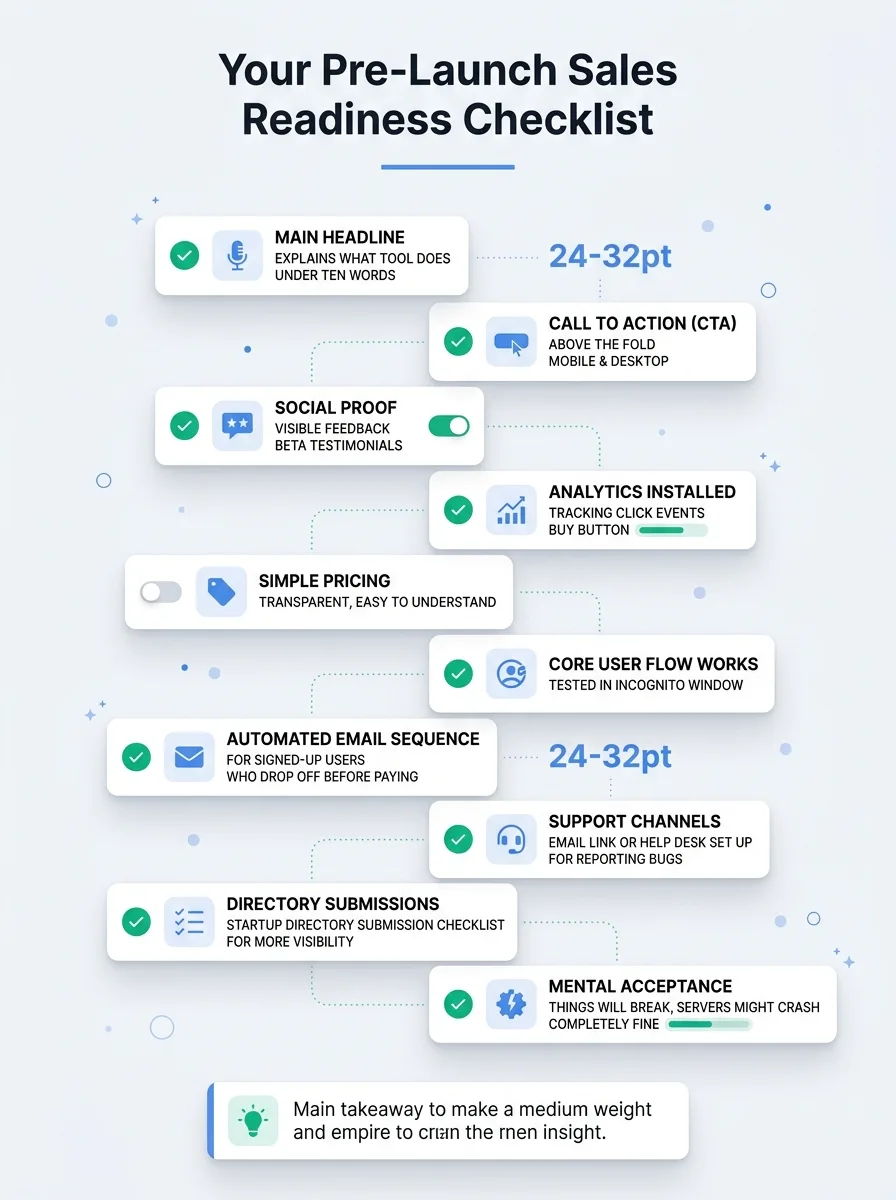
Your Pre-Launch Sales Readiness Checklist
Before you ever hit publish, run through this list. Print it out if you have to.
The main headline explains exactly what the tool does in under ten words.
A clear call to action sits above the fold on mobile and desktop.
You have at least one piece of social proof or beta feedback visible.
Analytics are installed and specifically tracking click events on your buy button.
Pricing is simple, transparent, and easy to understand at a glance.
The core user flow actually works. Test this yourself on a fresh incognito window.
You've prepared an automated email sequence for users who sign up but drop off before paying.
Support channels or a simple email link are set up so early users can easily report bugs.
You've worked through The Startup Directory Submission Checklist for More Visibility to keep traffic flowing after day one.
A mental acceptance that things will break, servers might crash, and that is completely fine.
Frequently Asked Questions About Startup Launches
When is the best time to launch?
Tuesday or Wednesday mornings are standard for most tech platforms. But honestly, the best time is the exact moment your core feature works. Don't overthink the day of the week. Just get it out there.
How much should I spend on ads for my launch?
Zero dollars. Until you have organic traction and a proven conversion rate, paid ads are just setting money on fire. Prove people want it for free first.
How do I handle a failed launch?
You learn from it. Talk to the few people who did visit the site or sign up. Ask them directly why they didn't pay. Fix the messaging, tweak the offer, and launch again. Product launches aren't a one-time event.
Mastering the Art of the Lean Launch
Moving from product-centric thinking to sales-centric thinking takes time. You have to stop hiding behind your code editor and start talking to real human beings. That is the only way to avoid the classic common startup launch mistakes we've talked about here.
To keep your momentum up, I highly recommend using a platform like WeekHack. It lets you submit products weekly, get real community feedback, and secure dofollow backlinks without the insane pressure of a massive one-day launch event. Ship small, sell early, and keep iterating.
Written by

Jan Orsula
Serial maker and founder of WeekHack, SocialCal, and SocialOrbit. Builds tools that help creators launch side projects, schedule social media, and generate content — so they can focus on what matters.